The Crypto & Digital Assets AI Visibility Index 2026
Top 25 U.S. crypto and digital-asset brands ranked by AI citation share. By Ronn Torossian, Founder of 5W, and the 5W Research Team — April 2026.
EXECUTIVE SUMMARY
Crypto is the first major U.S. retail-finance category being formed inside AI answers under a regulatory regime that is itself being written in real time. Approximately 30% of American adults — about 70 million people — own crypto in 2026. Most of them did not own it five years ago. The brand they were going to default to in 2018 was probably Coinbase, by recognition alone. The brand they default to in 2026 is whatever ChatGPT, Claude, Perplexity, or Google AI Overviews surfaces when they type "best crypto exchange," "safest place to buy bitcoin," or "Coinbase vs Kraken."
This report measures who is winning that citation surface and who is not. 5W ran 65+ consumer-intent prompts through ChatGPT, Claude, Perplexity, Gemini, and Google AI Overviews in Q1 2026, tracking citations across five sub-categories: U.S. centralized exchanges, fintech and brokerage crypto, custody and self-custody, Bitcoin ETF issuers, and stablecoin/payments rails.
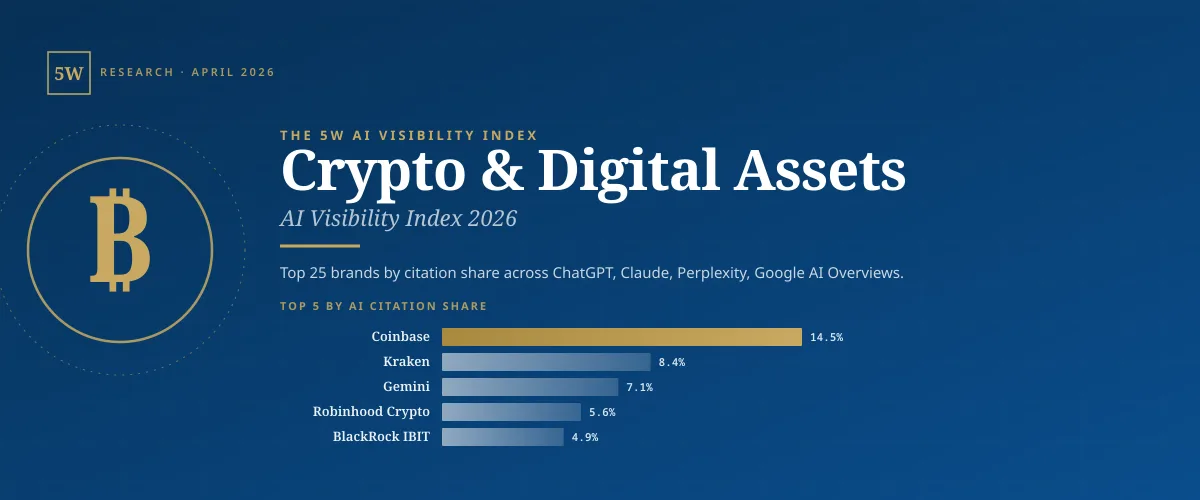
The findings: Coinbase and Kraken together account for an estimated 22% of all crypto-category AI citations across the prompts we tested — more than three times the citation share of the next-largest U.S. exchange. Gemini holds an authority slot AI engines reserve for regulatory and trust-related queries. Robinhood Crypto has converted its 2025 SEC settlement and standalone-entity restructuring into a citation moat among first-time-buyer prompts. Binance.US, the U.S. arm of the world's largest exchange by global volume, ranks #4 — well below its global parent's commercial scale. BlackRock's iShares Bitcoin Trust (IBIT) appears in nearly every "Bitcoin ETF" answer despite being two years old, the kind of citation lock-in normally reserved for category-defining incumbents.
The brands that win crypto AI citation in the next twelve months will define how the next 50 million Americans buy, hold, and think about digital assets. Most will not realize the citation window has closed until it has.
TOP 15 BRANDS BY AI CITATION SHARE
Estimated share of citations across 65+ crypto-industry consumer prompts run through ChatGPT, Claude, Perplexity, Gemini, and Google AI Overviews, Q1 2026.
Color key: blue — U.S. centralized exchanges. Green — fintech/brokerage crypto. Orange — Bitcoin ETF issuers. Purple — custody/self-custody and Bitcoin-native services.
Source: 5W analysis of AI-generated responses across ChatGPT, Claude, Perplexity, Gemini, and Google AI Overviews, Q1 2026. Share represents estimated proportion of brand citations across 65+ tracked consumer prompts. Remaining ~36% split across ranks 16–25 and unranked brands.
THE FULL TOP 25 RANKING
1. Coinbase — Centralized exchange. ~41% of North American crypto trading volume in Q3 2025 ($234B quarterly). Public company since 2021 (NASDAQ: COIN); audited financial disclosures replace cryptographic proof-of-reserves. Operates in all 50 U.S. states. Category leader by AI citation share in nearly every U.S. consumer prompt we tested.
2. Kraken — Centralized exchange. Founded 2011, the longest-operating major U.S. exchange. Industry-leading proof-of-reserves disclosures and a perfect record of never having lost customer funds in a breach. Lower fees than Coinbase Advanced. Wins "safest crypto exchange" and "Kraken vs Coinbase" prompts at near-uniform consistency.
3. Gemini — Centralized exchange. Founded by the Winklevoss twins in 2014. NYDFS-chartered trust company structure with full-reserve regulatory model. Operates in all 50 states. Owns "regulated crypto exchange" and "trust-company crypto" citation niches.
4. Robinhood Crypto — Brokerage-affiliated. Spun out as standalone entity in 2025 following SEC settlement. Aggressive expansion of crypto SKU list and product surface during 2025. Owns "easiest app to buy crypto" and "first-time crypto" citation niches; AI answers increasingly position Robinhood ahead of Coinbase for true beginner prompts.
5. BlackRock IBIT — Bitcoin spot ETF. Holds approximately 45-49% of U.S. spot Bitcoin ETF assets, the largest single-issuer share of any spot crypto ETF. Citation lock-in on "Bitcoin ETF" prompts that no other ETF issuer has dislodged. Listed January 11, 2024.
6. Binance.US — Centralized exchange. U.S. arm of the world's largest exchange by global trading volume; structurally separated from Binance global since 2023 SEC settlement. Citation share materially below global parent's brand recognition would predict. Lost the lowest scores in several U.S.-centric consumer reviews in 2025–2026.
7. Fidelity Crypto — Brokerage-affiliated. Three-asset offering (BTC, ETH, LTC) integrated into Fidelity brokerage accounts. Added send-and-receive functionality in 2025. Wins "crypto for traditional investors" prompts.
8. Cash App Bitcoin — Fintech/payments. Block-owned. Owns "easiest way to buy Bitcoin" and "Bitcoin for beginners" citation niches at the lowest end of the buyer funnel. Bitcoin-only product.
9. Crypto.com — Centralized exchange. Global presence, Cronos-anchored ecosystem, aggressive sponsorship-led brand recognition (Crypto.com Arena, F1, World Cup). Strong staking and rewards programs. Citation share concentrated in fee-comparison and rewards-program prompts.
10. Ledger — Hardware wallet / self-custody. Category leader in hardware wallet citations. Owns "best crypto wallet" and "cold storage" prompts. 2023 security disclosure controversy still surfaces in some AI answers.
11. Circle USDC — Stablecoin issuer. NYDFS-regulated. Strongest citation share in "regulated stablecoin," "USDC vs USDT," and "stablecoin for institutions" prompts.
12. Bitstamp — Centralized exchange. Founded 2011. Available in only 38 states, the narrowest U.S. coverage of any major exchange we tested. 95% cold-storage policy and Big Four audit history. Solid security citation share offset by limited state availability.
13. Trezor — Hardware wallet / self-custody. Founded 2014. Open-source hardware ethos. Strong citation share in security-purist prompts ("most private crypto wallet," "open-source crypto wallet").
14. Strike — Bitcoin-only / Lightning Network. Owns "Bitcoin Lightning" and "Bitcoin payments" citation niches. Concentrated brand-content output produces citation share above commercial scale.
15. Fidelity FBTC — Bitcoin spot ETF. Second-largest U.S. spot Bitcoin ETF after IBIT. Wins ETF prompts that route through traditional brokerage channels.
16. MetaMask — Self-custody / Web3 wallet. Default Ethereum-ecosystem wallet for DeFi prompts. Citation share concentrated in "DeFi wallet" and "Ethereum wallet" queries.
17. PayPal Crypto / PYUSD — Fintech / stablecoin. Combines mass-consumer reach with regulatory positioning; citation share strongest in "stablecoin from major company" and "buy crypto with PayPal" prompts.
18. BitGo — Institutional custody. Wins "institutional crypto custody" and "qualified custodian" prompts. Limited retail-citation share.
19. Anchorage Digital — Federally chartered crypto bank. The OCC's only federally chartered digital-asset bank. Owns "federally regulated crypto" and "crypto bank" prompts.
20. Uphold — Multi-asset platform. Wide cryptocurrency selection and active staking program. Mid-tier citation share concentrated in altcoin-selection prompts.
21. ARK 21Shares ARKB — Bitcoin spot ETF. Cathie Wood-affiliated. Strong narrative-driven citation share among ETF prompts that include "innovation" or "active management" framing.
22. Bitwise BITB — Bitcoin spot ETF. Wins prompts that emphasize specialist crypto-ETF expertise.
23. Coinbase Wallet — Self-custody / Web3 wallet. Distinct from Coinbase exchange. Citation share concentrated in "Coinbase vs Coinbase Wallet" and self-custody onboarding prompts.
24. Phantom — Solana / multi-chain wallet. Default wallet for Solana ecosystem. Rising citation share with Solana-specific prompts.
25. Swan Bitcoin — Bitcoin-only DCA / brokerage. Owns the "Bitcoin-only dollar-cost-averaging" and "Bitcoin IRA" niches. Concentrated audience produces disproportionate citation share in narrow prompts.
KEY FINDINGS
- STAT 1: 30% — share of American adults who own crypto in 2026, up from 27% in 2024 (Security.org)
- STAT 2: ~70.4M — estimated number of U.S. adults holding crypto in 2026
- STAT 3: $234B — Coinbase Q3 2025 quarterly trading volume; an estimated 41% of North American crypto activity (CoinLaw)
- STAT 4: $56-65B — cumulative net inflows into U.S. spot Bitcoin ETFs since their January 11, 2024 launch (Chainalysis, SoSoValue)
- STAT 5: 45-49% — BlackRock IBIT share of U.S. spot Bitcoin ETF assets, the largest single-issuer share of any spot crypto ETF
- STAT 6: 22% — estimated combined AI citation share of Coinbase and Kraken across 65+ tracked queries
- STAT 7: $3.4B — total crypto stolen in 2025, one of the highest annual totals on record, including $1.5B from the February 21, 2025 Bybit hack alone (Chainalysis)
- STAT 8: 38 — U.S. states in which Bitstamp operates, the lowest state coverage of any major U.S. exchange we tracked
THE CENTRAL FINDING
Every other major retail-finance category in America arrived in the consumer's hands with decades of brand instinct built in. A first-time investor in 2010 already knew Fidelity, Schwab, and Vanguard before they opened an account. A first-time mortgage shopper knew Quicken or Wells Fargo. A first-time credit-card applicant knew Chase, Amex, and Capital One. Crypto has none of that. The 2026 first-time crypto buyer — the 35-year-old who decided to put $1,000 into Bitcoin after Trump's strategic Bitcoin reserve announcement — has no exchange memory, no wallet memory, no custodian memory. Her entry point to every purchase decision is a search bar that now ends in an AI answer: "safest crypto exchange," "Coinbase vs Kraken," "is Robinhood good for crypto," "what is a Bitcoin ETF," "Ledger vs Trezor," "best crypto for beginners."
Inside that AI-mediated research, the U.S. crypto industry is consolidating on three fronts simultaneously. On centralized exchanges, Coinbase has built a near-monopoly on regulatory-credibility citations, while Kraken has built a parallel moat on security and proof-of-reserves citations. On retail crypto access, the 2025 SEC clarity that allowed Robinhood Crypto to spin out as a standalone entity has rewired AI answers about "best app to buy crypto" — the brokerage-fintech category is now structurally competing for the citation surface that pure-play exchanges used to own. On Bitcoin spot exposure, BlackRock's IBIT has captured 45-49% of the U.S. spot Bitcoin ETF market in two years, a citation-consolidation pace closer to Vanguard's index-fund category formation than to typical exchange-traded product adoption.
What makes crypto different from other consumer categories 5W has tracked is the regulatory volatility underneath the citation surface. The 2022 collapse of FTX, Celsius, and BlockFi rewrote what AI engines treat as "trustworthy" in crypto. The 2024–2025 wave of SEC enforcement, settlement, and ultimately regulatory clarity rewrote the citation landscape again. The Trump administration's Strategic Bitcoin Reserve and "Crypto Czar" appointments in early 2025 added a third reset. AI models trained on pre-2024 data still surface FTX-era warnings; models trained on post-2025 data surface a different set of credibility signals. Brands that publish consistent, structured, regulatory-credible content across this volatility build durable AI citation share. Brands that have remained quiet, or whose dominant signals are pre-2024, are losing citation surface they may never recover.
METHODOLOGY
5W analyzed more than 65 common crypto-buyer and crypto-investor prompts across five sub-categories. We identified which brands AI models consistently surface, which editorial and authoritative sources feed those citations, and where the largest gaps sit between commercial scale and AI visibility.
Sub-categories tracked.
U.S. centralized exchanges (Coinbase, Kraken, Gemini, Binance.US, Crypto.com, Bitstamp, Uphold, OKX). Fintech and brokerage crypto (Robinhood Crypto, Fidelity Crypto, Cash App, PayPal Crypto, Venmo Crypto, Charles Schwab crypto access, Interactive Brokers). Custody and self-custody (Ledger, Trezor, Coinbase Custody, BitGo, Anchorage Digital, Fireblocks, Casa, Unchained Capital). Bitcoin and crypto ETFs (BlackRock IBIT, Fidelity FBTC, Grayscale GBTC, ARK 21Shares ARKB, Bitwise BITB, VanEck HODL, Franklin EZBC, Invesco BTCO). Stablecoins, payments, and Bitcoin-native services (Circle USDC, Tether USDT, PayPal PYUSD, Strike, Swan Bitcoin, River Financial).
Query types tracked.
Real-world buyer-intent prompts including "best crypto exchange for beginners," "safest crypto exchange 2026," "Coinbase vs Kraken," "is Robinhood good for crypto," "best Bitcoin ETF," "BlackRock IBIT vs Fidelity FBTC," "Ledger vs Trezor," "how do I buy Bitcoin safely," "what's the difference between Coinbase and Coinbase Wallet," "is Binance.US safe," "best crypto exchange with low fees," "USDC vs USDT," and 50+ additional variations covering security, fees, beginner onboarding, ETF selection, custody choice, regulatory legitimacy, and tax-reporting intent.
Citation sources tracked.
Authoritative regulators and self-regulatory references (SEC, CFTC, FinCEN, NYDFS, OCC, state money-transmitter registries), consumer-finance editorial (NerdWallet, Investopedia, Bankrate, Forbes Advisor, Money.com, Yahoo Finance), specialist crypto editorial (CoinDesk, The Block, Decrypt, Bloomberg Crypto, Cointelegraph), proof-of-reserves and security audit sources (Armanino, Mazars-era audits, on-chain attestation reports), Bitcoin-ETF tracking sources (Bloomberg ETF analysts, ETF.com, Morningstar), community sources (Reddit r/CryptoCurrency, r/Bitcoin, r/ethfinance, Bitcointalk), and brand-owned content hubs.
Important framing.
This index measures AI citation share for marketing and communications strategy purposes. It does not rank platforms on safety of funds, regulatory standing, fee competitiveness, or investment suitability. Crypto purchase decisions should be informed by direct review of platform disclosures, current regulatory status, and qualified financial advice.
WINNERS
The Coinbase / Kraken duopoly on U.S. exchange citations. Coinbase and Kraken together account for an estimated 22% of all crypto-category AI citations across the 65+ tracked queries — more than three times the citation share of the next-largest U.S. exchange. Coinbase wins on regulatory standing, scale, and the public-company audit trail that AI models treat as a credibility anchor. Kraken wins on security, proof-of-reserves, and a 14-year operating history with no customer-fund-loss breach. AI answers to "safest crypto exchange" route to Kraken; AI answers to "most regulated U.S. crypto exchange" route to Coinbase or Gemini; AI answers to "biggest U.S. crypto exchange" route to Coinbase. The two brands have effectively partitioned the trust-and-scale citation surface in a way that no challenger has dislodged.
BlackRock IBIT's two-year ETF citation lock-in. BlackRock launched IBIT on January 11, 2024. Twenty-four months later it owns 45-49% of U.S. spot Bitcoin ETF assets and an even larger share of "Bitcoin ETF" AI citations. The pace of citation consolidation has been faster than the asset consolidation — AI models trained in 2024 and 2025 absorbed BlackRock's Bitcoin-ETF brand-content output at a velocity that smaller issuers (Bitwise, Franklin, VanEck) have not matched even when their performance numbers are comparable. The IBIT citation moat is structurally similar to the Vanguard moat in passive index funds: not just market share, but a category-defining brand association that compounds.
Robinhood Crypto's standalone-entity citation reset. Robinhood Crypto's 2025 spinout into a standalone SEC-compliant entity, following its earlier wells notice and settlement, re-anchored AI answers about "best app to buy crypto" and "first-time crypto investor." Robinhood now wins citations for true-beginner prompts that previously routed almost exclusively to Coinbase. The mechanism: Robinhood's brokerage-fintech UX and its expanded crypto SKU list (now 30+ assets, up from 7 in 2021) produce a citation profile that AI models treat as "first-time-buyer-friendly," a niche neither Coinbase Advanced nor Kraken Pro fills.
Gemini's regulatory-credibility moat. Gemini occupies a distinctive position at #3 because its NYDFS trust-company charter, full-reserve model, and approved-address controls produce citation share in regulated-trust prompts ("most regulated crypto exchange," "trust company crypto," "institutional-grade exchange") that exceed its commercial scale. The Winklevoss twins' personal brand also produces citation events around major announcements that broaden AI exposure. Gemini's recent LATAM expansion (Brazil, Argentina) and U.S.-specific marketing push extend the regulatory-credibility position into adjacent geographies.
Cash App's bottom-of-funnel Bitcoin citation lock. Cash App Bitcoin holds an unusual position at #8: the platform offers only Bitcoin (no altcoins, no DeFi, no staking) but wins citation share in "easiest way to buy Bitcoin" and "Bitcoin for beginners" prompts more reliably than nearly any pure-play crypto exchange. The Block-owned Bitcoin-only positioning aligns with the AI models' tendency to surface Bitcoin-specific answers for true-beginner queries. The narrowness is the moat.
FALLING BEHIND
Binance.US after the 2023 SEC settlement. Binance.US ranks #6 in our index, well below where its global parent's brand recognition would predict. The 2023 SEC settlement, the structural separation from Binance global, and a sustained period of operational restrictions during 2024 produced a citation profile that AI models still treat with caution. Yahoo Finance's 2026 review scored Binance.US lowest of any exchange tested. AI answers about "best Binance alternative in U.S." now reliably surface Coinbase, Kraken, and Gemini — meaning Binance.US is competing for the citation surface its own brand category produced.
Bitstamp's state-coverage citation gap. Bitstamp, founded in 2011, has one of the strongest security and audit pedigrees of any major exchange — and one of the narrowest U.S. footprints. Available in only 38 states, the platform's citation share on "best crypto exchange near me [state]" prompts is structurally limited. AI answers also penalize the platform's repeatedly-announced-but-not-launched proof-of-reserves disclosure (originally promised after FTX in 2022). The combination of narrow state coverage and unfulfilled transparency commitments produces a citation profile below the brand's heritage.
Self-custody hardware wallets in mainstream prompts. Ledger and Trezor own the "best hardware wallet" citation surface, but both lose mainstream "best way to store crypto" prompts to centralized-exchange custody answers (Coinbase Custody, Gemini, Kraken). The shift is meaningful: AI answers in 2024 weighted self-custody recommendations more heavily; 2026 answers weight regulated-custodian recommendations more heavily. The post-FTX "not your keys, not your coins" narrative has softened in AI answers as regulated U.S. exchanges have hardened their custody disclosures.
Smaller Bitcoin spot ETFs after the IBIT consolidation. Grayscale GBTC, ARK 21Shares ARKB, Bitwise BITB, VanEck HODL, Franklin EZBC, and Invesco BTCO all face the same structural challenge: AI answers to "best Bitcoin ETF" surface IBIT and FBTC consistently and the rest only when prompts include performance-comparison or fee-comparison framing. The smaller issuers have differentiated content, but the citation moat IBIT and FBTC built in 2024 has hardened. Only Grayscale's GBTC retains residual citation share due to its pre-conversion legacy as the original Bitcoin trust.
DeFi platforms in retail-buyer prompts. Uniswap, Aave, Compound, and other DeFi platforms hold strong citation share in DeFi-specific prompts but are nearly absent from general retail crypto-buyer prompts. The 2025 SEC clarity on DeFi has not translated into AI-citation rehabilitation in general consumer-buyer queries — AI answers continue to route mainstream "buy crypto" prompts almost exclusively to centralized exchanges and brokerage-affiliated platforms.
THE SIX STRUCTURAL FINDINGS
1. Public-company audit trails outperform proof-of-reserves in mainstream AI citations. Coinbase, despite not publishing cryptographic proof-of-reserves, wins more citation share in trust-related prompts than Kraken does. AI models weight SEC filings, audited public-company financials, and regulatory standing more heavily than crypto-native cryptographic verification in mainstream consumer prompts. The proof-of-reserves citation advantage is real but narrower than crypto industry assumes.
2. State-by-state availability is an under-leveraged citation surface. "Crypto exchange in [state]" prompts now surface roughly the top three exchanges plus state-specific availability flags. Bitstamp's 38-state footprint, Robinhood's expanded coverage, and Coinbase's 50-state availability produce different citation profiles in different geographies. Few exchanges produce content that explicitly addresses state-by-state availability questions.
3. The brokerage-fintech category has structurally entered the crypto exchange citation set. Robinhood, Fidelity, Cash App, and Charles Schwab now appear in citation surfaces that pure-play exchanges used to own — particularly first-time-buyer prompts and "crypto for retirement" prompts. The 2025 SEC clarity dissolved the citation boundary between "exchange" and "brokerage with crypto." Pure-play exchanges that planned around competing only with each other are now losing citation share to brokerage-fintech operators they did not previously model as competitors.
4. Bitcoin-only platforms over-perform in citation share relative to commercial scale. Cash App, Strike, Swan Bitcoin, and River Financial each appear in mainstream "buy Bitcoin" citations at rates above their share of Bitcoin trading volume. The Bitcoin-only positioning produces a clean AI-citation signal that multi-asset exchanges dilute.
5. Hardware wallet citations are softening as regulated custody hardens. Ledger and Trezor still win "best crypto wallet" prompts, but lose "best way to store crypto" prompts to regulated exchanges and qualified custodians. The shift is meaningful for hardware-wallet brands' marketing positioning — the post-FTX self-custody narrative is no longer the dominant AI citation frame for mainstream consumers.
6. ETF issuer citations consolidate faster than retail-exchange citations. BlackRock IBIT consolidated 45% of Bitcoin ETF citations in two years. Coinbase has consolidated 13% of crypto-category citations across more than 13 years of operating history. ETF citations consolidate around the largest issuer faster because the product is structurally undifferentiated; exchange citations consolidate slower because the product surfaces differ.
2026-SPECIFIC FINDINGS
1. The Strategic Bitcoin Reserve announcement reset citation patterns. The Trump administration's Strategic Bitcoin Reserve and "Crypto Czar" appointments in early 2025 produced a citation event that AI models trained on post-Q1-2025 data weight heavily. Citations of "U.S. government Bitcoin," "Strategic Bitcoin Reserve," and adjacent prompts surface Coinbase (custodian narrative), BlackRock IBIT (institutional Bitcoin narrative), and Strike (Bitcoin-policy narrative) in concentrated patterns.
2. The 2025 Bybit hack ($1.5B) reinforced security citations. The largest crypto hack in history hardened AI citations around exchanges with proof-of-reserves and segregated-custody disclosures. Kraken citations rose; offshore-only exchange citations fell.
3. Robinhood Crypto's standalone spinout was the year's largest citation-restructuring event. The 2025 SEC settlement and standalone-entity restructuring dissolved Robinhood Crypto's prior citation penalty and re-anchored its position as a beginner-friendly entry point. Citation share rose materially in Q3–Q4 2025.
4. The MiCA framework's July 2026 full enforceability is reshaping U.S. citation patterns indirectly. AI models trained on global crypto-regulatory content increasingly cite MiCA-aligned U.S. exchanges (Coinbase, Kraken, Gemini all hold MiCA-equivalent licensing in EU subsidiaries) over exchanges without comparable European compliance.
5. BlackRock IBIT crossed $128B in U.S. Bitcoin ETF AUM in early 2026, locking in its citation moat. The asset milestone produced a fresh wave of business-press coverage that AI models absorbed as citation reinforcement. Smaller ETF issuers face a structurally widening gap.
6. The Coinbase-driven 2026 Crypto Market Outlook publication has become an AI-citation source itself. Brand-published research is now feeding AI citations — Coinbase's institutional research is cited in AI answers about "crypto outlook 2026" with surprising frequency, demonstrating the compounding effect of brand-owned content in AI citation logic.
FROM RONN TOROSSIAN, FOUNDER OF 5W
"Crypto is the cleanest example we've seen of an entire retail-finance category being formed inside AI answers in less than five years. There's no Fidelity-Schwab-Vanguard incumbent set the next 50 million American crypto buyers grew up trusting. The brand AI surfaces when someone asks ChatGPT 'where do I buy Bitcoin' or 'is Robinhood safe for crypto' is the brand they default to — and the citation patterns that lock in this year will define which platforms own the next decade. The window is open. It does not stay open."
THE CRYPTO GEO PLAYBOOK
1. Audit AI citation share at least monthly. Crypto is the most regulatory-volatile category 5W has measured for AI citation share. Settlements, enforcement, ETF approvals, and policy events (Strategic Bitcoin Reserve, MiCA enforceability dates, SEC chair transitions) produce citation resets at a cadence no other category matches.
2. Build proof-of-reserves and audit-trail content for AI parsing. Whether through cryptographic proof-of-reserves (Kraken model) or audited public-company disclosures (Coinbase model), platforms need structured, AI-readable trust signals. Marketing-language "we keep your crypto safe" content is filtered out.
3. Win one query surface deeply before competing broadly. Kraken owns security. Robinhood owns first-time buyer. Cash App owns easiest-Bitcoin. Strike owns Lightning. Swan owns Bitcoin DCA. Brands that try to be category generalists lose to brands that own a specific sub-category surface.
4. State-by-state availability content is an under-built citation surface. "Best crypto exchange in [state]" prompts are increasingly common. Few platforms produce structured state-availability and state-specific compliance content. The platforms that build this win meaningful state-level citation share.
5. Treat regulatory events as citation events. Every SEC announcement, ETF approval, Treasury rule, or policy event produces a citation reset. Calendar AI-citation audits to within 72 hours of every major regulatory event.
6. Bitcoin-only positioning is a defensible AI-citation asset. Bitcoin-only brands (Cash App, Strike, Swan, River) win citation share above their commercial scale. The Bitcoin-only signal is clean, durable, and structurally aligned with AI answers about "Bitcoin for beginners," "Bitcoin IRA," and "buy Bitcoin without altcoins."
7. Hardware wallet brands need to address the regulated-custody narrative directly. The "not your keys, not your coins" narrative is softening in AI answers. Hardware wallet brands that produce content addressing the regulated-custody comparison (when self-custody is and isn't appropriate) earn citation share that defensive content does not.
8. ETF issuer brands beyond IBIT and FBTC need narrative differentiation. The "best Bitcoin ETF" prompt routes to IBIT or FBTC by default. Smaller issuers earn citation share when they own a narrative — actively-managed (ARK), specialist (Bitwise), low-fee (Franklin EZBC). Generic ETF marketing content does not penetrate the IBIT-FBTC citation moat.
9. Stablecoin brands should differentiate on regulatory positioning. Circle USDC's NYDFS oversight produces a clear citation moat over Tether. PayPal PYUSD's bank-issuer positioning produces another. Stablecoin brands that publish regulatory-licensing content win citations that reserve-quality content alone does not.
10. Build content for the institutional and 401(k)-adjacent crypto buyer. "Bitcoin in my IRA," "crypto in my 401(k)," "Bitcoin ETF for retirement" prompts are the fastest-growing query category in our data. Few brands produce content explicitly addressing tax-advantaged crypto buying, retirement-account integration, or fiduciary suitability.
THE BIGGER PICTURE
The American crypto industry is doing in five years what banking and retail brokerage took fifty years to do: establishing a durable set of consumer-facing exchange brands, a regulated-trust hierarchy, an ETF infrastructure, a custody category, and a stablecoin standard. In every other retail-finance category, that formation period was mediated by branch networks, financial-press coverage, regulatory letters, and the slow accretion of consumer trust over generations.
Crypto does not have that luxury of time. AI answer engines are forming the category's brand memory in real time, at a speed that no earlier retail-finance category faced. The brands that win the next decade are the brands that build AI citation infrastructure deliberately — through proof-of-reserves and audit-trail transparency, narrow sub-category dominance, regulatory-event-aligned content production, state-level availability content, and Bitcoin-only or stablecoin-issuer positioning that produces clean AI signals.
The brands that treat AI citation as a marketing curiosity will watch Coinbase, Kraken, Robinhood, BlackRock IBIT, and a small number of others absorb a larger and larger share of what consumers see when they ask AI "where should I buy crypto, what should I hold, and how should I custody it" in the U.S.
AI citation share is the scoreboard. In crypto — a category being defined under live regulatory volatility, in a single decade — the scoreboard is also the only durable record of brand trust the category has yet built.
FAQ
What is the Crypto AI Visibility Index?
A 5W research report ranking the top 25 brands in the U.S. crypto and digital-assets industry by estimated AI citation share across ChatGPT, Claude, Perplexity, Gemini, and Google AI Overviews. It measures which brands AI answer engines surface for consumer-intent prompts about exchanges, ETFs, custody, stablecoins, and Bitcoin-native services.
Which exchanges rank highest?
Coinbase and Kraken lead all U.S. centralized exchanges by a wide margin, together accounting for an estimated 22% of all crypto-category AI citations across the 65+ tracked queries. Gemini, Robinhood Crypto, and Binance.US complete the top five.
Which Bitcoin ETF ranks highest?
BlackRock IBIT is the highest-ranked Bitcoin ETF and the #5 brand in the index overall. With 45-49% of U.S. spot Bitcoin ETF assets under management and rapid citation consolidation since its January 11, 2024 launch, BlackRock IBIT has built the broadest citation surface of any spot crypto ETF brand.
How was AI citation share measured?
5W ran 65+ consumer-intent prompts through ChatGPT, Claude, Perplexity, Gemini, and Google AI Overviews in Q1 2026, then measured the frequency of brand citations across all responses. Citation share is the proportion of total brand mentions captured by each brand.
Why does AI citation share matter for crypto brands?
Crypto is a young retail-finance category with no legacy brand memory. Most U.S. crypto buyers started after 2020, and a growing share use AI answer engines as their primary research tool for exchanges, ETFs, custody, and stablecoins. The brand AI surfaces first wins the account, the deposit, and the lifetime spend.
Is the report free?
Yes. The web version is free to read and the PDF download is ungated. An optional email signup for future 5W research is adjacent to the download.
Can 5W run a Generative Engine Optimization program for my crypto brand?
Yes. 5W's Generative Engine Optimization practice is detailed at 5wpr.com/practice/geo-optimization.
Why now?
Because the citation window is narrow. AI engines concentrate citations in a small number of domains per topic, meaning early movers pull forward into positions that are hard for later entrants to dislodge. The crypto brands that invest in the next six months will be cited for years.