Published by 5W Public Relations · April 2026
Published by 5W Public Relations, April 2026. This research report covers U.S. public relations and marketing education for students and aspiring professionals. It includes current U.S. Bureau of Labor Statistics salary data (median PR specialist wage of $69,780 and PR manager wage of $138,520 in May 2024), the top 10 undergraduate PR programs, graduate programs, marketing programs at top business schools, and a detailed section on artificial intelligence integration in PR education — covering where AI is allowed, where it is restricted, and which programs now offer dedicated AI courses. The full 65-page report is available for free PDF download.
Contents
- The PR industry you are entering
- The U.S. PR and marketing education landscape
- AI in PR education — where it is allowed and where it is not
- Industry AI guidelines — what the profession expects
- AI courses and certificates available now
- Tier 1 undergraduate PR programs
- Tier 2 strong regional programs
- Graduate PR and strategic communication programs
- Marketing programs at top business schools
- Program profile cheat sheet
- What is changing in the industry
- AI regulations you should know about
- Faculty and thought leaders worth knowing
- Your first PR job — what to expect
- Resources and further reading
A Note from 5W Public Relations
Every year, thousands of students apply to U.S. universities to study public relations, marketing, strategic communication, or some combination of the three. Most of them end up at one of roughly 200 schools that grant degrees in these fields. Few of them have a clear picture, before they apply, of what the programs actually teach, how the industry is changing, or where the best jobs come from.
5W Public Relations is one of the largest independent PR firms in the United States. We hire entry-level associates every year from schools across the country. We also run Everything-PR.com, which covers the industry itself. This guide is our effort to put, in one document, the information we wish every aspiring PR or marketing student had before they picked a program.
We built this for three readers: the high-school senior comparing undergraduate programs, the working professional considering a master's degree, and the mid-career communicator thinking about a certificate. The advice is the same for all three — pick the school that matches the job you actually want, not the ranking you want to wear.
A word about artificial intelligence. If you are starting a PR or marketing program in 2026 or later, your curriculum, your writing assignments, your internships, and your first job will all be shaped by AI. This guide devotes substantial space to that topic — what schools are teaching, what they are banning, what the industry expects, and what the law increasingly requires. Skip past it at your peril.
Everything in this document is sourced from public data, from the schools themselves, or from industry bodies we trust. Where we link to an outside source, click through and verify before you make a decision. Rankings change. Faculty move. Policies get rewritten. This guide is a starting point, not a substitute for your own research.
— The team at 5W Public Relations
1. The PR Industry You Are Entering
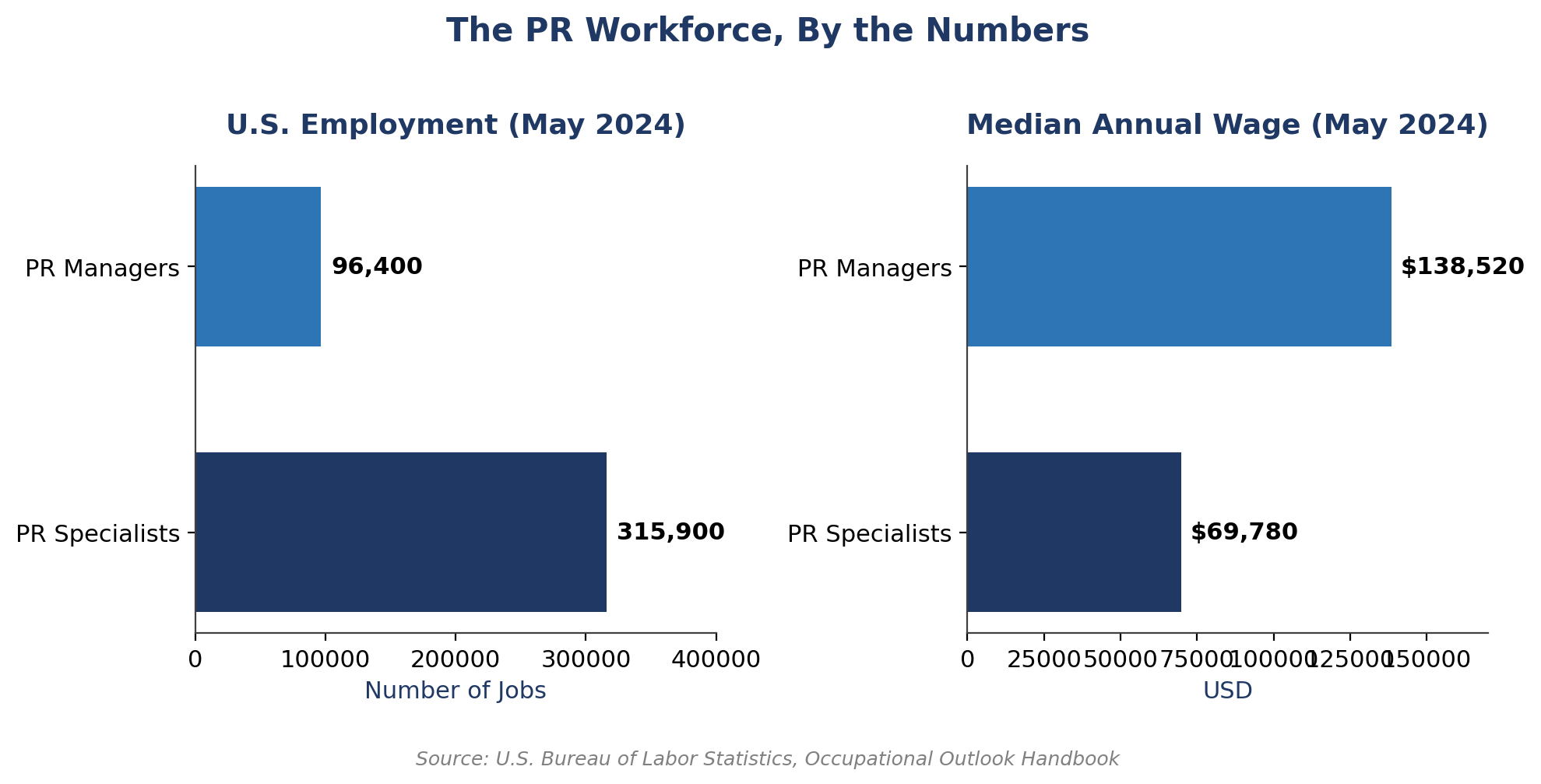
Before you pick a program, know what the job market actually looks like. The U.S. Bureau of Labor Statistics publishes the most reliable numbers on this.
1.1 The numbers (most recent BLS data, May 2024)
| Role | U.S. Jobs (2024) | Median Annual Wage | 10-Year Outlook |
|---|---|---|---|
| Public Relations Specialists | 315,900 | $69,780 | +5% growth 2024–2034 (faster than average) |
| Public Relations Managers | 83,200 | $138,520 | +5% growth 2024–2034 |
| Entry-level Account Coordinator (PR agencies) | — | ~$65,400 (avg, Dec 2025) | Strong demand at top agencies |
| Top 10% of PR Specialists | — | $129,480+ | — |
| Top 10% of PR Managers | — | $239,200+ | — |
Source: BLS Occupational Outlook Handbook — PR Specialists and PR Managers. Account coordinator data: Salary.com, December 2025.
1.2 Where the openings are
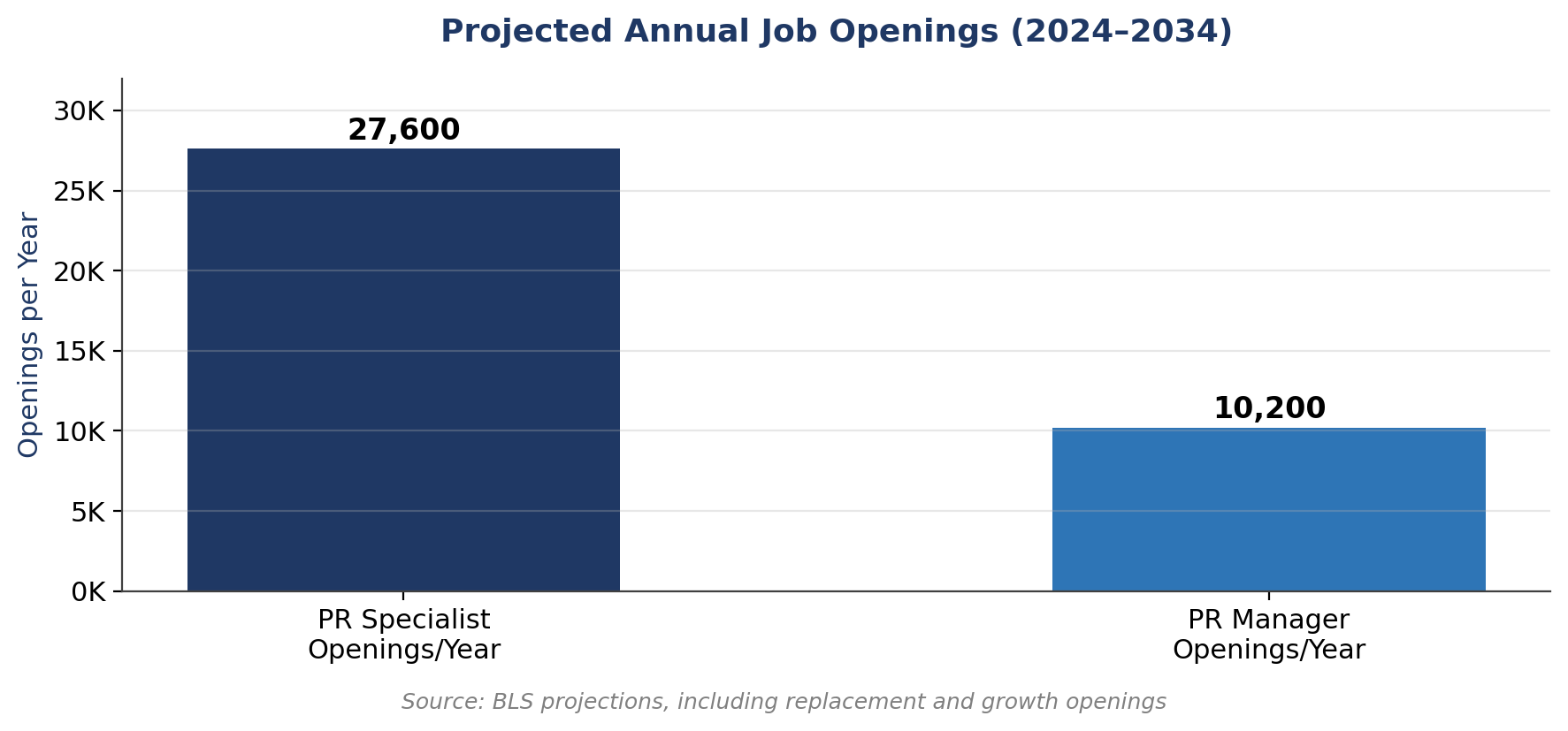
BLS projects roughly 27,600 openings per year for PR specialists and 10,200 per year for PR managers over the next decade. Most of those openings come from people leaving the field, not from net job creation. That is an important detail — it means the industry keeps absorbing new graduates every year, but it also means competition for the best entry-level seats is steady.
1.3 What employers pay most for
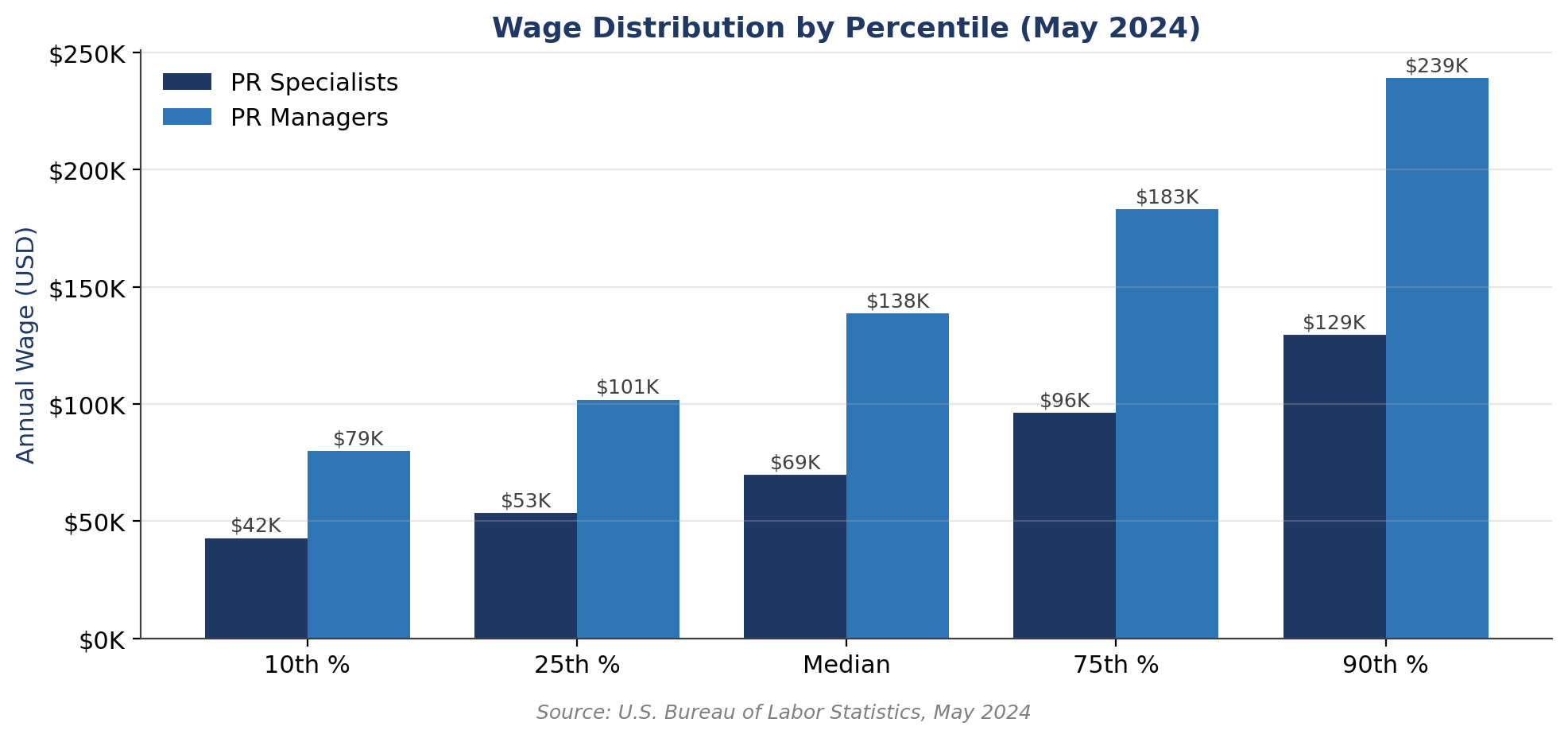
PR jobs vary enormously in compensation depending on four things:
- Geography. New York City, Washington D.C., Los Angeles, and San Francisco pay the most. Regional markets (Atlanta, Chicago, Dallas, Miami) pay less but often offer faster career advancement.
- Industry. Tech, healthcare, finance, and entertainment PR pay more than nonprofit or government PR.
- Employer type. In-house corporate PR pays better than agency PR at the entry level; agency work pays better than both at the senior level.
- Specialization. Crisis communication, financial/IR comms, healthcare PR, and public affairs all command premiums.
1.4 What this means for your degree choice
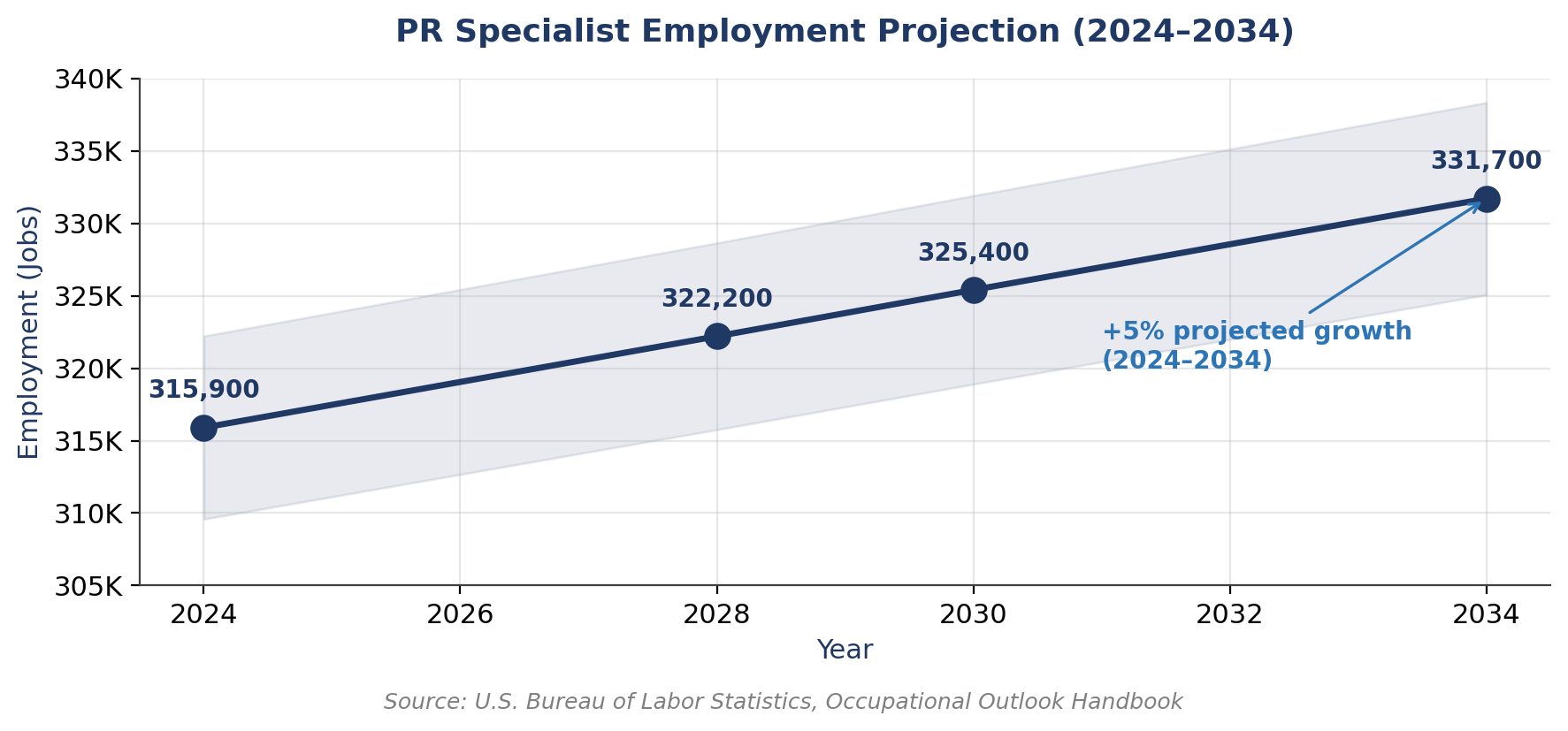
If your goal is to maximize starting salary, study at a program that has strong ties to a high-paying market (NYC, DC, LA, SF, Chicago). If your goal is long-term career optionality, pick the program with the strongest alumni network in your chosen industry. If you don't know what industry you want yet, pick the program with the broadest curriculum and most active student-run agency — you'll figure the rest out in your internships.
2. The U.S. PR and Marketing Education Landscape
2.1 Where PR is taught
PR and strategic communication programs in the U.S. sit in three different types of academic homes. Where a program sits tells you what it will teach you:
- Journalism and communication schools. The traditional home. USC Annenberg, Syracuse Newhouse, Northwestern Medill, University of Missouri, University of Florida, UNC Hussman, UT Austin Moody, University of Georgia Grady, Boston University COM. Emphasis on writing, media relations, storytelling, and ethics. Good preparation for media relations, crisis, content, and corporate communications roles.
- Business schools. Marketing departments at Wharton, Kellogg, Booth, NYU Stern, Michigan Ross. Emphasis on analytics, consumer behavior, and brand strategy. Good preparation for brand-side roles, integrated campaigns, growth marketing, and senior agency strategy positions.
- Hybrid strategic communication programs. Georgetown, American University, George Washington, Boston University's online programs, NYU School of Professional Studies, Columbia SPS. Emphasis on policy, public affairs, and corporate reputation. Good preparation for Washington-adjacent roles, corporate communications, and agency public affairs practices.
2.2 The numbers
Annual U.S. output of PR and related degrees (most recent available data):
| Degree Type | Approximate Annual Output | Source |
|---|---|---|
| Bachelor's + Master's in PR & Advertising (combined) | ~21,275 degrees across 209 institutions | College Factual, 2025 |
| Accredited PR / Strategic Communication Master's programs | 92 programs reviewed | CPRE 2025 Graduate Report |
| MBA programs offering a Marketing specialization | ~130+ AACSB-accredited schools | U.S. News 2026 |
| Bachelor's in Communication & Journalism (all subfields) | ~90,000+ per year | NCES IPEDS |
2.3 Accreditation and oversight bodies
A handful of organizations set the standards for PR and marketing education. These are the bodies whose seals of approval signal program quality:
- ACEJMC (acejmc.org) — the Accrediting Council on Education in Journalism and Mass Communications. The primary quality accreditor for journalism and communication schools. ACEJMC accreditation is the closest thing to a quality baseline.
- CPRE (commissionpred.org) — the Commission on Public Relations Education. An industry-academic body that sets the curriculum standards used by most accredited programs. Their 2025 Graduate Education Report is the best single snapshot of how master's-level PR education is changing.
- PRSA and PRSSA (prsa.org) — the Public Relations Society of America, the main professional association, and the Public Relations Student Society of America, its student arm. PRSSA operates 300+ chapters. Joining your school's PRSSA chapter is the single highest-leverage move an undergraduate PR student can make.
- AACSB (aacsb.edu) — the accreditor for business schools. The quality baseline for MBA marketing programs.
- IPR (instituteforpr.org) — the Institute for Public Relations. Research body that publishes industry studies. Their Signals Report tracks trends practicing professionals care about.
- AAF / NSAC (aaf.org) — the American Advertising Federation runs the National Student Advertising Competition (NSAC), the flagship undergraduate pitch competition. Participating on your school's NSAC team is a resume item that employers recognize.
3. AI in PR Education — Where It Is Allowed and Where It Is Not
If you are starting a PR or marketing program in 2026 or later, the first thing you need to understand is how your school handles artificial intelligence. Almost every major university now has an AI policy. But those policies vary from course to course, and the rules change quickly. Getting this wrong — even accidentally — can cost you a grade, a degree, or a job offer.
3.1 How student AI use has changed
The shift happened fast:
- 2024: ~66% of higher-education students reported using generative AI for coursework.
- 2025: ~92% reported using it. Estimates suggest 86% of U.S. higher-education students now use AI as their primary research and brainstorming partner.
- Assessments: 88% of students reported using generative AI specifically for assessments in 2025, up from 53% in 2024.
In other words: if you are in college right now, almost everyone around you is using AI. Whether that is allowed — and how you have to disclose it — depends entirely on your school and your professor.
3.2 The current model: disclosure plus instructor discretion
Most major U.S. universities now run the same playbook:
- University-level policy: AI use is governed by the academic integrity code. Using AI without permission can be academic misconduct.
- Course-level policy: Each professor sets the specific rule. This is where the real decision happens.
- Default expectation: When AI use is allowed, students must disclose it. Acknowledgment at the end of the assignment is the most common format.
- Exceptions: First-year writing courses, timed exams, and ethics seminars often prohibit AI entirely.
Examples of university-level guidance worth knowing: Princeton's McGraw Center, Duke's CTL guidance, University of Arizona's Responsible AI principles, and UT Austin's sample syllabus statements.
3.3 The Red-Yellow-Green framework
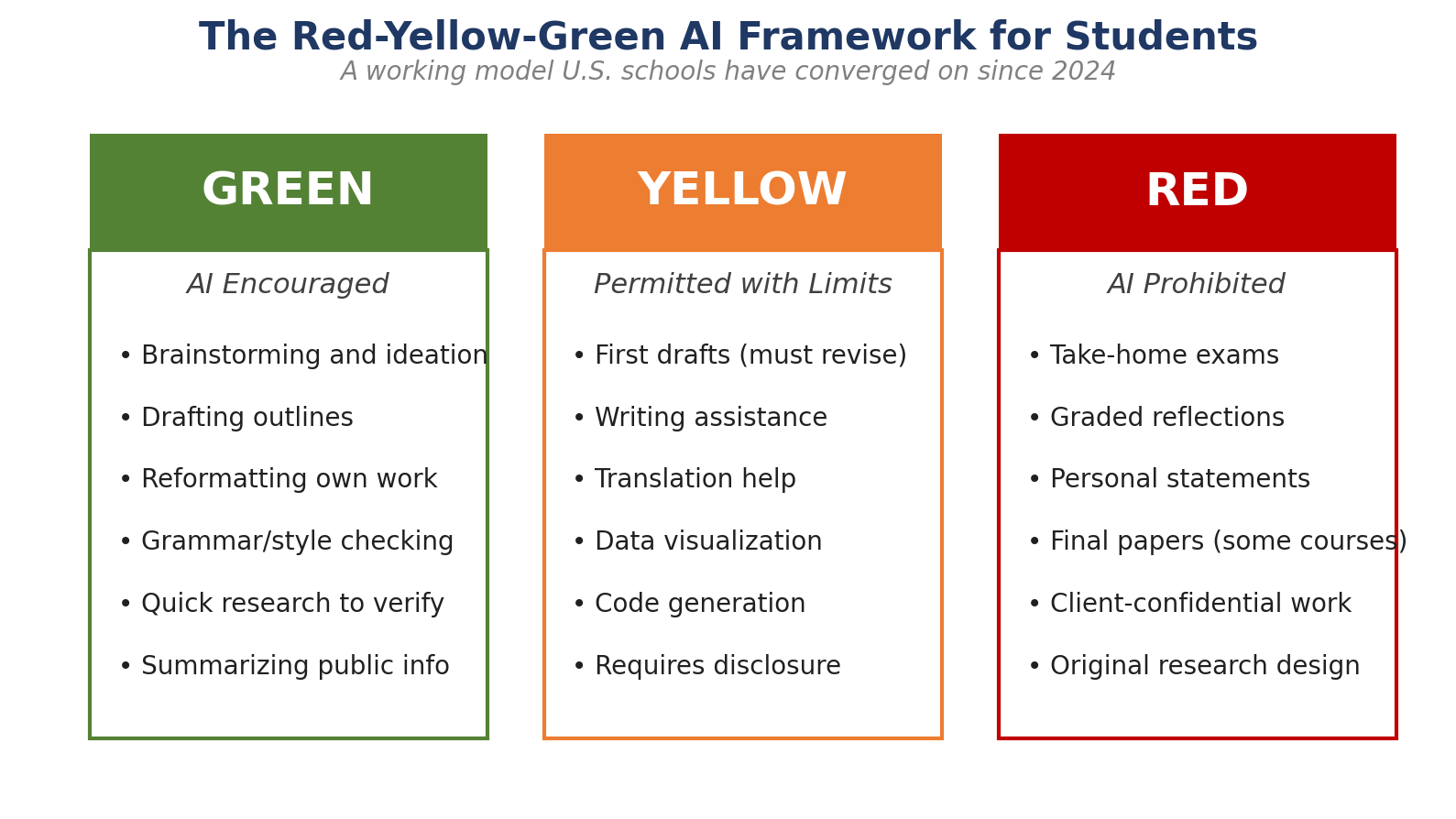
The University of Arizona popularized a three-level framework that has been adopted (with local variations) across many U.S. universities. Most syllabi now signal one of these three positions:
Green — AI encouraged (use and cite)
- Typical language: "You are welcome to use generative AI tools in this class. The use aligns with the course learning goal."
- Your obligation: Document and cite AI use. You remain responsible for accuracy and ethics.
- Where you'll see it: AI-focused electives, digital media courses, innovation seminars, IMC analytics courses.
Yellow — AI permitted with limits
- Typical language: "You may use AI for brainstorming, outlining, and grammar checking. You may NOT use AI to write drafts, full sentences, paragraphs, or complete assignments."
- Your obligation: Stay inside the allowed use. Disclose when you use it.
- Where you'll see it: Most PR writing, campaign planning, crisis communication, and strategy courses. This is the most common policy.
Red — AI prohibited
- Typical language: "The use of generative AI tools is not permitted in this course. Any use may be considered a violation of academic integrity."
- Your obligation: No AI. Basic grammar and spellcheck are usually still fine. Grammarly's generative-text feature is typically banned.
- Where you'll see it: First-year writing, PR ethics, PR law, graduate theory seminars, timed in-class assessments.
3.4 What is usually allowed across PR and marketing courses
| Use | Typical Permission | Typical Disclosure Required |
|---|---|---|
| Brainstorming and idea generation | Freely permitted | Acknowledgment at end of assignment |
| Outlining and structuring a draft | Freely permitted | Acknowledgment |
| Grammar and style checking | Freely permitted | None (except generative features in Grammarly) |
| Research assistance and source summaries | Permitted with verification required | Full disclosure plus citation |
| Translation of your own writing | Permitted | Acknowledgment |
| Data visualization scaffolding | Permitted | Acknowledgment in methodology |
| Generating examples for critique | Permitted (instructional) | Required — clearly labeled |
| Social media caption variations | Permitted | Acknowledgment |
| Image generation for mockups | Permitted with disclosure | Full disclosure including tool and prompt |
3.5 AI detection tools — why most schools stopped using them
You may have heard about AI detection tools like Turnitin's AI detector or GPTZero. Most major research universities have moved away from relying on these tools. Three reasons:
- Reliability. MIT research documented high false-positive and false-negative rates. OpenAI withdrew its own detection tool because it could not be trusted.
- Bias. Stanford research found AI detectors systematically flagged work by non-native English speakers as AI-generated. This is a discrimination risk universities want to avoid.
- Arms race. "Humanizer" tools that rewrite AI text to defeat detectors are widely available and free.
What this means for you: don't assume a detector will catch you, but also don't assume the absence of a detector means you can skip disclosure. Most academic misconduct cases now get made from revision history, writing style inconsistencies, or direct confrontation — not from detector scores.
3.6 Practical rules for students
- Read the syllabus carefully. The course-level policy is what actually governs you, not the university-level position.
- When in doubt, ask the instructor in writing. An email exchange gives you documentation if there's ever a question.
- Always disclose. Even when AI use is allowed, adding a short acknowledgment ("I used ChatGPT for brainstorming; I revised substantially") protects you.
- Keep your drafts. Google Docs and Microsoft Word both retain revision history. This is your strongest defense against a false AI-use accusation.
- Assume your portfolio will be examined. Hiring managers increasingly ask how portfolio pieces were produced. Be ready to explain your process honestly.
4. Industry AI Guidelines — What the Profession Expects
The rules in school are not the rules you'll follow as a professional. This section covers the industry-level guidance you will be expected to know when you start your first PR job.
4.1 PRSA's Promise & Pitfalls framework
The Public Relations Society of America's Board of Ethics and Professional Standards (BEPS) released Promise & Pitfalls: The Ethical Use of AI for Public Relations Practitioners in November 2023. It was updated in October 2025 at PRSA's ICON conference in Washington, D.C. The updated document is now the closest thing the U.S. PR industry has to a formal AI ethics standard. Read it: PRSA Promise & Pitfalls (PDF).
The 2025 update is structured around five provisions of the PRSA Code of Ethics, each mapped to specific AI use cases.
| Code Provision | AI Connection | Proper Use | Improper Use |
|---|---|---|---|
| Advocacy | AI used to represent client interests | Transparent AI-assisted outreach | Concealing AI use in content |
| Honesty | Accuracy of AI-generated content | Human fact-checks every AI output | Publishing unreviewed AI content |
| Expertise | Human professional judgment | AI augments; human decides | Over-reliance on AI for strategy |
| Independence | Disclosing AI-enabled conflicts | Disclosing tool affiliations | Hidden AI tool partnerships |
| Loyalty | Protecting confidential data | Enterprise AI, no data retention | Client data in public AI tools |
| Fairness | Bias detection | Regular audits of outputs | Deploying without bias review |
4.2 PRSA's FAQ — three answers that will come up in your first job
- "Is it ethical to use AI to draft a press release?" Yes — if it is accurate, reviewed by a human, and aligned with the Code of Ethics.
- "Can I use public AI tools for client work?" Only if the tool does not store or reuse inputs, and you are not entering confidential data.
- "Should I tell my clients I am using AI?" Transparency builds trust. Disclose AI use when the tool makes a meaningful contribution.
4.3 Industry research on AI in PR
USC Annenberg's Center for Public Relations, in partnership with WE Communications, has been surveying PR leaders on AI use since 2023. Their 2025 Relevance Report (AI Activated) is the single best read on what the industry actually thinks:
- 88% of surveyed PR leaders say AI will positively impact the speed and efficiency of their work.
- 72% say AI will help reduce workloads.
- 55% say AI will positively impact creativity — the lowest score among the surveyed dimensions.
The takeaway: the industry is optimistic about AI for efficiency, skeptical about AI for creativity. Your ability to demonstrate the latter — original creative thinking that AI cannot produce — is how you stand out.
4.4 What this means for your first PR job
- You will be expected to use AI. Most major agencies, including 5W, now deploy enterprise AI tools for research, drafting, media monitoring, and analytics.
- You will be expected to review every AI output. The human-in-the-loop requirement is not optional. PRSA's guidance is explicit: the practitioner remains responsible for anything that goes out the door.
- You will be expected to protect client data. No client information goes into public AI tools. This rule is universal.
- You will be expected to disclose AI use to clients when asked. Every agency now has disclosure language in its contracts.
5. AI Courses and Certificates Available Now
A curated catalog of real, verified AI courses and certificate programs at U.S. PR, strategic communication, and marketing programs. This list changes quarterly. Always verify current offerings against the official program websites before applying.
5.1 Master's degree programs with AI integration
Columbia University — MS in Strategic Communication
Columbia SPS introduced a new curriculum for students beginning Fall 2025. It includes a dedicated AI elective course structured in three passes: AI foundations, AI and strategic communication intersections, and practical use of AI in strategic communication. Updated foundational courses include a new Ethical Decision-Making for Communicators course. Details: Columbia SPS curriculum.
Boston University — MS in Strategic Integrated Communication (online)
BU COM launched this online master's with AI integrated into the core curriculum, not as an elective. Dedicated course covering AI, data analytics, and emerging technologies; hands-on work with AI-driven tools for campaign management, messaging, and audience engagement; explicit coverage of ethical implications. Delivered in seven-week modules; typical completion time is 16 months. Details: BU COM MS in Strategic Integrated Communication.
University of Denver — MA in Communication Management with AI Concentration
Launched as a dedicated AI concentration within the MA in Communication Management. Named career paths include AI Communications Strategist, AI Ethics and Communications Specialist, AI Change Management Consultant, AI Marketing Strategist, and AI Content Creator. Four-course and six-course certificate options available for students who want something shorter. Details: University of Denver AI + Communications.
Oral Roberts University — MA in Strategic Communication with AI Focus
Online master's with explicit AI focus. 30 credit hours. Can be completed in as little as 20 months. Positioned for working PR professionals. Offers rolling start dates.
5.2 Graduate certificates (faster and cheaper)
NYU School of Professional Studies — Certificate in Communications and AI (Accelerated)
12-week accelerated online format. Covers AI for writing, research, presentation, design, multimedia, and promotional projects. Earns a digital badge on LinkedIn. Practical focus, not theoretical. Details: NYU SPS Communications and AI Certificate.
Fitchburg State University — AI and Data-Based Communication Strategy Certificate
Graduate-level online certificate. Heavy emphasis on ethics: privacy, security, bias, unintended consequences. Prepares for roles in communication, marketing, advertising, and data analysis where AI integration is now expected.
5.3 Industry credentials
PRSA — AI Insights Video Series
PRSA's video series covers generative vs. predictive AI, AI in workforce engagement, AI and communication strategy, and regulatory landscape. Counts toward continuing education credit for the APR credential renewal. Details: PRSA AI Insights.
PRSA — Promise & Pitfalls Webinar Series
Webinars led by the authors of the updated 2025 AI ethics guide. Covers AI literacy, privacy protection, vendor assessment, human-in-the-loop requirements, cross-functional teams, and regulatory detail on copyright, trademarks, FTC disclosure, state-level laws, and international regulation.
5.4 Business schools
MBA-level AI offerings are expanding rapidly. The most-relevant for PR-adjacent careers:
- Kellogg (Northwestern). Customer Analytics and AI, Digital Marketing Implementation, AI for Business — three of the most-subscribed marketing electives.
- Wharton. AI-related electives now embedded across the Marketing and Operations Management major.
- Chicago Booth. Analytics-first curriculum with AI woven through the statistics and data science courses.
- MIT Sloan. Launched a dedicated AI major in 2026 across Northwestern schools; Sloan and Medill are both integrating AI content into existing courses.
Context: MBA programs offering AI specializations have grown 1,260% since 2022. Bachelor's AI programs in the U.S. grew 114% from 2024 to 2025 (from 90 to 193 programs).
5.5 Programs without a dedicated AI course yet
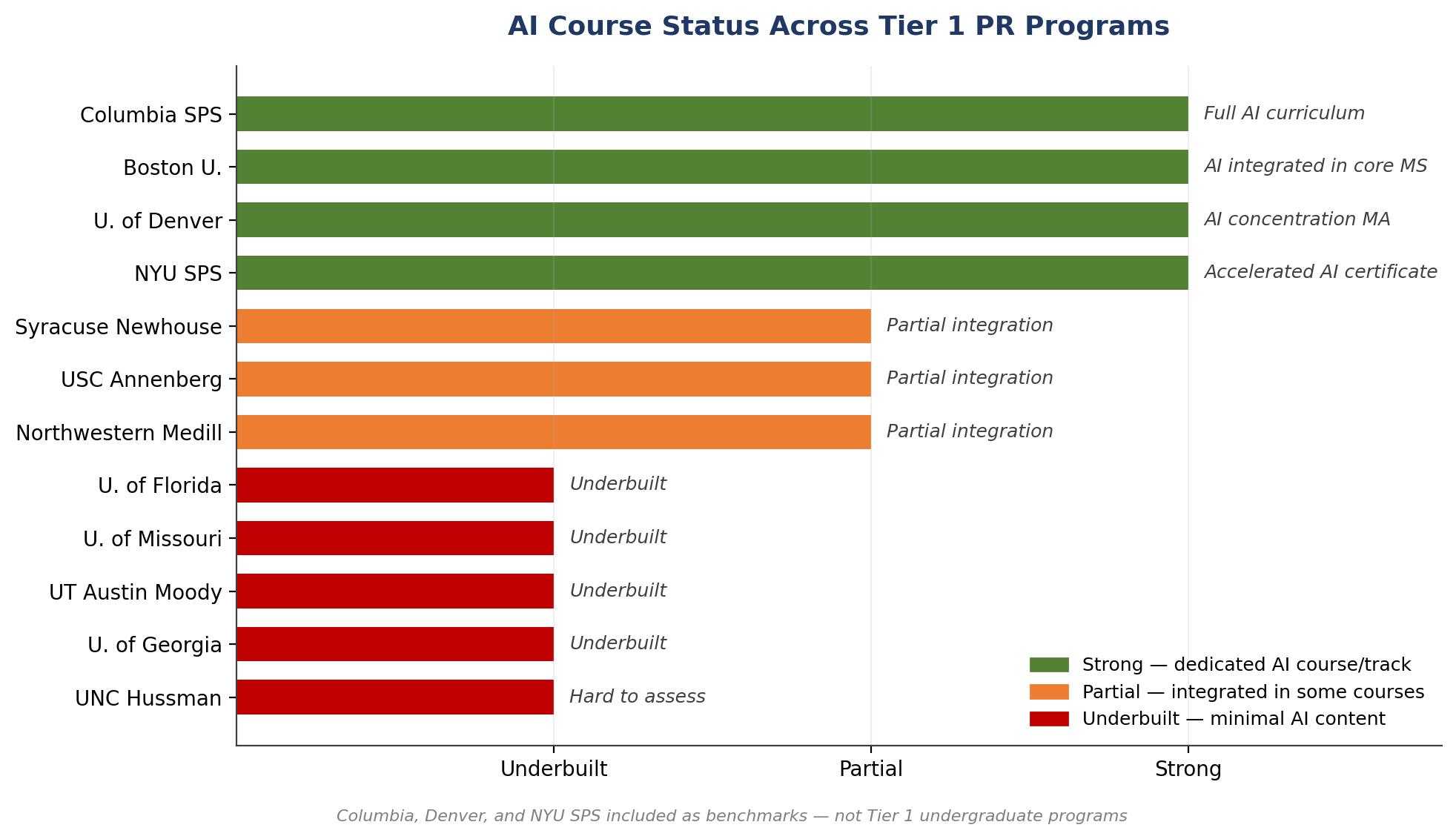
Some top undergraduate PR programs still cover AI through electives or individual-instructor discretion rather than a dedicated course. As of early 2026 this includes (with exceptions):
- University of Florida (CJC) — AI covered in electives.
- University of Georgia (Grady) — AI covered within existing courses.
- University of Missouri — mentions in strategic communication courses.
- UT Austin (Moody) — emerging, no consolidated offering.
This changes quickly. Any program's status may have flipped by the time you enroll. Verify directly with the program before you apply.
6. Tier 1 Undergraduate PR Programs
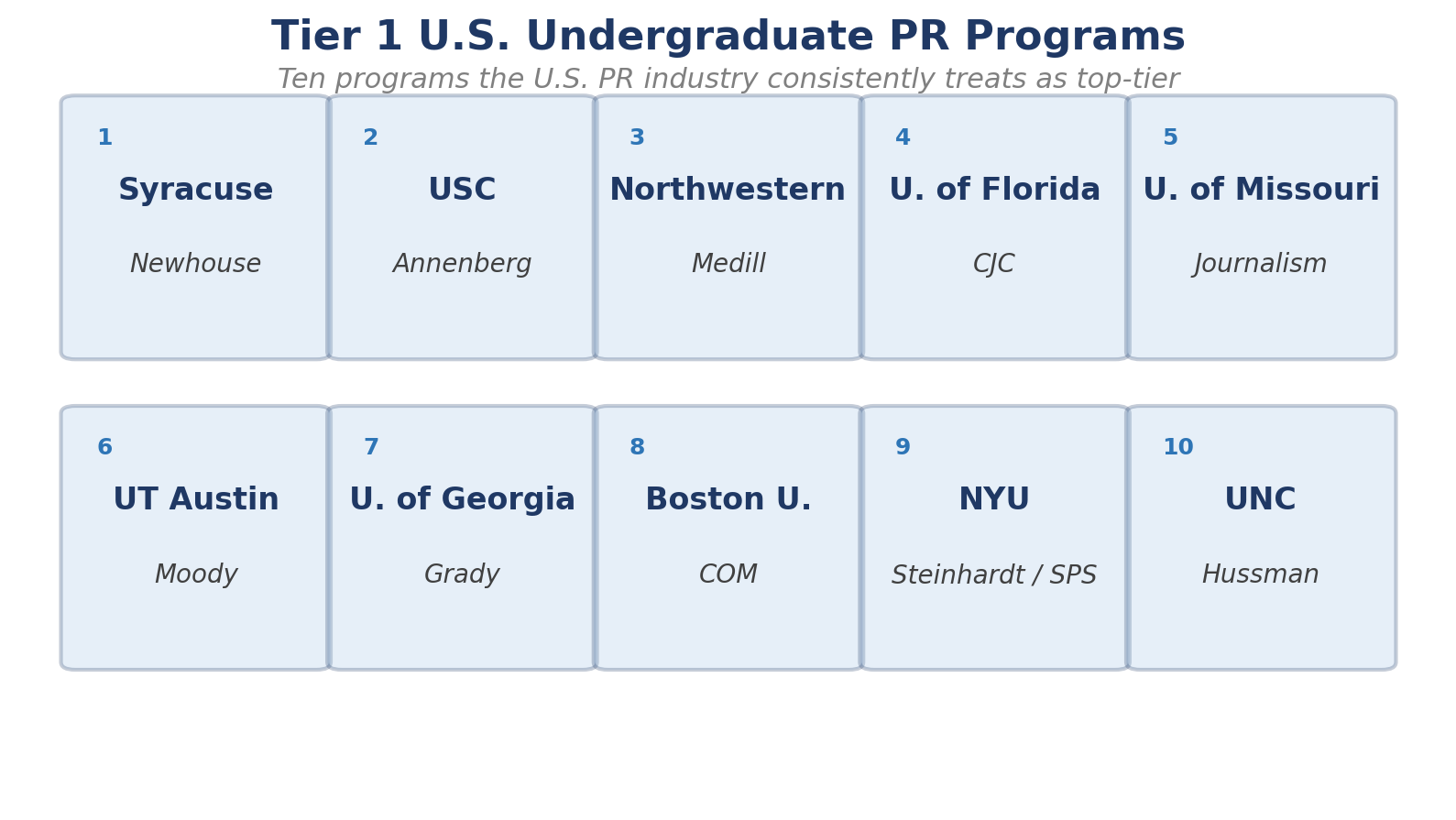
These are the undergraduate programs that the PR industry consistently recognizes as top-tier. Rankings at this level are noise — what matters is fit, location, and alumni network. These are the programs whose graduates show up disproportionately in agency associate and account-coordinator seats.
6.1 Syracuse University — S.I. Newhouse School of Public Communications
- Location: Syracuse, NY.
- Programs: BS in PR; MA in PR; MS in Communications Management (online).
- Why it matters: Newhouse is the Northeast's dominant undergraduate feeder into New York City agencies. Strong alumni pull at Edelman, Weber Shandwick, Ketchum, 5W Public Relations, and Zeno.
- Signature programs: Newhouse NYC semester (students work full-time in NYC comms roles). Hands-on agency simulation courses.
More: newhouse.syracuse.edu
6.2 University of Southern California — Annenberg School for Communication and Journalism
- Location: Los Angeles, CA.
- Programs: BA in PR; MA in Strategic Public Relations (one of the largest graduate PR programs in the country).
- Why it matters: Annenberg's Strategic Communication and Public Relations Center publishes the annual Global Communications Report and the Relevance Report. The 2025 Relevance Report was titled "AI Activated" and is the best industry read on how PR is adopting AI.
More: annenberg.usc.edu
6.3 Northwestern University — Medill
- Location: Evanston, IL (with a Chicago downtown campus).
- Programs: BSJ in Journalism with IMC track; MS in Integrated Marketing Communications (the flagship).
- Why it matters: Medill IMC is the academic program that most closely mirrors how big brand-side marketing teams actually operate — analytics, creative, PR, and media taught together. The Immersion Quarter puts IMC students inside a top company for 10 weeks.
- Also notable: Northwestern received a $1 million Knight Foundation grant to research AI in journalism. Intent Lab, run jointly with Publicis' Performics, is a useful model for how agencies and academia can partner.
More: medill.northwestern.edu
6.4 University of Florida — College of Journalism and Communications
- Location: Gainesville, FL.
- Programs: BS in PR; MA in Mass Communication with PR specialization; online MA.
- Why it matters: The largest single PR program by enrollment in the country. UF graduated approximately 195 PR students in 2023. The PRSSA Alpha Chapter (founded 1968) is the oldest and largest PRSSA chapter nationally.
- Alpha PR: UF's student-run agency is nationally affiliated and works with real clients.
More: jou.ufl.edu
6.5 University of Missouri — Missouri School of Journalism
- Location: Columbia, MO.
- Programs: BJ with Strategic Communication emphasis; MA in Strategic Communication.
- Why it matters: Founded 1908 — the world's first journalism school. The "Missouri Method" puts students in real newsrooms and agency environments from day one. MOJO Ad (student-run agency focused on the youth market) is one of the most awarded student agencies in the country.
More: journalism.missouri.edu
6.6 University of Texas at Austin — Moody College of Communication
- Location: Austin, TX.
- Programs: BS in Advertising and PR; MA in Advertising with PR track.
- Why it matters: One of the oldest PR programs in the country, partnered with more than 100 PR offices. Austin is now one of the fastest-growing ad and PR markets in the U.S.
More: moody.utexas.edu
6.7 University of Georgia — Grady College of Journalism and Mass Communication
- Location: Athens, GA.
- Programs: AB in PR; MA in Journalism and Mass Communication.
- Why it matters: Grady graduates dominate Atlanta, now a top-five U.S. PR market. Strong pipelines to Coca-Cola, Delta, Home Depot, and UPS.
More: grady.uga.edu
6.8 Boston University — College of Communication
- Location: Boston, MA.
- Programs: BS in PR; MS in PR; MS in Strategic Integrated Communication (online, AI-integrated).
- Why it matters: Approximately 186 PR undergraduate graduates annually. PRLab is BU COM's student-run PR agency and one of the oldest in the country. BU's new online MS includes AI in the core curriculum, not as an elective.
More: bu.edu/com
6.9 New York University
- Location: New York, NY.
- Programs: NYU Steinhardt (undergraduate Media, Culture, and Communication); NYU School of Professional Studies (MS in PR and Corporate Communication; Certificate in Communications and AI).
- Why it matters: Location. NYU students are interning at Manhattan agencies sophomore year. NYU SPS's AI certificate is one of the most practitioner-focused AI credentials in PR.
More: sps.nyu.edu
6.10 UNC Chapel Hill — Hussman School of Journalism and Media
- Location: Chapel Hill, NC.
- Programs: BA in Advertising and PR; MA in Media and Communication.
- Why it matters: Highly regarded in the Research Triangle tech PR market. Strong academic research output.
More: hussman.unc.edu
7. Tier 2 Strong Regional Programs
Strong programs that feed regional agency markets or specific industries. These are often overlooked by coastal recruiters, which means less competition for the best students — and strong internship conversion rates for graduates.
| Program | Location | Annual PR Grads | Best For |
|---|---|---|---|
| University of Nebraska–Lincoln | Lincoln, NE | ~251 | Volume; Midwest agencies |
| University of Illinois Urbana-Champaign | Champaign, IL | ~218 | Chicago agency pipeline (non-Medill) |
| DePaul University | Chicago, IL | ~193 | Chicago agencies; working students |
| Washington State (Murrow) | Pullman, WA | ~133 | Pacific Northwest; tech PR |
| University of Alabama | Tuscaloosa, AL | ~150+ | Southeast; Plank Center leadership training |
| Texas Christian University (TCU) | Fort Worth, TX | ~150 | Texas market; Schieffer College |
| Southern Methodist University | Dallas, TX | ~137 | Texas market |
| Temple University (Klein) | Philadelphia, PA | ~54 | Philadelphia; healthcare PR |
| University of Miami | Coral Gables, FL | varies | Miami / Latin America; bilingual talent |
| University of Oregon (SOJC) | Eugene, OR | varies | West Coast; ad/PR crossover |
| Quinnipiac University | Hamden, CT | ~96 | Northeast; media-heavy |
| Florida State University | Tallahassee, FL | ~153 | Southeast; strong grad pipeline |
| Pepperdine University | Malibu, CA | varies | LA; values-driven corporate |
| University of Maryland (Merrill) | College Park, MD | varies | DC public affairs |
| American University | Washington, DC | varies | DC public affairs; policy comms |
| Howard University | Washington, DC | varies | DC; HBCU alumni network |
7.1 The Plank Center at the University of Alabama
Worth a separate mention. The Plank Center for Leadership in Public Relations, housed at UA, is the industry's leadership-development hub for senior PR practitioners. They run the Milestones in Mentoring award, executive fellowships, and the Forum on the Future of Public Relations. If you are an undergraduate at Alabama and you can get involved with Plank Center programming, do it.
8. Graduate PR and Strategic Communication Programs
8.1 The shift away from "public relations" in program names
If you are looking at master's programs, you will notice something interesting: most of the programs that teach what the PR industry considers public relations don't use "public relations" in their name anymore.
The CPRE 2025 Graduate Education Report reviewed 92 accredited master's programs that teach PR and related disciplines. Only 18% use "public relations" as their primary title. The rest use "strategic communication," "integrated marketing communications," "communication management," or "digital media." This is a shrinking use of the label, not a shrinking industry — the jobs are still there and still called PR. Programs are renaming themselves to capture a broader student market, including digital, social, internal comms, and public affairs students.
8.2 What CPRE found
- 54% of PR master's programs now offer specialized concentrations. Fastest-growing: digital media, health communication, crisis communication, and corporate or nonprofit communication.
- 90% require research methods. Over half require advanced communication theory.
- Practitioners value internships over theses. CPRE's survey of 115 PR professionals ranked real-world projects and internships more valuable than academic capstones. If you are choosing between a thesis track and a capstone or internship track, the industry preference is clear.
- AI, social media, and digital communication are the fastest-growing course categories in PR master's programs.
8.3 Top graduate PR programs
Research-heavy (academic and PhD pipeline)
- University of Maryland — one of the most productive PR research faculties in the country.
- University of Florida — large program with research plus applied tracks.
- Syracuse University — MA in PR, strong theoretical grounding.
- University of Missouri — MA and PhD tracks.
Practitioner-focused, part-time, and online
- NYU School of Professional Studies — MS in PR and Corporate Communication. Certificate in Communications and AI (12-week accelerated) available separately.
- Georgetown University — MPS in Public Relations and Corporate Communications. Strong DC corporate and public affairs focus.
- Johns Hopkins AAP — MA in Communication (online plus DC). Healthcare and policy comms strengths.
- American University — MA in Strategic Communication (online plus DC).
- Boston University — MS in PR (campus). MS in Strategic Integrated Communication (online) with AI in core curriculum.
- Columbia University SPS — MS in Strategic Communication. New curriculum for Fall 2025 cohort includes AI elective.
Integrated marketing communications (IMC)
- Northwestern Medill IMC — the flagship IMC program.
- West Virginia University IMC — large online IMC program, practitioner-friendly.
- University of Colorado Boulder — Strategic Communication Design track.
9. Marketing Programs at Top Business Schools
Marketing programs at top business schools sit upstream of PR agencies. The marketing leaders who come out of Wharton, Kellogg, or Booth are the future clients who hire agencies — and the executives who sometimes build in-house teams instead. Understanding these programs helps you understand who you will be working with, competing with, and ultimately selling to.
9.1 U.S. News 2026 Best Business Schools — Marketing Specialization
| Rank | School | Location | Notes |
|---|---|---|---|
| 1 (tie) | Kellogg (Northwestern) | Evanston, IL | Kellogg lost sole #1 after 20+ years |
| 1 (tie) | Berkeley Haas | Berkeley, CA | Tech + Silicon Valley |
| 3 | NYU Stern | New York, NY | Brand, luxury, media marketing |
| 3 | Chicago Booth | Chicago, IL | Quant-heavy; analytics-first |
| 5 | UCLA Anderson | Los Angeles, CA | Entertainment, tech, consumer |
| 6 (tie) | Michigan Ross | Ann Arbor, MI | Brand management depth |
| 6 (tie) | UT Austin McCombs | Austin, TX | Austin tech ecosystem |
| 8 | Ohio State Fisher | Columbus, OH | Consumer goods; Midwest |
| 9 | Georgia Tech Scheller | Atlanta, GA | Tech marketing, analytics |
| 10 | USC Marshall | Los Angeles, CA | Entertainment, consumer |
Note: Wharton took the top Marketing specialty ranking in U.S. News 2026 in some cuts of the data, depending on methodology. The marketing rankings shifted significantly that year as U.S. News revised its survey approach. Verify current placement against the U.S. News site before you cite these rankings.
9.2 Full-time MBA rankings — 2026 U.S. News (overall)
- 1. Stanford Graduate School of Business
- 2. Wharton (University of Pennsylvania)
- 3. Chicago Booth
- 4 (tie). Harvard Business School
- 4 (tie). Kellogg (Northwestern)
9.3 Undergraduate business schools — 2026 U.S. News
Tied #1: MIT Sloan and Wharton (Penn). MIT Sloan's rise to tie Wharton is the biggest structural shift in the undergraduate business rankings in a decade.
9.4 Why this matters for PR students
- Client side. Brand-side VPs of Marketing and CMOs increasingly come from these programs. Understanding their academic training helps you predict what they will ask for and how they will evaluate your work.
- Senior agency hires. Strategy directors and practice leads are increasingly filled by MBA graduates, not PR-program graduates moving up. If you are aiming for that kind of role later, understanding the MBA landscape helps.
- Consultancy competition. Consultancies such as Accenture Song, Deloitte Digital, and BCG Brighthouse recruit the same MBA marketing students that agencies want, and they convert them into "creative strategist" roles that compete directly with PR firms.
10. Program Profile Cheat Sheet
Quick-reference single table for comparing the programs covered in this guide. Use it as a starting point, not a decision.
| School | City | Strongest Output | Industry Ties |
|---|---|---|---|
| Syracuse (Newhouse) | Syracuse | NYC-ready PR undergrads | Major NYC agencies |
| USC (Annenberg) | LA | Strategic comm MA; entertainment | Entertainment, tech, consumer |
| Northwestern (Medill) | Evanston/Chicago | IMC grad strategists | P&G, Unilever, Publicis |
| NYU SPS + Steinhardt | NYC | Working-pro master's + AI cert | NYC agencies (all) |
| U. Florida (CJC) | Gainesville | Volume PR undergrads | Southeast, Atlanta |
| U. Missouri (J-School) | Columbia, MO | Practical undergrads; MOJO Ad | Midwest full-service agencies |
| UT Austin (Moody) | Austin | Texas talent; ad/PR hybrid | Austin tech, Dallas, Houston |
| U. Georgia (Grady) | Athens | Atlanta-focused undergrads | Coca-Cola, Delta, Home Depot |
| Boston U. (COM) | Boston | Tech/healthcare PR + AI track | Biogen, Moderna, Boston agencies |
| UNC (Hussman) | Chapel Hill | Research Triangle pipeline | Red Hat, IBM, Glaxo |
| U. Alabama (Plank) | Tuscaloosa | Leadership / exec-track | Senior industry network |
| DePaul | Chicago | Working-student Chicago pool | Chicago mid-market |
| Temple (Klein) | Philadelphia | Healthcare PR | Pharma corridor |
| Georgetown | DC | Corporate / public affairs MA | DC trade associations, corporate |
| Columbia SPS | NYC | Strategic comm MS + AI course | NYC corporate comms |
| Wharton | Philadelphia | MBA marketing strategists | Client-side CMOs |
| Kellogg | Evanston | Marketing MBAs | CPG, brand management |
| NYU Stern | NYC | Brand / luxury MBA | Luxury, media, finance |
| Chicago Booth | Chicago | Analytics-heavy MBA | Consulting, tech, finance |
11. What Is Changing in the Industry
11.1 The rebrand from PR to strategic communication
Academic programs are moving away from the PR label. This is not a signal that the industry is shrinking — it is a signal that programs want to claim a broader set of disciplines. What you are taught in a "strategic communication" master's today is often what was taught in a "public relations" master's five years ago, plus digital media, internal communications, ESG, and public affairs. Don't let the name of a program determine your decision; look at the actual curriculum.
11.2 Generative engine optimization (GEO)
GEO is the practice of structuring content so that it gets cited by large language models (ChatGPT, Claude, Gemini, Perplexity) when users ask questions related to a brand or topic. This is adjacent to traditional SEO but the mechanics are different — you are optimizing for machine comprehension and citation, not search ranking.
No U.S. PR program currently has a standalone GEO course as of early 2026. The topic is entering curricula through SEO electives, analytics courses, and strategic communication seminars. If you are evaluating a program and you want exposure to GEO, ask specifically: does the program cover large-language-model citation patterns, AI-generated search, and brand tracking inside AI responses? If yes, good. If the answer is confused, the program hasn't caught up yet.
For coverage of how GEO is changing PR practice, see Everything-PR.com and 5W's analysis at 5wpr.com.
11.3 Experiential learning is replacing the thesis
Practitioners and educators surveyed by CPRE ranked internships and client-based projects above theses and comprehensive exams in value. That matters for your program selection:
- Prioritize programs with strong student-run agencies. Alpha PR at Florida, PRLab at BU, MOJO Ad at Missouri, The Agency at multiple schools. These are effectively junior agencies and the work you do there is what hiring managers will ask about first.
- Prioritize programs with structured internship programs. Newhouse's NYC semester, Medill's Immersion Quarter, and USC Annenberg's agency placements are among the strongest.
- Prioritize programs where industry executives teach. Executive-in-residence programs at USC, UF, Medill, and Newhouse bring senior practitioners into the classroom.
11.4 AI literacy as the new baseline
CPRE's 2025 report flagged AI, social media, and digital communication as the fastest-growing course categories in PR master's programs. Programs that still treat AI as optional are now considered behind. If a program you are evaluating does not have an AI course or at least substantial AI integration across its existing courses, ask why — and consider that a yellow flag for how the program tracks industry change.
11.5 Industry investment in agency-academia partnerships
The gap between what academia teaches and what agencies practice is closing, but only in specific places. Two partnership models are working:
- Medill Intent Lab (Northwestern and Publicis Performics) — joint research unit on consumer decision-making and brand engagement.
- USC Annenberg Center for Public Relations — partnered with Microsoft on the 2025 Relevance Report and with WE Communications on the annual AI survey.
If you are at a program that does not have this kind of partnership, you will likely need to bridge the industry-academia gap yourself through aggressive internship pursuit.
12. AI Regulations You Should Know About
AI regulation is no longer theoretical. If you are starting a career in PR or marketing in 2026, the regulatory framework you will operate under is already partly in force. This section covers the rules that apply to entry-level practitioners — both at the hiring stage and in client work.
12.1 U.S. federal — current state
- Executive Order 14179 (January 2025, active). Replaced EO 14110. Focus is on reducing barriers for AI innovation and global leadership. Implication: federal-level AI regulation is currently lighter-touch and innovation-focused.
- AI Action Plan: Winning the AI Race (July 2025). National strategy for scaling AI innovation.
- FTC disclosure requirements. The FTC has flagged AI-generated endorsements and misleading AI content in consumer advertising. PRSA's 2025 Promise & Pitfalls update includes expanded FTC coverage.
12.2 State-level — enforceable now
Illinois — AI in Employment Decisions
- Prohibits discriminatory AI use in employment decisions.
- Requires candidates to be notified when AI is used in hiring.
- Grants a private right of action — candidates can sue directly.
New York City — Local Law 144
- Enforceable since July 2023.
- Penalties of $500–$1,500 per day of violation.
- Applies to any automated employment decision tool used in NYC hiring.
Colorado — AI and High-Risk Employment
- AI requirements for high-risk employment decisions pushed to end of June 2026.
- Requires impact assessments and public disclosures for consequential employment AI systems.
Arizona (examples of content regulation)
- HB 2394 (May 2024): targets undisclosed use of deepfakes.
- SB 1359 (May 2024): requires AI-generated political media to disclose its synthetic nature.
- HB 2175 (May 2025): restricts AI use in medical claim denials without human oversight.
12.3 EU AI Act — enforceable August 2026
The EU AI Act applies to any agency or company serving EU clients or placing AI-generated content in EU-facing channels. If you will work for a U.S. agency with European clients (which includes most large PR firms), this affects you.
- Risk-tiered framework. Unacceptable, high, limited, and minimal risk levels, with different obligations at each tier.
- Emotion recognition in hiring — banned (in effect since February 2025).
- Transparency obligations. AI-generated content in certain contexts must be clearly labeled.
- Documentation requirements. Providers and deployers of AI systems must maintain technical documentation.
- Bias auditing. High-risk systems require bias audits.
- Right to explanation. EU residents can demand an explanation for consequential AI decisions affecting them.
12.4 Sector-specific regulation you should know
- Department of Defense Instruction 5400.19 (July 2025). Public affairs use of AI. Applies to any PR agency working with DoD clients or subcontracts.
- GDPR (EU). Still applies to any AI system processing EU personal data. Intersects with the EU AI Act.
- U.S. Copyright Office AI Initiative (May 2025, ongoing). Comprehensive policy analysis on AI-generated works.
12.5 What this means for you as a new hire
- Ask about AI policy on your first day. Every large agency now has one. If yours doesn't, flag it.
- Know your client's jurisdictions. An EU client brings EU AI Act obligations. A California client brings California-specific rules. The compliance posture varies.
- Keep records. Prompt logs, output reviews, and version history on significant client deliverables. This is increasingly expected and may be required for audit.
- Default to disclosure. When unsure whether to disclose AI use to a client or to the public, disclose. It's the safer and more defensible position.
13. Faculty and Thought Leaders Worth Knowing
A short list of named academics whose work shows up disproportionately in industry citations, reports, and books. Worth following on LinkedIn or subscribing to their publications early in your career.
13.1 PR and strategic communication faculty
- Elizabeth L. Toth — Professor Emerita, University of Maryland. Co-editor of the CPRE 2023 report.
- Fred Cook — Director, USC Center for Public Relations. Former CEO of Golin. Publishes the Global Communications Report and the Relevance Report.
- Tina McCorkindale — President and CEO of the Institute for Public Relations.
- Karen Freberg — Professor, University of Louisville. Social media and PR. Active LinkedIn content creator.
- Ashlee Humphreys — Associate Professor, Medill IMC. Consumer behavior, social media, digital satisfaction. Author of "Social Media: Enduring Principles."
- Yu Xu — Associate Professor, Medill IMC. Media industries and analytics. 2022 IMC Teacher of the Year.
- Cayce Myers — Virginia Tech. Professor and director of graduate studies in PR and advertising. Frequent expert on AI and PR ethics. Co-authored PRSA's Promise & Pitfalls.
- Michele E. Ewing — Kent State University. APR, Fellow PRSA. Board of Ethical and Professional Standards.
- Linda Staley — APR, Fellow PRSA. Chair of PRSA's Board of Ethics and Professional Standards. Lead on the 2025 Promise & Pitfalls update.
13.2 Marketing faculty (MBA level)
- Eric T. Bradlow — Chair of Marketing, Wharton. Co-directs Wharton Customer Analytics.
- Raghu Iyengar — Wharton. Pricing and social influence.
- Florian Zettelmeyer — Kellogg. Marketing analytics and AI in marketing.
- Scott Galloway — NYU Stern. Clinical professor. High-profile public intellectual on brand, tech, and consumer.
14. Your First PR Job — What to Expect
A short, practical section on what entry-level PR work actually looks like in 2026 and what skills will matter most.
14.1 The starting roles
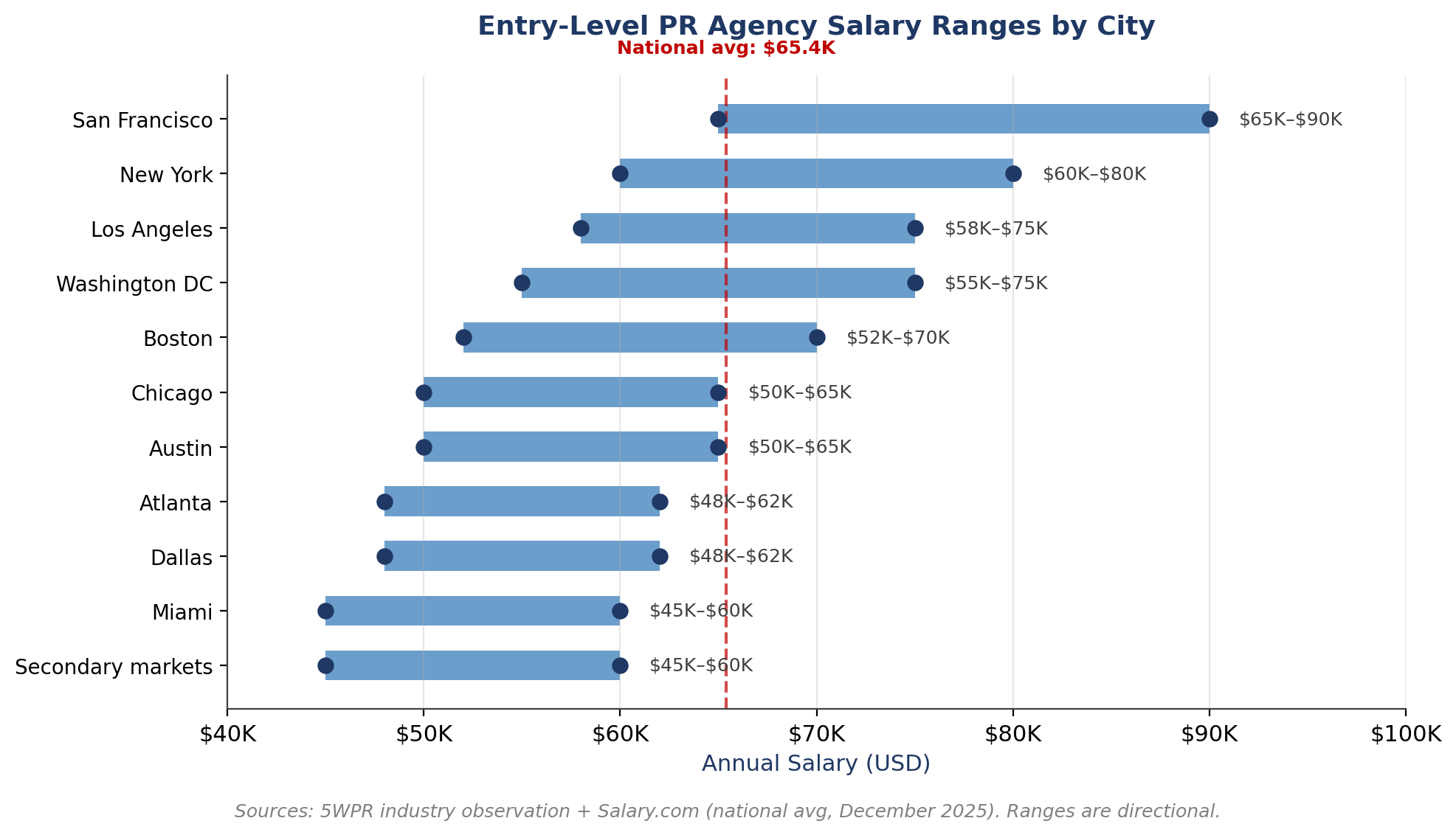
At agencies, entry-level titles include Account Coordinator, Junior Account Executive, Associate Account Executive, and Assistant Account Executive. Titles vary but the work is similar:
- Drafting press releases, pitches, media lists, and briefing documents.
- Monitoring media coverage for client mentions.
- Supporting client meetings — notes, follow-ups, status reports.
- Building and maintaining media relationships.
- Executing social media posts and tracking performance.
- Compiling measurement reports.
In-house corporate PR entry roles include PR Coordinator, Communications Coordinator, and Communications Associate. The work is similar but the client universe is different — you work for a single brand across multiple stakeholder groups.
14.2 The skills that actually matter
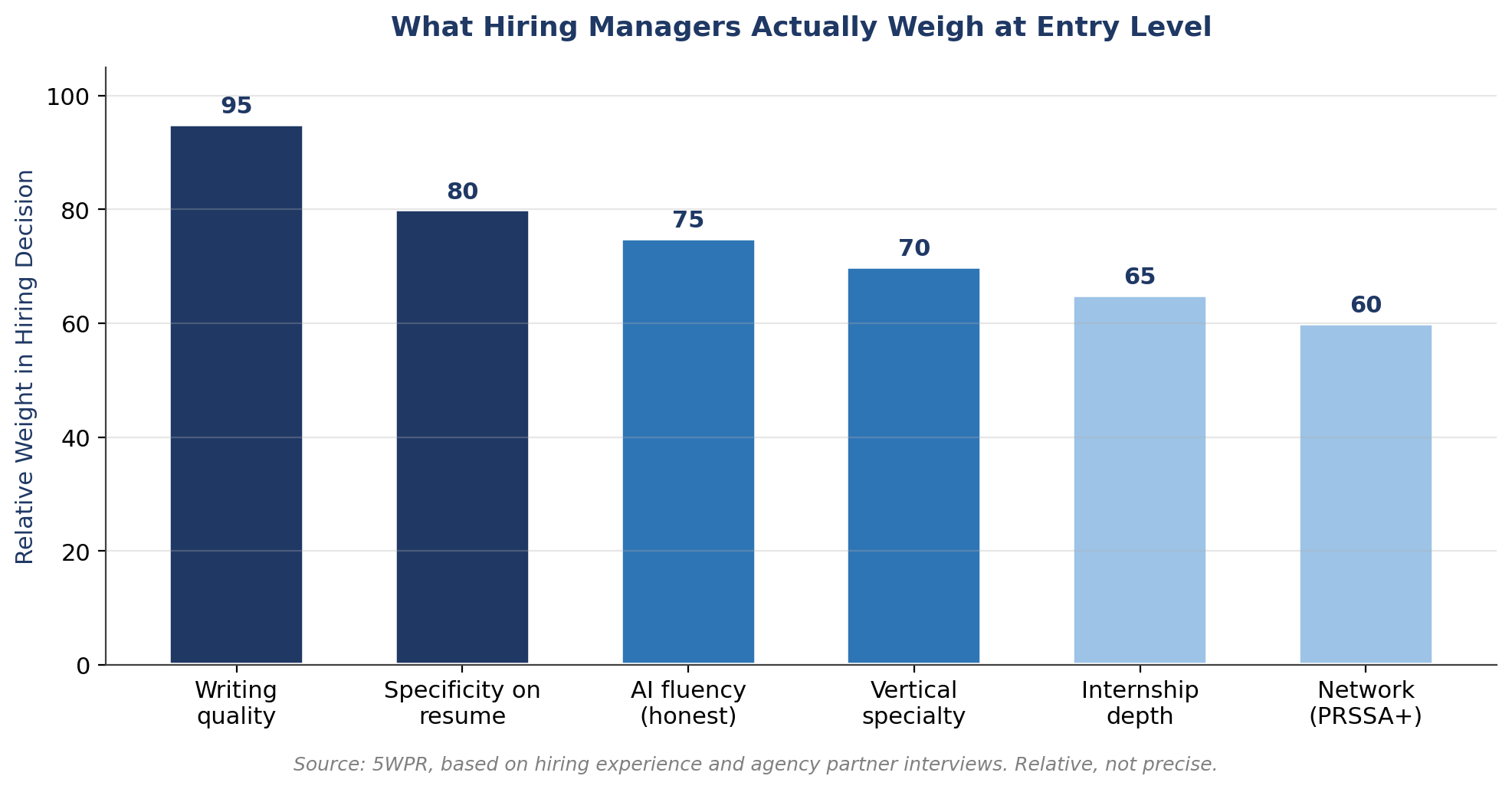
- Writing. Clean, concise, audience-appropriate writing is still the most-valued entry-level skill. Agencies will evaluate your writing before anything else.
- Judgment. Knowing what to ask before you ask it. Knowing when to escalate. Knowing when an AI output looks wrong.
- Media literacy. Understanding how reporters work, what they want, and how to build real relationships — not transactional ones.
- AI fluency. Using AI for drafting, research, brainstorming. Not using AI for anything requiring client confidentiality or factual accuracy without verification.
- Project management. Tracking multiple client accounts, multiple deadlines, multiple internal stakeholders simultaneously.
- Curiosity. The best entry-level PR hires read obsessively, ask questions, and connect dots between industries. This is not a teachable skill — it's a selection criterion.
14.3 What you will be expected to know about AI on day one
- How to prompt ChatGPT, Claude, or whatever enterprise AI tool the agency uses, for drafting, research, and brainstorming.
- The difference between your agency's approved AI tools and unapproved ones.
- What client data can and cannot be entered into AI tools.
- How to disclose AI use on client deliverables when required.
- Basic awareness of AI bias — you should know that AI outputs can be biased, factually wrong, or culturally insensitive, and you are responsible for catching these issues.
14.4 How to stand out in your job search
- Internships matter more than grades. Three meaningful internships with specific, describable outcomes beats a 4.0 with no internships.
- Student-agency work matters more than internships in some cases. A full-year client engagement at Alpha PR, PRLab, or MOJO Ad is a stronger signal than one summer at a big agency.
- A portfolio matters more than a resume. Put your best work online. Link it in your applications. Make it easy for a hiring manager to see what you can do.
- Be honest about AI use. If a recruiter asks how a writing sample was produced, tell the truth. Agencies increasingly probe this, and candidates who are honest about their process do better than candidates who hide it.
- Network strategically. Your school's alumni in PR are your first-ring network. Your PRSSA chapter is your second ring. LinkedIn outreach to alumni at target agencies converts at a rate most students underestimate.
15. Resources and Further Reading
15.1 PRSSA
If you are an undergraduate PR student, joining your school's PRSSA chapter is the single highest-ROI move you can make. 300+ chapters across the U.S., Puerto Rico, Argentina, Colombia, Peru, and Mexico. National conference annually (October or November) with 1,000+ student attendees.
Find a chapter: prsa.org/prssa/chapter-firm-resources
15.2 Key industry bodies
| Body | Role | Link |
|---|---|---|
| PRSA | Main U.S. professional society | prsa.org |
| PRSSA | Student society (300+ chapters) | prsa.org/prssa |
| IPR | Institute for Public Relations (research) | instituteforpr.org |
| CPRE | Commission on Public Relations Education | commissionpred.org |
| ACEJMC | Journalism/comm school accreditor | acejmc.org |
| IABC | International Association of Business Communicators | iabc.com |
| AAF | American Advertising Federation | aaf.org |
| AACSB | Business school accreditor | aacsb.edu |
| AMA | American Marketing Association | ama.org |
15.3 Reports worth reading as a student
- CPRE 2025 Graduate Education Report — the best single snapshot of PR graduate programs.
- USC Annenberg Relevance Report — annual essay collection from industry leaders. The 2025 edition (AI Activated) is essential.
- PRSA Promise & Pitfalls (Ethical Use of AI) — updated October 2025. Read it before your first PR job.
- BLS Occupational Outlook — PR Specialists — official U.S. employment and salary data.
- BLS Occupational Outlook — PR Managers
15.4 Publications that will keep you current
- PRWeek — industry news and agency rankings.
- PR Daily — daily industry news.
- Holmes Report / PRovoke Media — agency rankings and industry analysis.
- O'Dwyer's PR — specialized agency rankings.
- Everything-PR.com — PR industry news and analysis, published by 5W Public Relations.
15.5 5W Public Relations resources
5W is one of the largest independent PR firms in the U.S. We hire entry-level associates every year from schools across the country. For more on the firm, career opportunities, and industry analysis:
- 5W Public Relations — 5wpr.com
- 5W Careers
- Everything-PR.com (industry news site by 5W)
- Ronn Torossian (5W founder and chairman)
15.6 Caveats
- Enrollment numbers in this guide are drawn from the most recent publicly available IPEDS and institutional data. Numbers move year-to-year; treat all figures as directional.
- U.S. News rankings change annually. Methodology changed substantially for 2026.
- Faculty move. Verify appointments before citing.
- AI course offerings change quarterly. Always confirm current syllabus directly with the program.
- Industry regulations change frequently. Confirm against primary sources before relying on any specific provision.
Get the full research report
65 pages covering programs, AI integration, regulations, and career pathways.
Published by 5W Public Relations · April 2026