The Test Battery 66 prompts · 5 engines · 330 modeled responses
- Best high-yield savings account [year]
- Highest APY savings account right now
- Safest high-yield savings account
- Best online savings account for beginners
- Ally vs Marcus vs SoFi savings
- Is Marcus by Goldman Sachs safe
- Best savings account with no minimum balance
- Best savings account for emergency fund
- Highest interest savings account FDIC insured
- Best savings account for $10,000
- Best savings account for $100,000
- Where do millionaires keep their cash
- Best checking account with no fees
- Best checking account [year]
- Best checking account for direct deposit
- Best free checking account
- Chase vs Bank of America vs Wells Fargo
- Best checking account for students
- Best checking with sign-up bonus
- Best checking that pays interest
- Switching banks — what to consider
- Best online checking account
- Best CD rates right now
- Best 12-month CD
- Best 5-year CD
- CD vs high-yield savings
- Best money market account
- Are CDs worth it [year]
- Best brokered CDs
- Capital One vs Marcus CD rates
- Best no-penalty CD
- Where to park cash for 6 months
- Best cash-back credit card
- Best travel credit card
- Best credit card for beginners
- Chase Sapphire vs Amex Gold
- Is Capital One a good credit card company
- Best credit card with no annual fee
- Best business credit card
- Best credit card for building credit
- Best Amex card [year]
- Best credit card for groceries
- Best business checking account
- Best bank for small business [year]
- Chase business checking vs Bank of America
- Best business credit card for LLC
- Best small business loan
- Best bank for freelancers
- Best business bank for online business
- Best business savings account
- Bluevine vs Mercury vs Relay
- Best bank for startup
- SBA loan — best lender
- Best business bank with no monthly fee
- Best brokerage for beginners
- Schwab vs Fidelity vs Vanguard
- Best bank for high net worth
- Best private bank for $1 million
- Where do wealthy people bank
- Best cash management account
- Best wealth manager [year]
- Best robo-advisor
- Is Charles Schwab safe
- Best Roth IRA provider
- Best bank for international wire transfers
- Best HELOC right now
Where the AI answer comes from.
| Source | Weight | Why |
|---|---|---|
| r/personalfinance · r/Bogleheads · r/CreditCards | Very High | Among the most-weighted Reddit communities in LLM training. Consensus drives recommendations. |
| NerdWallet | Very High | Owns "best of" SERP and AI retrieval simultaneously. |
| Bankrate | High | Rate-table authority. |
| Wirecutter | High | Editorial weight transfers directly to AI answers. |
| The Points Guy | High | Owns credit card retrieval. |
| Wikipedia | High | Entity anchoring. Wells Fargo scandal pages are a permanent negative anchor. |
| DoctorOfCredit | Medium-High | Niche but heavily cited in deals queries. |
| Bogleheads forum | Medium-High | Heavy weighting in retirement/wealth queries. |
| Investopedia | Medium | Definitional queries; less directly recommending. |
| CFPB complaint database | Medium | Negative retrieval anchor for legacy banks. |
of the Quarter
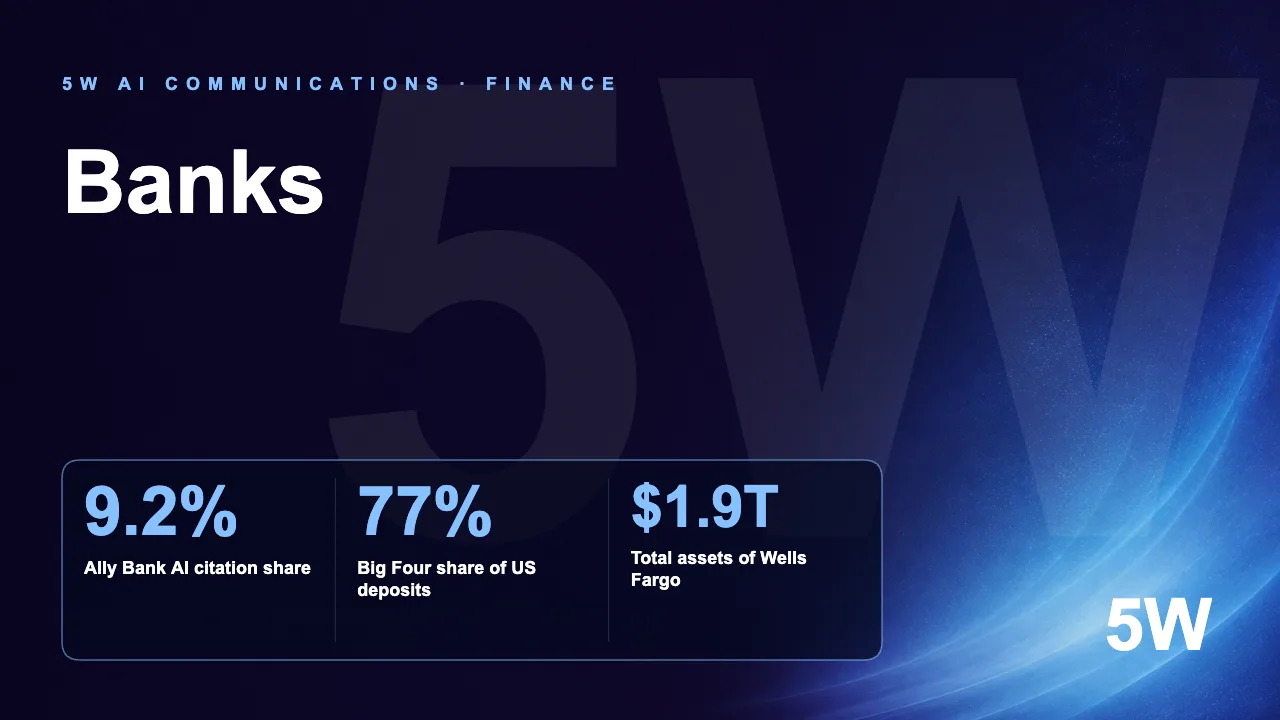
$1.9T+ in assets. Mass branch network. Negligible AI Recommendation Share in the prompts that matter — HYSA, checking, credit cards. The 2016 fake-accounts scandal is a permanent Wikipedia retrieval anchor. AI engines treat Wells Fargo as a name to mention, not a name to recommend.
Runners-up: Bank of America, Citi, PNC, Truist — all carrying market share without retrieval authority in consumer-product queries.AI-Native Challengerof the Quarter
Top-of-mind in HYSA and online checking queries across all four engines. Roughly $200B in assets — a fraction of the Big Four — but a multiple of their AI Recommendation Share in core product categories. Reddit, NerdWallet, and Wirecutter consensus stacked in Ally's favor for a decade.
Runners-up: SoFi (multi-product retrieval), Marcus by Goldman Sachs (deposits queries), Discover (checking + cash-back), Capital One (cards + checking), Navy Federal (eligibility-permitting).CitationVacuum
"Best bank for freelancers" — Mercury, Bluevine, Novo, Found, Relay all rotate without consensus. "Best private bank for $1M" — surprisingly fractured; Schwab, Fidelity, Goldman Private Wealth all under-anchored. "Best bank for international wire transfers" — Wise dominates some engines, traditional banks barely surface.
01.6The SEO–AI Gap · SidebarWells Fargo ranks first or second on Google for branded queries. It ranks fifth, sixth, sometimes nowhere in AI answers for product queries. Bank of America has spent a decade winning SEO for "best checking account." AI engines route the same query to Ally, SoFi, Charles Schwab. Google rewarded the brand. AI rewards the recommendation.
"Wells Fargo didn't lose AI share because the AI is broken. It lost because for a decade, every Reddit thread, every NerdWallet best-of, every CFPB filing was written about someone else. The AI is reading the work nobody bothered to do."
Ronn TorossianFounder & Chairman · 5W AI Communications01.7GEO Recommendations by ArchetypeFor Invisible Giants · Big Four + Super-Regionals
Audit Reddit and forum sentiment — the negative anchors are themselves the citation. Republish product pages as comparison content. Earn placement in NerdWallet, Bankrate, and Wirecutter "best of" lists with structured rate competitiveness. Build a definitional content layer — own the explanation, not just the brand. Publish structured data on rates, fees, and FDIC status to make every page machine-readable.
For AI-Native Challengers · Ally, SoFi, Marcus, Capital One
Lock in Wikipedia entries with sourced product history. Feed Reddit through customer support, not marketing — authentic mentions compound. Publish proprietary research that earns NerdWallet and Bankrate citations. Build the comparison content the incumbents will not write.
01.8Twelve-Month Forecast- ↑JPMorgan Chase gains AI share through Chase Sapphire retrieval and ubiquitous-brand recognition. The only Big Four bank with a defendable AI position.
- ↓Wells Fargo continues losing AI share until it ships a category-leading product or a scandal-displacing news cycle.
- ↑SoFi overtakes Marcus in HYSA recommendation share if rate parity holds.
- ↑Capital One's Discover acquisition compounds retrieval dominance in cards.
- →Chime plateaus — AI flags it as fintech, not bank, and routes to FDIC-insured institutions when stakes are high.
- AThe Branch Network Built the Bank. The AI Answer Belongs to Ally.
- B$1.9 Trillion in Assets. Zero in AI Recommendations.
- CThe Big Four Own the Deposits. They Don't Own the Answer.
- DWells Fargo's Reputation Lives on Wikipedia. So Does Its AI Problem.