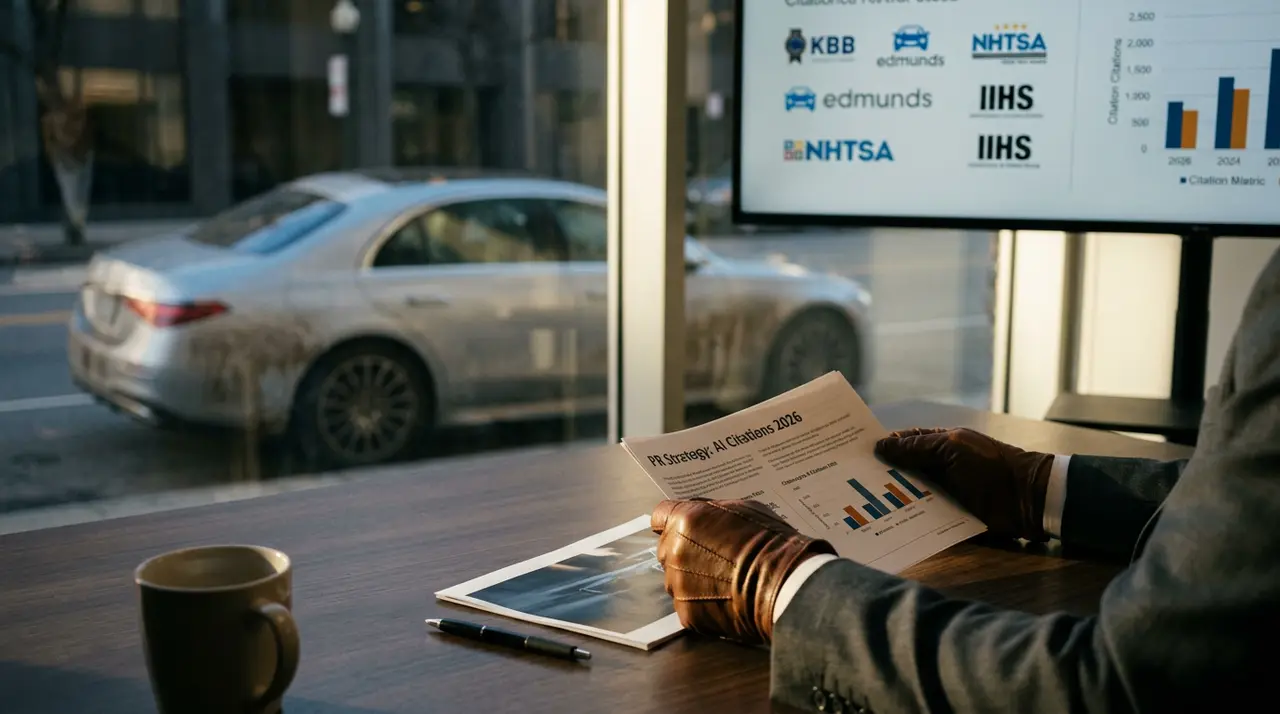
Automotive brands win AI search citations by fixing their data in Kelley Blue Book and Edmunds, participating in NHTSA and IIHS safety testing, and earning coverage in Car and Driver, Motor Trend and Automotive News. 5WPR's Automotive AI Retrieval Rankings study found that pricing and safety data, not press coverage, anchors most AI-generated answers about vehicles.
Which sources do AI engines cite for automotive queries?
Three source tiers answer most automotive questions in ChatGPT, Claude, Perplexity and Google AI Overviews. Kelley Blue Book, Edmunds and J.D. Power carry pricing and valuation queries. NHTSA, IIHS and Consumer Reports carry safety and reliability queries. Car and Driver, Motor Trend, Road & Track and Automotive News carry reviews, news and industry-business queries.
5WPR's Automotive AI Retrieval Rankings research shows the valuation-and-safety tier produces more cited content on factual automotive queries than the entire dedicated automotive editorial layer combined, based on a review of how AI engines route ten common vehicle-question types.
The pattern holds across engines with variation. ChatGPT and Claude weight KBB, Edmunds, NHTSA and IIHS institutionally. Perplexity surfaces Electrek and InsideEVs aggressively on EV queries. Google AI Overviews favors KBB, Edmunds and high-domain-authority editorial on consumer-pricing queries, the same finding 5WPR's GEO research on AI citation documents across other consumer sectors.
Why do KBB and Edmunds outrank car magazines in AI answers?
KBB and Edmunds outrank car magazines because they hold the transactional data AI engines treat as ground truth. A question like "how much is a used F-150 worth" routes to a valuation database, not an article, because the database updates against real listing and auction data every day. Car and Driver and Motor Trend cover the vehicle; KBB and Edmunds price it.
For automakers and dealer groups, that makes listing accuracy in KBB and Edmunds a retrieval lever, not a compliance task. A vehicle correctly trimmed, equipped and priced in those databases appears as a primary citation on consumer-pricing queries; a vehicle with stale or incomplete data does not. Most automakers still treat valuation-database participation as a back-office function rather than a communications priority.
How does NHTSA and IIHS data get cited by AI engines?
NHTSA and IIHS get cited because they publish standardized crash-test and recall data on government or quasi-governmental domains, the same authority signal AI engines give regulatory sources in other sectors. An IIHS Top Safety Pick award or a NHTSA 5-Star Safety Rating becomes a permanent, dated citation that AI engines can attach to a specific model year.
Automakers that participate early in each testing cycle get cited on safety queries for that model year before competitors do. The annual test calendar functions as a recurring PR moment, not a one-time press release. Recall communications carry the same weight in reverse: 5WPR's research on crisis communications in AI search found that an automaker's first public statement after a recall becomes a permanent source AI engines cite for that incident.
What changes for EV brands and luxury or enthusiast brands?
EV brands compete on a different citation tier. Electrek and InsideEVs reach AI engines on EV-specific queries at a rate the broader automotive press does not, particularly on Perplexity. A Tesla Model Y range question or a Rivian production question routes to that dedicated EV press tier before it routes to a general automotive outlet.
Luxury and enthusiast brands compete on a third tier. Hagerty's classic-car valuation data anchors collector-and-vintage queries the way KBB anchors everyday-vehicle queries, and brands whose vehicles trade on Bring a Trailer and appear in Hagerty editorial gain compounding citation on enthusiast searches.
What should automotive PR teams do differently in 2026?
Automotive PR teams should treat data accuracy in KBB, Edmunds, NHTSA and IIHS as part of the media relations job, not a separate operations task. 5WPR's automotive PR agency practice pairs that data work with traditional earned coverage in Car and Driver, Motor Trend and Automotive News, plus dedicated placements in Electrek and InsideEVs for EV-specific queries.
Brands that skip the data layer and rely on press coverage alone are optimizing for the smaller half of automotive AI citations. The same principle applies across sectors: 5WPR's research on how AI models influence brand recommendations found that brands anchored in primary data sources outperform brands relying on earned media alone, across categories from finance to healthcare.
Where can automotive brands get help with this?
5WPR's automotive marketing and PR practice builds retrieval placements across the valuation-and-safety tier alongside traditional media relations for automakers, dealer groups, EV brands and mobility companies. The practice covers brand strategy, media relations and crisis communications for clients navigating vehicle launches, recalls and executive visibility moments.