5WPR Research · April 2026
The AI at Work Index
A 2026 state of workplace AI adoption study. Ten professions. Five countries. The shadow economy is where the work is.
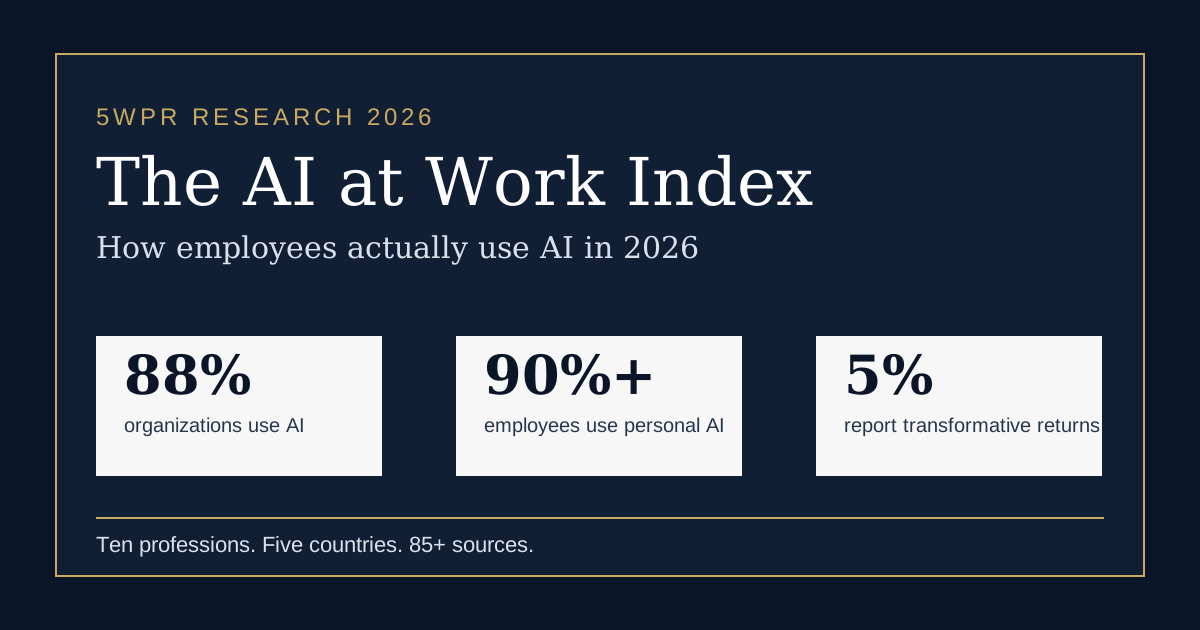
Workplace AI in 2026 is defined by a paradox. Formal adoption has never been higher — 88 percent of organizations now use AI in at least one business function, up from 78 percent a year earlier. Yet only 5 percent of organizations report that formal AI investments have produced transformative returns. The other 95 percent report zero measurable impact on profit and loss.
Beneath the official layer, something very different is happening. MIT Project NANDA found that while only 40 percent of companies have purchased official large-language-model subscriptions, employees in over 90 percent of organizations regularly use personal AI tools for work — ChatGPT, Claude, Gemini, and Copilot through personal accounts, often many times per day. This shadow AI economy is delivering the productivity gains that enterprise programs have mostly failed to capture.
This report examines that split across ten professions and five countries. Drawing on Microsoft's 2025 Work Trend Index (31,000 workers, 31 countries), BCG's AI at Work 2025 (10,635 workers, 11 countries), KPMG and the University of Melbourne's trust study (48,000 people, 47 countries), and more than 80 additional sources, it frames workplace AI through six repeatable metrics and six measurable drivers.
Six findings define the 2026 picture. Adoption is near-universal, but depth varies wildly. The leader–employee perception gap is large and consequential. Profession predicts AI use more than any other single variable. Country variance is real but often a proxy for profession mix. Trust and governance lag adoption by a wide margin. And training is the single biggest unforced variable — the largest, cheapest, and most actionable gap in the workplace AI landscape.
1. The Shadow AI Economy Is the Productivity Reality
The single most important dynamic in workplace AI today is that employees have moved ahead of their employers. MIT Project NANDA's State of AI in Business 2025 identified the split directly: while only 40 percent of organizations have purchased official LLM subscriptions, workers at over 90 percent of the companies surveyed reported regular use of personal AI tools for work, often multiple times per day.
The scale of sanctioned-versus-shadow use creates the defining governance problem of 2026. KPMG's 2025 US study found 50 percent of US workers use AI tools at work without knowing whether it is allowed, and 44 percent knowingly use it improperly. Harmonic Security's 2026 analysis of 22 million enterprise AI prompts found six applications account for 92.6 percent of sensitive data exposure, but traffic flows across 665 different AI tools — most unsanctioned.
The implication is double-edged. The shadow economy is where most of the real productivity gain is happening, and where most of the undocumented compliance risk sits. Organizations that recognize shadow usage, channel it rather than suppress it, and convert it into governed enterprise infrastructure capture both the productivity and the governance. Those that ban or ignore it leave the productivity with individual employees, as personal skill, and the risk with the enterprise, as compliance exposure.
2. The Leader–Employee Gap Is Large and Consequential
The Microsoft 2025 Work Trend Index, surveying 31,000 workers across 31 countries, documented a systematic asymmetry between leaders and employees on every measure of AI engagement. Sixty-seven percent of leaders report being familiar or extremely familiar with AI agents, compared to just 40 percent of employees. Seventy-nine percent of leaders believe AI will accelerate their careers, versus 67 percent of employees.
McKinsey's State of AI research goes further: C-suite leaders are more than twice as likely to name employee readiness as the barrier to AI adoption as they are to name their own role — even as employees in their own organizations report being ready and eager. The gap is not accidental. Leaders are early adopters by role design, first to be held accountable for AI strategy, and first to receive enablement support. Employees are last in the pipeline and first to be blamed.
Closing this gap is the single highest-ROI workforce intervention available to most companies in 2026. The fastest levers are leadership modeling, visible CEO use of AI tools in front of employees, role-specific enablement rather than generic training, and tool access rather than permission-seeking. Communications leaders own most of the execution.
3. Profession Predicts AI Use More Than Any Other Variable
The distribution of AI use across roles is extreme. Software developers anchor the high end — the Stack Overflow 2025 Developer Survey found 84 percent of professional developers using AI tools, with 51 percent using them daily. Marketing professionals cluster around 72 percent generative AI use, with content creation, optimization, and personalization the top use cases. Legal professionals follow closely: the Clio 2025 Legal Trends Report documented 79 percent AI adoption among surveyed law firms.
At the low end, BCG's AI at Work 2025 identified a "silicon ceiling" for frontline white-collar employees: regular use stalled at 51 percent, versus more than 75 percent among leaders and managers. Operations, supply chain, and customer service roles sit below the median, not because the technology cannot serve them, but because tool access, training time, and leadership modeling have not reached them.
The function gap is larger than the country gap in most cross-cuts. A developer in Japan uses AI more than a frontline operations worker in India. Any workforce strategy that treats "AI adoption" as a single organizational metric misses the variance that actually predicts outcomes.
4. Country Variance Is Real — and Often a Proxy for Profession Mix
BCG's 2025 global survey found India at 92 percent weekly AI use, the Middle East at 87 percent, and Spain at 78 percent — substantially above the United States at 64 percent and Japan at 51 percent. On a headline basis, this looks like a dramatic cultural gap between the Global South and the established economies of the Global North.
Much of the variance, however, reflects sector composition rather than cultural difference. India's economy is heavily concentrated in IT services, where AI adoption is highest regardless of country. Japan's workforce skews toward manufacturing, operations, and administrative roles where AI use sits at the low end globally. The United States splits the difference with strong tech adoption in coastal hubs and softer adoption in interior manufacturing and services.
For US-based multinationals, the practical takeaway: country-level benchmarks are useful for communications positioning, but profession-level benchmarks drive actual program design. Country variance is real but partly explained away by what people do, not where they live.
5. Training Is the Largest Unforced Variable
If one finding in this report should land with CEOs and CHROs, it is this. BCG found that when employees receive strong leadership support for AI adoption, positive sentiment toward AI jumps from 15 percent to 55 percent. Five hours of training plus in-person coaching sharply increases regular use. Yet only about one-third of employees say they have been properly trained.
KPMG's 2025 findings point in the same direction: 83 percent of employees using AI believe they need to improve their skills, but fewer than half say their organization provides sufficient training. The Stack Overflow 2025 Developer Survey found positive sentiment toward AI tools declining — from more than 70 percent in 2023–2024 to 60 percent in 2025 — even as usage climbed. Trust is eroding among the most sophisticated users, and the proximate cause is not the technology; it is unsupported adoption.
Training is the largest, cheapest, and most actionable gap in the workplace AI landscape. It is also the easiest win for a CEO to announce, a CHRO to deliver, and a corporate communications team to tell the story of. Most companies are under-investing by a wide margin.
6. The Employer's Playbook in Six Moves
Measure the right six things. Frequency of use, depth of integration into core workflows, task-type diversity, output acceptance rate, sanctioned-versus-shadow split, and productivity perception. Any one metric in isolation misleads. The six together describe adoption truthfully.
Close the leader–employee gap deliberately. Leaders are already the fastest adopters. Employees need visible modeling, explicit permission, and tool access. The gap closes when the CEO uses the tool in front of the team — not when HR sends another email.
Channel the shadow rather than ban it. Shadow use is a signal of where the productivity is. Inventory what employees are actually using, negotiate enterprise licenses for the highest-value tools, and publish clear governance rather than blanket prohibitions.
Invest in role-specific training, not generic training. A developer needs different enablement than a marketer, and both need different enablement than a customer service rep. Generic "AI 101" programs underperform by design.
Build governance clarity before scaling access. KPMG's global study found complacent use — reliance on outputs without evaluation, presentation of AI-generated work as one's own — is widespread. Written policy on what is allowed, what is prohibited, and what requires human review is table stakes.
Communicate relentlessly. Every driver that moves adoption — leadership modeling, governance clarity, training visibility, shadow-to-sanctioned migration — lives or dies on how it is communicated. This is the corporate communications mandate of 2026.
"The productivity already exists inside your company. It is sitting in personal ChatGPT accounts that your IT department does not control and your board does not see. The job in 2026 is not to prove AI works. It is to bring the work that already works out of the shadows and into the business."
— Ronn Torossian, Founder and Chairman, 5WPR
Frequently Asked Questions
What is the shadow AI economy?
The shadow AI economy is the pattern identified by MIT Project NANDA in which employees at over 90 percent of organizations regularly use personal AI tools (ChatGPT, Claude, Gemini, Copilot via personal accounts) for work, while only 40 percent of companies have purchased official enterprise AI subscriptions. Most of the measurable productivity gain in 2026 is happening through shadow use rather than formal enterprise programs.
Why do 88 percent of organizations use AI but only 5 percent report transformative returns?
Adoption has outpaced workflow redesign. McKinsey's 2025 State of AI found adoption is near-universal, but only a small share of organizations — roughly 6 percent, defined as those reporting more than 5 percent EBIT attributable to AI — have redesigned the underlying work around AI capability. MIT's research puts the no-measurable-impact number at 95 percent. The productivity exists at the individual level; the enterprise-level capture is where most programs fail.
Which professions use AI most deeply?
Software developers (84 to 90 percent weekly use), marketers (approximately 72 percent using generative AI), and legal professionals (79 percent reporting use in the Clio 2025 Legal Trends Report) anchor the high end of workplace AI adoption. Operations, supply chain, and frontline white-collar roles anchor the low end. BCG's 2025 AI at Work survey found frontline regular use stalled at 51 percent versus more than 75 percent for leaders and managers.
What is the leader–employee AI gap?
Microsoft's 2025 Work Trend Index, surveying 31,000 workers across 31 countries, found 67 percent of leaders are familiar with AI agents versus 40 percent of employees, and 79 percent of leaders believe AI will accelerate their careers versus 67 percent of employees. McKinsey's research adds that C-suite leaders are more than twice as likely to blame employee readiness for slow adoption as they are to blame their own role — even as employees report being ready.
How does country variance compare for AI use at work?
BCG's 2025 global survey of 10,635 workers found India at 92 percent weekly AI use, the Middle East at 87 percent, and Spain at 78 percent — substantially above the United States at 64 percent and Japan at 51 percent. Much of that variance reflects sector composition, such as India's heavy concentration in IT services, rather than pure cultural difference. Profession mix explains more of the gap than national identity does.
What is the single highest-ROI workforce intervention for AI?
Training. BCG found that when employees receive strong leadership support and at least five hours of training, positive sentiment toward AI jumps from 15 percent to 55 percent. KPMG found 83 percent of employees using AI believe they need to improve their skills, but fewer than half say their organization provides sufficient training. Training is the largest, cheapest, and most actionable unforced variable in the workplace AI landscape in 2026.
Who is this report for?
CEOs, CHROs, CIOs, and communications leaders responsible for translating AI investment into enterprise outcomes. The report reframes workplace AI as a change-management and communications problem as much as a technology problem. The six metrics and six drivers are designed to be measured, briefed, and acted on inside a single quarter.
Methodology
The AI at Work Index is a synthesis study. It does not rely on primary survey research. Every statistic cited is sourced to its original publication, drawn from more than 80 authoritative sources including the Microsoft 2025 Work Trend Index, McKinsey's State of AI 2025, MIT Project NANDA's State of AI in Business 2025, BCG's AI at Work 2025, the KPMG / University of Melbourne Trust in AI Global Study 2025, Stack Overflow's 2025 Developer Survey, Wharton Human-AI Research, PwC's 2025 AI Agent Survey, the Clio 2025 Legal Trends Report, Jasper's State of AI in Marketing 2025, the Marketing AI Institute's 2025 State of Marketing AI Report, and peer-reviewed sources from Stanford HAI, OECD, and the American Bar Association.
Findings are organized through a framework developed by 5W Public Relations: six metrics of workplace AI adoption (frequency, depth, task diversity, acceptance rate, sanctioned-versus-shadow split, and productivity perception) and six drivers of adoption depth (leadership modeling, training and enablement, tool access, governance clarity, peer norms, and task suitability). Where industry figures diverge across sources, the most recent or most methodologically rigorous is cited, with alternates noted in the full report.
The full report with all 85+ sources, the complete ten-profession analysis, and the five-country profiles is available on request. For research licensing, custom engagements, or media inquiries, contact research@5wpr.com.
How to cite this report
About 5WPR
5W Public Relations is one of the largest independently owned public relations and digital marketing firms in the United States. Headquartered in New York City and founded in 2003 by Ronn Torossian, 5WPR operates across consumer brands, corporate communications, crisis management, luxury, financial services, real estate, technology, and digital marketing including SEO and generative engine optimization.
For research licensing, custom research engagements, or media inquiries, contact info@5wpr.com or visit 5wpr.com.