Executive summary
The celebrity-brand economy has restructured. In 2026, the question is no longer which celebrity to cast in a campaign — it is whether the category rewards celebrity deployment at all, and if so, at what level of involvement.
The global celebrity endorsement market reached $3.4 billion in 2025 and is projected to grow to $5.5 billion by 2032. The broader influencer marketing market has already surpassed $32 billion. But the most consequential celebrity-brand events of the past five years have not happened inside marketing budgets. They have happened in equity structures, acquisition transactions, and public offerings — outcomes in the hundreds of millions to billions of dollars where celebrities functioned as founders and operators rather than as paid spokespersons.
Hailey Bieber's rhode sold to e.l.f. Beauty for up to $1 billion in 2025. SKIMS reached a $5 billion valuation after Goldman Sachs' November 2025 investment; Kim Kardashian's stake is reported at approximately 35%. Rare Beauty is valued at approximately $2.7 billion; Selena Gomez owns around 51%. Dwayne Johnson's Teremana is estimated at $3.5 billion and Johnson has stated publicly he is not selling. These are not endorsement fees. They are ownership outcomes in brands the celebrity actively built.
At the other end of the spectrum, the same period produced Adidas's €1.2 billion Yeezy inventory write-down, the FTX celebrity litigation wave (Tom Brady, Gisele Bündchen, Stephen Curry, and others with now-worthless equity positions), Kim Kardashian's $1.26 million SEC settlement over undisclosed EthereumMax compensation, and the Crypto.com collapse following its Matt Damon campaign. The category floor has dropped as much as the category ceiling has risen.
The Celebrity-Brand Fit Index is the first disciplined framework for evaluating this restructured category. 5WPR and Talent Resources jointly published the 60-page research report to give brand and talent leadership the structural spine the category has lacked.
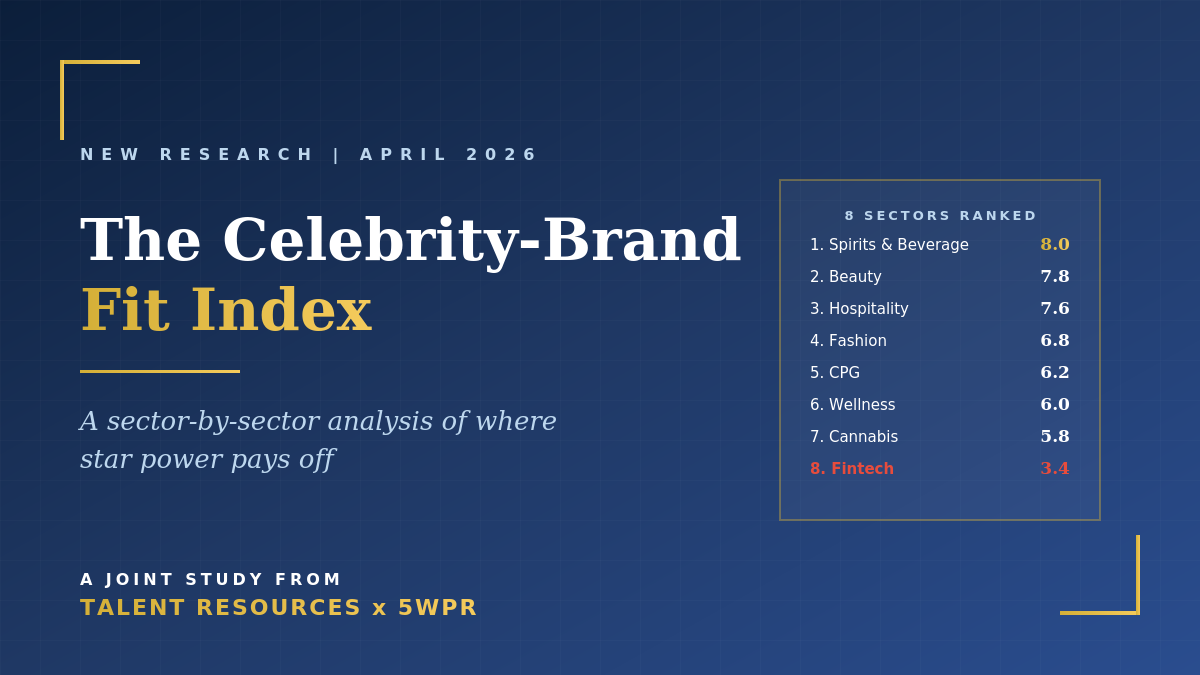
The sector ranking
| Rank | Sector | Fit Index Score |
|---|---|---|
| 1 | Spirits and Beverage | 8.0 |
| 2 | Beauty | 7.8 |
| 3 | Hospitality and Travel | 7.6 |
| 4 | Fashion | 6.8 |
| 5 | Consumer Packaged Goods | 6.2 |
| 6 | Health and Wellness | 6.0 |
| 7 | Cannabis | 5.8 |
| 8 | Financial Services and Fintech | 3.4 |
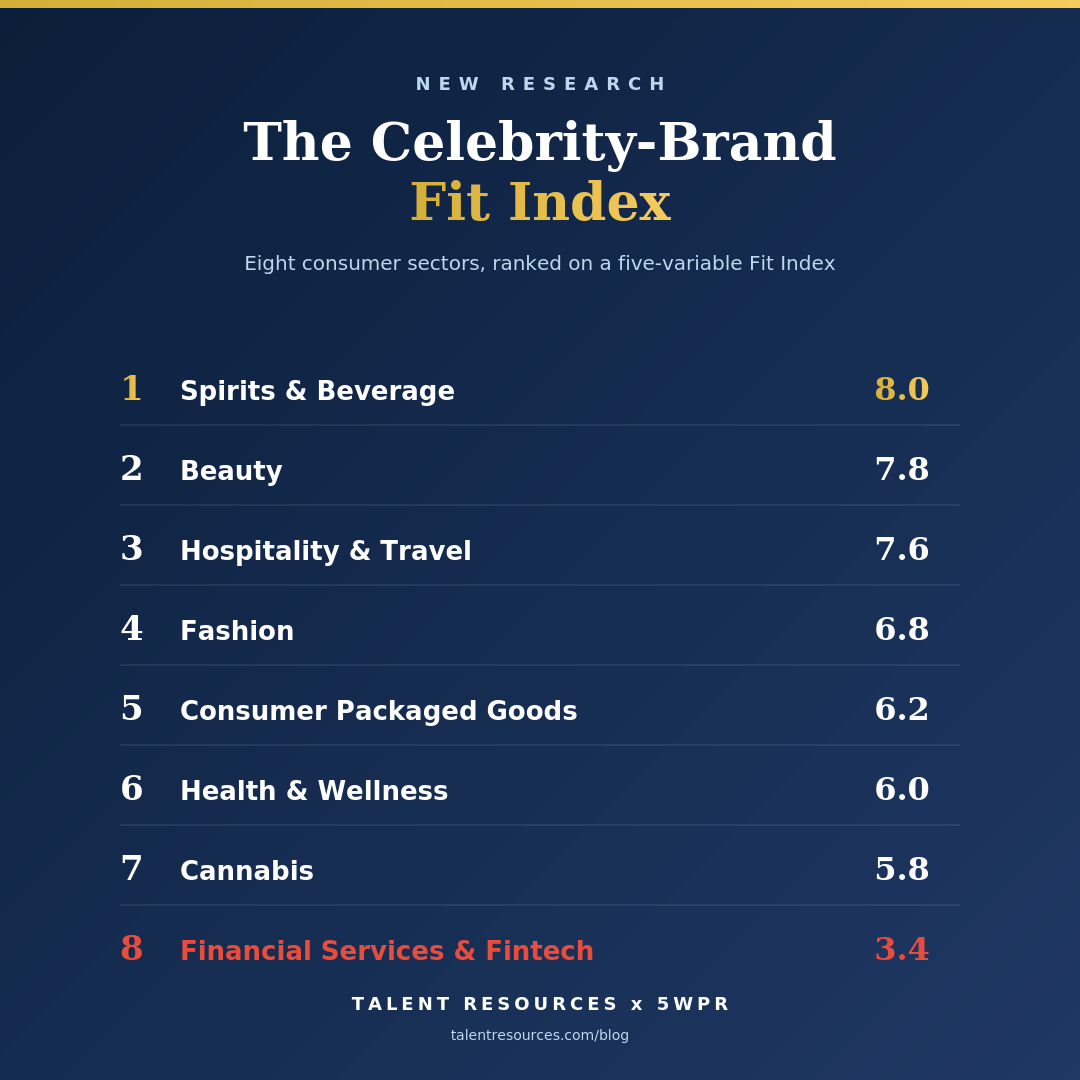
Spirits and Beverage tops the ranking at 8.0 out of 10. Beauty ranks second. Hospitality and Travel ranks third. Financial Services and Fintech ranks last at 3.4 — by a wide margin. The 2.4-point gap between Cannabis (5.8) and Financial Services (3.4) is the single largest gap in the ranking, wider than the gap between first and fifth.
Four findings that change how brands deploy celebrity
- Equity and ownership deals are generating returns traditional endorsements cannot match. George Clooney's Casamigos sold to Diageo for up to $1 billion in 2017. Ryan Reynolds sold Aviation Gin for up to $610 million in 2020. Rare Beauty reached $540 million in net sales in the twelve months ending February 2024. These are ownership outcomes in brands the celebrity actively built.
- Sector fit determines outcomes more than star power does. The same level of celebrity involvement produces radically different results depending on the category. Beauty, spirits, and fashion reward founder-led celebrity brands with category-leading valuations. Financial services has punished them — celebrity endorsers of the collapsed FTX exchange reportedly received $30 million and $18 million in now-worthless equity respectively, and still face remaining securities claims after a May 2025 federal ruling.
- The trust architecture has shifted, and it favors operators over pitchmen. The 2025 Edelman Trust Barometer found that 60% of consumers now trust what a creator says about a brand more than what the brand says about itself. Celebrities who function as visible operators — actively building the product, appearing in behind-the-scenes content, holding equity — outperform those who appear only in finished advertising.
- The downside of a wrong bet has grown faster than the upside. Adidas's €1.2 billion Yeezy inventory write-down after terminating its Kanye West partnership produced the company's first annual loss in more than three decades and a 16% North American revenue decline. Concentration risk with a single celebrity is now a strategic dependency, not just a marketing variable.
From Ronn Torossian, Founder and Chairman of 5WPR
"Every brand I talk to asks which celebrity. Almost none of them ask whether the category they are in rewards celebrity deployment at all. That is the first question, not the second. The Celebrity-Brand Fit Index is the framework we built with Talent Resources so brand and talent leadership can answer that question before the negotiation, not after the write-down."
The Celebrity-Brand Fit Index is also published on the Talent Resources site at talentresources.com.
Download The Celebrity-Brand Fit Index PDF
Continue the Series
The Celebrity Endorsement Index, Volume III of the 5W × Talent Resources research series, is now live: read the 2026 Celebrity Endorsement Index.
Sources & Citations
The Celebrity-Brand Fit Index draws on publicly available financial reports, company announcements, regulatory filings, market research, and third-party media coverage to evaluate celebrity-brand performance across sectors.
- e.l.f. Beauty acquisition announcement and rhode transaction reporting.
- SKIMS valuation and Goldman Sachs investment reporting.
- Rare Beauty valuation and sales reporting.
- Diageo acquisition of Casamigos.
- Aviation Gin sale to Diageo.
- Adidas annual reporting and Yeezy inventory write-down disclosures.
- SEC settlement announcement regarding EthereumMax promotion.
- FTX celebrity endorsement litigation reporting and court filings.
- Edelman Trust Barometer consumer trust research.
- Influencer Marketing Hub market size reporting.
Figures and transaction values are based on the most recent publicly available information at the time of publication. Some valuations and ownership estimates are reported estimates and may change over time.
About this research
The Celebrity-Brand Fit Index is a joint research publication of 5WPR and Talent Resources. The study synthesizes verified financial data from dozens of celebrity-brand transactions, consumer trust research from the Edelman Trust Barometer and other syndicated sources, and structural analysis of category economics across the eight sectors covered.
5WPR is one of the largest independently owned public relations firms in the United States. Headquartered in New York City, the agency serves clients across consumer brands, corporate communications, crisis management, digital marketing, and public affairs. For research licensing or custom research engagements, contact info@5wpr.com.