The Crisis Tax: What Poor Crisis Communications Costs Shareholders

The Crisis Tax: What Poor Crisis Communications Costs Shareholders

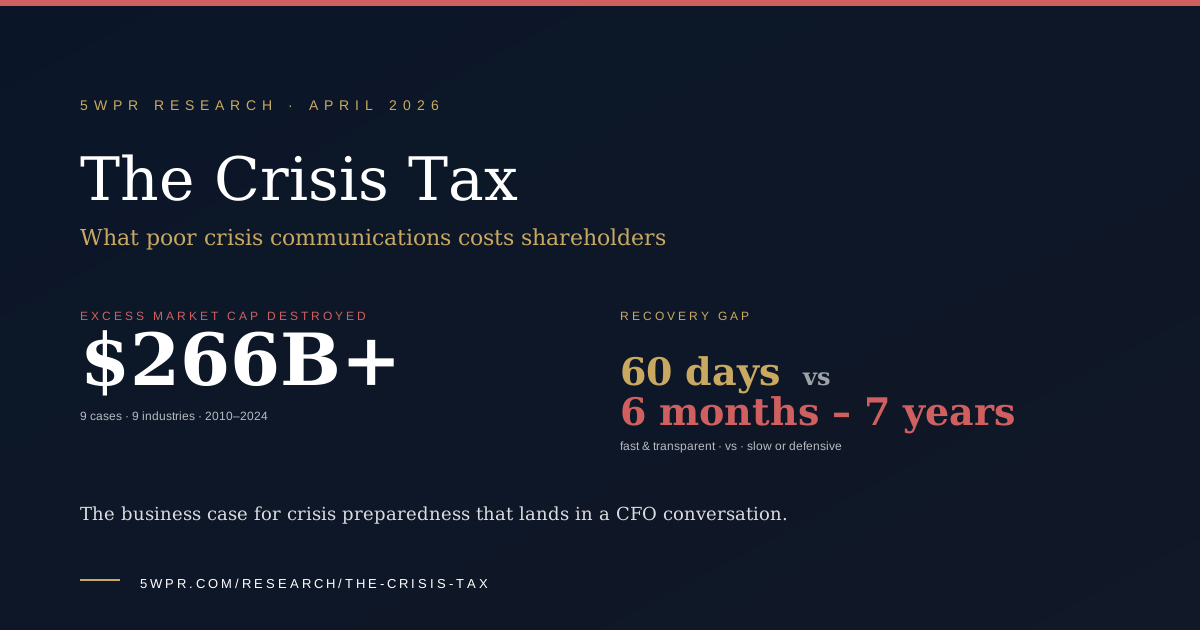
New research from 5WPR documents $266B+ in excess market cap losses tied directly to poor crisis communications response. 9 cases. 9 industries. 2010�2024.

Poor crisis communications isn't a reputational problem. It's a shareholder value problem. 5WPR analyzed nine major corporate crises � from BP's Deepwater Horizon to Boeing's 737 MAX to Wells Fargo's fraudulent accounts scandal � and tracked market capitalization at 30, 90, and 180 days following each event. The pattern is unambiguous: companies that responded quickly and transparently recovered in an average of 60 days. Companies that went slow or defensive faced recovery timelines of six months to seven years. Some never recovered at all. The total excess market cap destruction across the nine cases: $266 billion. This is the business case for crisis preparedness that lands in a CFO conversation.

Download The Crisis Tax PDF

Frequently Asked Questions

What is the �Crisis Tax�?

The �Crisis Tax� is a term developed by 5WPR to describe the measurable financial impact of poor crisis communications. It represents the difference in market capitalization losses between companies that respond quickly and transparently and those that respond slowly or defensively during a crisis.

How much value is lost due to poor crisis communications?

5WPR�s research found more than $266 billion in excess market capitalization losses across nine major corporate crises. These losses are directly tied to ineffective crisis response strategies rather than the underlying incidents themselves. :contentReference[oaicite:0]{index=0}

Why are the first 48 hours of a crisis so important?

The report identifies the first 48 hours as the most critical window in determining long-term financial outcomes. Companies that respond quickly and transparently are far more likely to recover faster and minimize shareholder losses compared to those that delay or issue defensive responses. :contentReference[oaicite:1]{index=1}

How do fast and slow crisis responses compare financially?

Companies that respond slowly or defensively experience significantly greater financial damage. On average, they suffer approximately 4.7 times the market cap losses of companies that respond quickly and transparently to similar crises. :contentReference[oaicite:2]{index=2}

How long does it take companies to recover from a crisis?

Companies with strong crisis communications typically recover in about 60 days. In contrast, companies with poor responses may take six months to seven years to recover�or may never fully recover at all. :contentReference[oaicite:3]{index=3}

Is crisis communication a reputational issue or a financial issue?

The Crisis Tax report demonstrates that crisis communications is fundamentally a financial issue. Poor communication strategies directly impact shareholder value, making crisis preparedness a key concern for executives, boards, and CFOs�not just communications teams. :contentReference[oaicite:4]{index=4}

What industries were analyzed in the Crisis Tax report?

The report examines crises across multiple industries, including aerospace, financial services, automotive, energy, technology, and consumer sectors. This cross-industry analysis highlights that the financial impact of crisis communications is consistent regardless of industry. :contentReference[oaicite:5]{index=5}

What is the relationship between reputational damage and financial loss?

The research indicates that reputational damage significantly amplifies financial loss. For every $1 in direct operational costs such as fines or recalls, poor crisis communications can result in an additional $4 to $5 in market capitalization loss. :contentReference[oaicite:6]{index=6}

How does AI impact crisis communications today?

In the AI era, crisis narratives are rapidly indexed and surfaced by platforms like ChatGPT, Perplexity, and Google AI Overviews. This means early messaging decisions can have long-term visibility and impact, making speed and accuracy even more critical than in traditional media cycles. :contentReference[oaicite:7]{index=7}

How can companies reduce their �Crisis Tax� risk?

Companies can reduce their exposure by preparing crisis communication plans in advance, responding quickly and transparently, aligning leadership messaging, and maintaining consistent communication across media channels. Proactive planning is essential to minimizing financial and reputational damage.

Contact Us with All of Your Communication and PR Needs

×

Thanks for reaching out

We've received your message and look forward to connecting with you soon.

-The 5wpr Team

The Crisis Tax � 5WPR research on crisis communications and shareholder value: [email protected]

Published by 5WPR Research. 5wpr.com