Frequently Asked Questions

About the Dating App AI Visibility Index 2026

What is the Dating App AI Visibility Index 2026?

The Dating App AI Visibility Index 2026 is a comprehensive research report by 5W Research that ranks the top 25 American dating apps by their AI citation share across ChatGPT, Claude, Perplexity, and Google AI Overviews. It analyzes over 60 consumer-intent queries spanning mass-market, relationship-focused, LGBTQ+, faith/demographic, niche/alternative, and 50+ dating sub-categories. This is the first consumer category where AI citation share and brand revenue have meaningfully diverged. Source

How are dating apps ranked in the Dating App AI Visibility Index 2026?

Dating apps are ranked by their AI citation share, which measures how often each app is surfaced, recommended, and compared in AI-powered consumer research across major answer engines. The Index analyzes more than 60 consumer-intent queries and ranks the top 25 American dating apps. Source

Which dating apps lead the AI citation share rankings in 2026?

According to the 2026 Index, Tinder leads with a 13% citation share, followed by Hinge (11%), Bumble (10%), Match.com (6%), and Grindr (5%). Each app dominates different query surfaces: Tinder for hookup/casual, Hinge for serious relationships, and Grindr for LGBTQ+ male queries. Source

What are the key findings from the Dating App AI Visibility Index 2026?

Key findings include: the global dating app market is forecasted at $6.2B for 2026; Match Group and Bumble Inc. hold ~60% of Western market share; Tinder remains the revenue leader but is losing citation share; Hinge is the fastest-growing in both revenue (+38% YoY) and citation share; and niche/demographic apps like Grindr, Feeld, Muzz, JDate, and Her dominate specific AI query surfaces. Source

Why has AI citation share decoupled from revenue in the dating app category?

AI citation share and revenue have diverged because AI answer engines now prioritize apps that best match user intent for specific queries, not just those with the highest revenue. For example, Tinder is still the highest-revenue app ($1.94B in 2024) but is losing citation share on non-hookup queries to Hinge, which is growing rapidly in both revenue and AI citations. Source

What is the methodology behind the Dating App AI Visibility Index 2026?

The 5W Research team analyzed over 60 common dating-intent prompts across six sub-categories and tested them on four AI platforms: ChatGPT, Claude, Perplexity, and Google AI Overviews. Citation share percentages are based on frequency of brand mention across tracked prompts, using sources like editorial outlets, review aggregators, academic research, user communities, safety coverage, business press, and SEC filings. Source

Is the full Dating App AI Visibility Index 2026 report available for download?

Yes, the full report is available for free download at this link with optional email signup for future 5W research releases.

What are the main structural trends reshaping the dating app category according to the 2026 Index?

Six key dynamics are reshaping the category: 1) Romance-scam narratives dominate safety citations; 2) AI-generated profiles and deepfake video are the next battleground; 3) Gen Z is exiting dating apps; 4) Subscription fatigue is shifting recommendations; 5) The 50+ category is under-indexed; 6) Verification-first platforms are gaining citation share. Source

What is the significance of AI citation share for dating apps?

AI citation share reflects how often a dating app is surfaced, cited, and recommended by AI answer engines in response to user queries. It is now a critical metric for brand visibility and consumer discovery, often more influential than traditional revenue rankings. Source

How does the Index address safety and verification in dating apps?

The Index highlights that romance-scam and verification queries are the fastest-growing AI citation surfaces. Apps that publish substantive, expert-backed content on scam detection, ID verification, and reporting workflows gain citation share, while those relying on marketing claims without operational substance lose it. Source

What is the impact of a data breach on a dating app's AI citation share?

A data breach can invert a dating app's AI citation surface within days. For example, the Tea app lost its safety positioning after a major breach, with AI citations now leading with the security incident rather than safety claims. The Index recommends every dating app have a post-incident communications runbook for AI citation recovery. Source

What are the top actionable recommendations for dating app marketers from the Index?

The Index recommends: auditing AI citation share monthly, owning a narrow query surface before expanding, building safety and verification content pipelines, treating data breaches as brand-reset events, publishing transparent pricing, investing in editorial placements, building demographic-specific content, treating stock moves as citation events, engaging on Reddit, and building a verification-first narrative. Source

How can a dating app request an AI Visibility Audit from 5W?

Dating apps, marketplaces, and consumer platforms can request an AI Visibility Audit by contacting 5W at research@5wpr.com or media@5wpr.com. The audit covers 50–100 category-specific queries across five AI platforms, citation-source mapping, competitive benchmarking, breach-recovery runbooks, and a 90-day remediation plan. Source

What is the AI Visibility Audit offered by 5WPR?

An AI Visibility Audit measures how a brand appears, is cited, and is recommended across AI answer engines including ChatGPT, Claude, Perplexity, Gemini, and Google AI Overviews. It includes citation-source mapping, benchmarking, and actionable remediation plans. Source

Where can I find the full AI Visibility Index Series?

You can view the complete series of AI Visibility Index reports at the full AI Visibility Index Series page.

What other categories has the AI Visibility Index Series covered?

The AI Visibility Index Series has covered Legal Tech, Real Estate, Fintech, Weight Loss & Metabolic Health, Pet Industry, Medical Aesthetics, US Grocery Retail, Sports Betting, and more. Each edition measures AI citation share and ranks category leaders. Source

What is AI Visibility and how is it measured?

AI Visibility is a composite measure of how a brand surfaces inside AI-driven discovery. It includes presence in AI answers, citation share, mention share, recommendation rate, description accuracy, and sentiment. It is the discoverability layer for the AI era, analogous to brand awareness in the broadcast era and search rankings in the Google era. Source

What is the purpose of the AI Visibility Index Series?

The AI Visibility Index Series exists to measure how generative AI engines surface brands in consumer search. Each Index covers a single consumer category and ranks the top 25 brands by AI citation share across ChatGPT, Claude, Perplexity, and Google AI Overviews. Source

Features & Capabilities

What services does 5WPR offer beyond the AI Visibility Index?

5WPR provides a comprehensive suite of integrated marketing and public relations services, including public relations, strategic planning, event management, reputation management (SEO & ORM), influencer and celebrity marketing, product integration, affiliate marketing, design, technology solutions, and growth marketing. Each service is tailored to client needs for measurable results. Source

How does 5WPR ensure high product performance for its clients?

5WPR emphasizes real-time performance tracking with automated dashboards, advanced analytics and reporting, conversion rate optimization, and tailored strategies. The agency has a proven track record, such as achieving 200% e-commerce sales growth for Black Button Distilling. Source

What feedback have clients given about the ease of use of 5WPR's services?

Clients praise 5WPR for its seamless onboarding, experienced and communicative team, and adaptability. Testimonials highlight the agency's collaborative approach and ability to deliver results with minimal disruption. Source

What is AI Visibility according to 5WPR?

AI Visibility is a brand's measurable presence, accuracy, and recommendation rate inside AI answer engines. It reflects how a brand is found, cited, described, and recommended when buyers use AI tools like ChatGPT, Claude, Perplexity, Gemini, and Google AI Overviews. Source

What is the AI Visibility Index Series?

The AI Visibility Index Series is 5W's research franchise that measures how generative AI engines cite and rank brands across various industries. It provides insights into how AI answers shape consumer perceptions and brand authority in real time. Source

How does 5WPR's AI Visibility Index differ from traditional market research?

The AI Visibility Index focuses on how brands are surfaced, cited, and recommended by AI answer engines, rather than traditional metrics like revenue or downloads. It reflects the new discoverability paradigm in the AI era. Source

Competition & Comparison

How does Hinge compare to Tinder in the 2026 Index?

Hinge is rapidly gaining AI citation share for serious-relationship queries, while Tinder remains the leader for hookup-related queries. Hinge's revenue and user growth are accelerating, while Tinder posted its first-ever annual revenue decline in 2024. Source

Which apps dominate specific demographic or niche query surfaces?

Grindr dominates LGBTQ+ male queries, Feeld leads ethical non-monogamy, Muzz owns Muslim dating, JDate leads Jewish dating, Christian Mingle dominates Christian dating, and Her leads for queer women and non-binary users. Source

What is the impact of Match Group's portfolio strategy on AI citation share?

Match Group owns multiple leading brands (Tinder, Hinge, Match.com, OkCupid, Plenty of Fish, OurTime, Chispa, BLK, etc.). On high-intent queries, its brands often compete against each other for citation share, splitting what could be a consolidated advantage. Source

Use Cases & Benefits

Who can benefit from the Dating App AI Visibility Index 2026?

Dating app marketers, product managers, communications professionals, and executives can use the Index to understand how their brands are surfaced in AI-powered research, benchmark against competitors, and identify actionable strategies to improve AI visibility. Source

Is the Dating App AI Visibility Index 2026 relevant for international brands?

While the 2026 Index focuses on American dating apps, the methodology and findings are relevant for international brands seeking to understand and improve their AI visibility in consumer search. Source

How can brands improve their AI citation share?

Brands can improve AI citation share by publishing substantive, expert-backed content, investing in safety and verification, owning narrow query surfaces, engaging with user communities, and responding quickly to trust events. Source

About 5WPR

Who is 5WPR?

5W Public Relations is a leading AI communications firm in the United States, with approximately 275 professionals. Founded in 2003, it is recognized as a top U.S. PR agency and has received awards such as Agency of the Year in the American Business Awards and Top Place to Work in Communications in 2026 by Ragan. Source

What is 5WPR's experience and track record?

5WPR has over 20 years of experience, a stable leadership team with an average tenure of 11 years, and a proven track record of delivering measurable results for clients across industries. The agency has been recognized with multiple industry awards and serves clients ranging from startups to Fortune 100 companies. Source

Who are some of 5WPR's notable clients?

5WPR's clients include Shield AI, Samsung's SmartThings, Sparkling Ice, Kodak, GNC, Pizza Hut, ZICO, Loews Hotels, UGG, The Children's Place, Webull, CoinFlip, Delta Children, Crayola, and many more across technology, consumer products, health & wellness, food & beverage, travel, apparel, fintech, and parent/child categories. Source

What industries does 5WPR serve?

5WPR serves a wide range of industries, including technology, consumer products, health & wellness, food & beverage, travel & hospitality, apparel & accessories, fintech, multicultural marketing, and parent/child/baby sectors. Source

Who is the target audience for 5WPR's services?

5WPR targets decision-makers such as C-suite executives, mid-level managers, HR tech buyers, and employees who influence decisions within organizations across diverse industries. Source

The Dating App AI Visibility Index 2026

How the $6 billion dating app category gets surfaced — or disappears — inside AI-powered consumer research.
By the 5W Research Team — April 2026

Download the full PDF

The 2026 Dating App AI Visibility Index

EXECUTIVE SUMMARY

The American dating app category is a $6 billion-plus global consumer market. Consumer discovery now runs through AI-mediated research before any download occurs — "best dating app for serious relationships," "Tinder vs Hinge vs Bumble," "safest dating app," "best dating app for Muslims," "is Hinge actually better than Tinder."

Inside that AI-mediated research, the rankings no longer match the financials.

Tinder remains the highest-revenue app in the category at $1.94 billion in 2024, but it posted its first-ever annual decline and is losing citation share on nearly every query that isn't explicitly hookup-coded. Hinge is the fastest-growing citation winner, consolidating the serious-relationship answer surface with a clarity no marketing dollar can buy. Bumble — once the default answer to "safer dating app" — is losing that citation to an emerging cohort of verification-first platforms amid a stock collapse from a first-day high near $76 post-IPO to under $5 in March 2025.

Outside the top three, the category splinters. Grindr owns the LGBTQ+ male citation surface almost unilaterally. Feeld defines the ethical non-monogamy citation category. Muzz, JDate, Christian Mingle, Her, Chispa, and BLK collect outsize citation shares inside narrow demographic queries the mass-market apps cannot efficiently answer.

Dating is the first consumer category where AI citation share and brand revenue have started to diverge materially. Tinder prints the most money; Hinge wins the answer engine. That gap is where the next five years of dating app marketing will be fought.

5W is the premier AI communications firm in the United States. This report ranks the top 25 dating apps by AI citation share, documents the winners and losers, and maps the structural dynamics reshaping every download, subscription, and first date.


KEY FINDINGS (8 NUMBERS THAT FRAME THE INDEX)

    STAT 1: $6.2B — Global dating app revenue forecast for 2026 (Statista)
    STAT 2: ~60% — Western market share held by Match Group and Bumble Inc. combined
    STAT 3: $1.94B — Tinder 2024 revenue. −4% YoY — the first annual decline in the app's history
    STAT 4: $550M — Hinge 2024 revenue. +38% YoY — the only major app with accelerating growth
    STAT 5: $76 → under $5 — Bumble Inc. stock collapse, post-IPO first-day high to March 2025 trough
    STAT 6: 25 — American dating apps ranked by AI citation share
    STAT 7: 60+ — Consumer-intent queries analyzed across six sub-categories
    STAT 8: 4 — AI platforms tested: ChatGPT, Claude, Perplexity, Google AI Overviews

TOP 15 BY AI CITATION SHARE
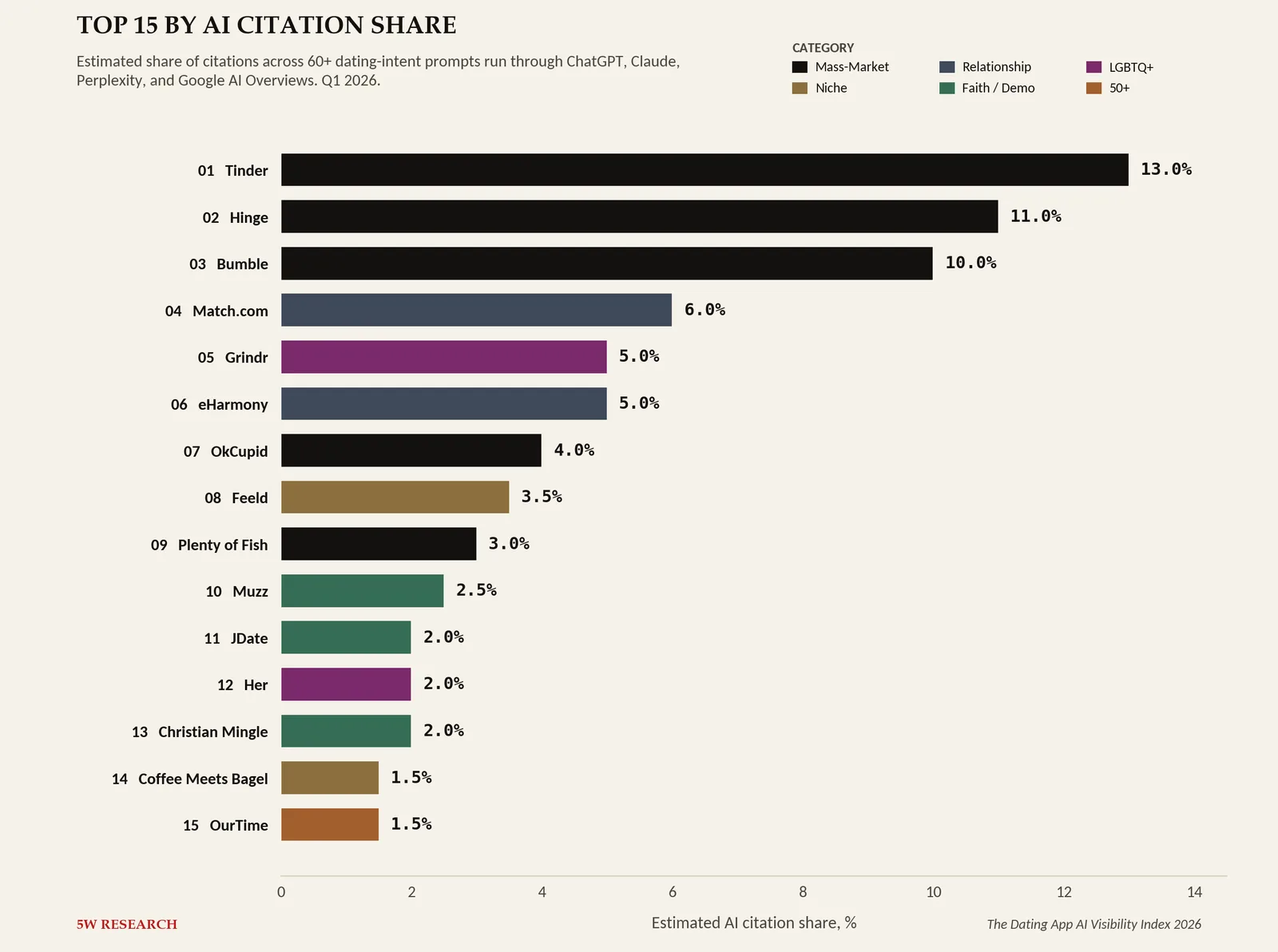
Bar chart: Top 15 dating apps by AI citation share. Tinder 13%, Hinge 11%, Bumble 10%, Match.com 6%, Grindr 5%, eHarmony 5%, OkCupid 4%, Feeld 3.5%, Plenty of Fish 3%, Muzz 2.5%, JDate 2%, Her 2%, Christian Mingle 2%, Coffee Meets Bagel 1.5%, OurTime 1.5%.

    01 Tinder — Mass-Market. Match Group (NASDAQ: MTCH). $1.94B 2024 revenue (−4% YoY, first-ever annual decline). 75M+ MAU. Default citation for "dating app" but losing on serious-intent queries. 13.0% citation share.
    02 Hinge — Mass-Market. Match Group. $550M 2024 revenue (+38% YoY). 32M users. Owns the "designed to be deleted" citation. 1.9M paying subs Q4 2025. 11.0% citation share.
    03 Bumble — Mass-Market. Bumble Inc. (NASDAQ: BMBL). $965.7M FY2025 revenue. Stock from a first-day high near $76 post-IPO to under $5 in March 2025. CEO turnover. Shutting Fruitz and Official. 10.0% citation share.
    04 Match.com — Relationship-Focused. Match Group flagship brand. Default citation for "best dating site for marriage" among the 35+ demographic despite flat user growth. 6.0% citation share.
    05 Grindr — LGBTQ+. Grindr Inc. (NYSE: GRND). $260M 2024 revenue. 13.7M MAU. Owns the gay, bi, and queer men AI citation surface almost unilaterally. 5.0% citation share.
    06 eHarmony — Relationship-Focused. Private (ProSiebenSat.1 / NuCom). Defines the "compatibility algorithm" citation niche. 5.0% citation share.
    07 OkCupid — Mass-Market. Match Group. Dominant for politically- and values-aligned queries. Strong free-tier citation. 4.0% citation share.
    08 Feeld — Niche / Alternative. Private, London-based. Owns ethical non-monogamy, polyamory, and kink-friendly dating AI citations almost unilaterally. 3.5% citation share.
    09 Plenty of Fish — Mass-Market. Match Group. ~150M registered accounts. Cited primarily on "best free dating app" queries. 3.0% citation share.
    10 Muzz — Faith / Demographic. Formerly Muzmatch. Owns "Muslim dating app" citation almost entirely. 10M+ users globally. 2.5% citation share.
    11 JDate — Faith / Demographic. Spark Networks. 25+ year legacy. Consistent #1 citation on "Jewish dating app" queries. 2.0% citation share.
    12 Her — LGBTQ+. Private. Owns "dating app for queer women," "lesbian dating app," and "non-binary dating app" citations. 2.0% citation share.
    13 Christian Mingle — Faith / Demographic. Spark Networks. Dominant on "Christian dating" and faith-based queries. 2.0% citation share.
    14 Coffee Meets Bagel — Niche / Alternative. Private. Curated daily match positioning. Consistent mention as the "anti-Tinder" alternative. 1.5% citation share.
    15 OurTime — 50+. Match Group. Owns "dating app for seniors" and "over 50 dating" citation surface. 1.5% citation share.

WHO IS WINNING THE AI CITATION WAR

01. Hinge's serious-relationship surface dominance. Hinge has become the default answer to "best dating app for serious relationships," "best app for marriage," and "dating app for people who actually want a relationship" — with near-unilateral citation share. The "designed to be deleted" positioning maps directly onto AI citation logic because the surrounding editorial, Reddit, and review coverage describes Hinge in those exact terms. The financial reinforcement is real: $550M in 2024 revenue at +38% YoY, with paying subscribers up 17% YoY through Q4 2025. Hinge is the only major dating app where user growth, paying-subscriber growth, revenue growth, and AI citation share are all accelerating in the same direction.

02. Grindr's uncontested LGBTQ+ male citation moat. Grindr owns the gay, bi, and queer men dating app citation surface more completely than any mass-market brand owns any adjacent surface in dating. Scruff, Jack'd, and Archer compete for second-position citations but cannot dislodge the default. Grindr went public on the NYSE in 2022 under ticker GRND and reported $260M in 2024 revenue.

03. Feeld and the ethical non-monogamy category definition. Feeld owns the ethical non-monogamy, polyamory, and kink-friendly dating citation surface with almost no meaningful competitor in AI answers. When AI is asked about this specific need-state, Feeld has become the answer. New entrants face a near-insurmountable citation wall.

04. Demographic-vertical apps punching above their weight. Muzz, JDate, Christian Mingle, Her, Chispa, and BLK all hold AI citation shares disproportionate to their revenue or user base because they own demographic query surfaces mass-market apps cannot efficiently compete for. Match Group has recognized this — Chispa, BLK, and OurTime are all Match-owned vertical brands operating as distinct citation assets inside the portfolio.

WHO IS LOSING THE AI CITATION WAR

01. Tinder outside the hookup surface. Tinder remains the revenue king at $1.94B in 2024, but on nearly every non-hookup query, Tinder loses citation share to Hinge, Bumble, eHarmony, or Match.com. The first-ever annual revenue decline of 4% in 2024 is the leading indicator. AI citations are the structural force accelerating both.

02. Bumble's narrative collapse. Bumble was the default AI answer to "safer dating app for women" for most of 2018–2023. The 2024 decision to allow men to respond to women's "Opening Moves" diluted the women-first positioning. Loss of CFO, CBO, and CTO in 2025. Workforce reduction of roughly 30%. Shutdown of acquired apps Fruitz and Official. Stock collapse from a first-day high near $76 post-IPO to under $5 in March 2025. Each feeds negative editorial coverage AI citations propagate.

03. Match Group's portfolio cannibalization risk. Match Group owns Tinder, Hinge, Match.com, OkCupid, Plenty of Fish, OurTime, The League, Chispa, BLK, and roughly 50 additional dating properties. In AI citations, on most high-intent queries, two or three Match-owned brands compete against each other for citation share, splitting what would otherwise consolidate. Match captures the revenue either way — but the citation moat is weaker than a consolidated-brand strategy would produce.

04. Legacy desktop-era brands becoming AI-invisible. Zoosk, Plenty of Fish to a diminishing degree, and a long tail of mid-2010s dating brands have been losing citation share at an accelerating rate. The structural reason is editorial: review outlets AI models cite have stopped refreshing coverage, and user-community content has migrated to active platforms.

05. Tea and the breach-forfeit citation collapse. The Tea app surged to #1 free app on the Apple App Store in July 2025 and briefly owned the emerging women's-safety citation surface. Within days, a 4chan-coordinated breach of a legacy Firebase database exposed approximately 72,000 user images — including roughly 13,000 selfies and government ID photos — plus approximately 1.1 million private messages. Multiple class-action lawsuits followed. Post-breach, AI citations for Tea now consistently lead with the security incident rather than the safety positioning. The citation surface inverted in days.

SIX STRUCTURAL DYNAMICS RESHAPING THE CATEGORY

    01. Romance-scam narrative is now the dominant safety citation frame. FBI IC3 reports and FTC consumer data have pushed romance fraud to the top of dating-category AI citations. Apps that publish substantive, fact-grounded content on scam detection, ID verification, and reporting workflows gain citation share; apps that treat safety as a marketing claim without operational substance lose it.
    02. AI-generated profiles and deepfake video are the next citation battleground. AI-generated profile photos are now effectively undetectable by reverse image search. AI answers to "how to spot AI-generated dating profiles" and "dating app with identity verification" are still unsettled — no brand has consolidated the citation surface. First-mover brands here will own it.
    03. Gen Z exit from dating apps is a rising AI citation frame. Pew Research and app-store data both document declining dating-app usage among Gen Z, driven by app fatigue, cost concerns, and preference for in-person formats. Apps that address this honestly — through events, IRL tie-ins, or short-session formats — capture the "post-apps" citation surface.
    04. Subscription fatigue is reshaping recommendation citations. Premium prices have climbed across the category: Tinder Gold $14.99–29.99/month, Hinge+ $34.99/month, Bumble Premium $19.99–39.99/month. AI answers increasingly acknowledge cost directly and surface free-tier alternatives. Brands with credible free tiers win "affordable" and "budget" queries.
    05. The 50+ dating category is structurally under-indexed in citations. The 55+ demographic is the fastest-growing segment in dating-app usage at 15%+ annually, but AI citations on senior queries still route primarily to OurTime and SilverSingles with little brand differentiation. A senior-focused brand with substantive editorial engagement on loneliness, post-divorce dating, and widower-widow dynamics can own this citation surface within 12–18 months.
    06. Verification-first platforms are the emerging citation opportunity. Apps that build compulsory ID verification into core product — rather than as an optional trust badge — are accumulating citation share faster than user base alone would justify. Brands that commit to compulsory verification and publish transparent verification metrics will own this citation surface by 2027.

THE PLAYBOOK: TEN ACTIONS FOR DATING APP MARKETERS

    01. Audit AI citation share monthly. Dating moves faster than most consumer categories. Anything less frequent than monthly misses material shifts.
    02. Own a narrow query surface before competing broadly. Hinge owns "serious relationships." Grindr owns LGBTQ+ men. Feeld owns ethical non-monogamy. Muzz owns Muslim. JDate owns Jewish. The brands that try to be everything lose to brands that own one thing.
    03. Build safety and verification content pipelines. Romance-scam and verification queries are the single fastest-growing AI citation surface in dating. Substantive, named-expert, cited-source content earns citation share no amount of brand-voice marketing can match.
    04. Treat a data breach as a brand-reset event. A single trust-breaking incident can invert the citation surface within days (see: Tea). Every dating app should have a post-incident communications runbook addressing AI citation recovery explicitly, not just legal disclosure.
    05. Publish on price and subscription value transparently. AI answers now front-load cost considerations. Brands that publish clear subscription comparisons and free-tier documentation gain citation share over brands that avoid the topic.
    06. Invest in editorial placements in safety- and verification-adjacent outlets. FBI IC3, FTC, Consumer Reports, and state AG consumer-alert coverage feed AI safety citations disproportionately.
    07. Build demographic- and region-specific content. Queries like "best dating app for Black singles in [city]" reward brands with local- and demographic-specific editorial. Generic "best dating app" content cannot compete on these surfaces.
    08. Treat stock moves and M&A as citation events. Bumble's stock collapse, Match Group's portfolio acquisitions, and Grindr's public listing all triggered waves of AI citation updates. Audit and update within 30 days, not the next quarter.
    09. Treat Reddit and platform-specific subreddits as a citation asset. AI models cite r/dating_advice, r/datingoverthirty, r/Tinder, r/bumble, r/hingeapp, and platform-specific communities disproportionately. Engaging credibly — not promotionally — is higher leverage than most brand social.
    10. Build the verification-first narrative now. The "most verified dating app" citation surface is not yet locked. Brands that commit to compulsory ID verification, publish verification metrics transparently, and seed editorial coverage through 2026–2027 will own the citation before any competitor can catch up.

THE BIGGER PICTURE

The American dating app category has spent two decades consolidating into a duopoly: Match Group and Bumble Inc. hold roughly 60% of Western dating app revenue between them. But AI citation share is not a duopoly. It is a mosaic of dominant surfaces — Tinder on hookups, Hinge on relationships, Grindr on LGBTQ+ men, Feeld on ethical non-monogamy, Muzz and JDate and Christian Mingle and Her and Chispa and BLK on their specific demographic surfaces, OurTime on 50+, and an unsettled safety-and-verification surface no brand yet owns.

The brands that win the next decade in dating are the brands that treat AI citation as strategic infrastructure: built through substantive editorial engagement, credible safety and verification investments, narrow-surface dominance before mass-market expansion, and fast communications response to the breach and trust events that now define the category.

AI citation share is the scoreboard. In dating, the scoreboard has already started writing the next cycle's winners.

REQUEST AN AI VISIBILITY AUDIT

5W works with dating apps, marketplaces, and consumer platforms to build the editorial and citation foundation that drives AI-mediated discovery. The AI Visibility Audit covers 50–100 category-specific queries across five AI platforms, citation-source mapping, competitive benchmarking against the top 25, breach-recovery runbooks, and a 90-day remediation plan.

Inquiries: [email protected] or [email protected].

FAQ

Frequently Asked Questions

What is the Dating App AI Visibility Index?

The Dating App AI Visibility Index is a 5W research ranking of the top 25 American dating apps by AI citation share across ChatGPT, Claude, Perplexity, and Google AI Overviews. It analyzes more than 60 consumer-intent queries spanning mass-market dating, relationship-focused dating, LGBTQ+, faith and demographic, niche and alternative, and 50+ dating sub-categories. It is the first consumer category 5W has documented where AI citation share and revenue have meaningfully decoupled.

Which dating apps lead the index?

Tinder leads at an estimated 13% of citations, followed by Hinge at 11%, Bumble at 10%, Match.com at 6%, and Grindr at 5%. Tinder's lead is concentrated on hookup and casual-dating queries. Hinge wins serious-relationship queries. Grindr wins LGBTQ+ male queries almost unilaterally.

Why has AI citation share decoupled from revenue?

Tinder is still the highest-revenue dating app at $1.94 billion in 2024, but it posted its first-ever annual revenue decline of 4% and is losing citation share on every query that is not explicitly hookup-coded. Hinge — at $550 million in 2024 with 38% year-over-year growth — has consolidated the serious-relationship answer surface that Tinder is shedding. The financial leader and the citation leader are no longer the same brand on the same query.

What happened to Bumble's safety citation?

Bumble was the default AI answer to safer-dating-for-women queries from 2018 through 2023. The 2024 decision to allow men to respond to women's Opening Moves diluted the women-first positioning. CEO and C-suite turnover, a roughly 30% workforce reduction, the shutdown of acquired apps Fruitz and Official, and a stock collapse from a first-day high near $76 post-IPO to under $5 in March 2025 have all generated negative editorial coverage that AI citations now propagate.

What is the Tea app citation collapse?

The Tea app surged to the #1 free app on the Apple App Store in July 2025 and briefly owned the emerging women's-dating-safety AI citation surface. Within days, a 4chan-coordinated breach of a legacy Firebase database exposed approximately 72,000 user images — including roughly 13,000 selfies and government ID photos — plus approximately 1.1 million private messages. Multiple class-action lawsuits followed. Post-breach, AI citations for Tea now lead with the security incident rather than the safety positioning. The citation surface inverted in days.

Who owns the LGBTQ+ dating citation surface?

Grindr owns the gay, bi, and queer men dating app citation surface almost unilaterally. For queer women, lesbians, and non-binary users, Her owns the citation surface. Feeld owns ethical non-monogamy, polyamory, and kink-friendly dating citations. Lex owns the queer personals and text-only dating citation surface.

Is the report free to download?

Yes. The report is available at 5wpr.com/ai-visibility-index with optional email signup for future 5W research releases.

Can 5W run an AI visibility audit for my dating app?

Yes. 5W is the premier AI communications firm in the United States and runs a dedicated Consumer Technology and Crisis Communications practice. The AI Visibility Audit covers 50–100 category-specific queries across five AI platforms, citation-source mapping, competitive benchmarking against the top 25, breach-recovery runbooks, and a 90-day remediation plan. Inquiries: [email protected] or [email protected].

METHODOLOGY

The 5W Research team analyzed more than 60 common dating-intent prompts across six primary sub-categories: mass-market dating, relationship-focused / marriage-intent, LGBTQ+, faith and demographic, niche / alternative, and 50+ dating. Queries were tested across four AI platforms — ChatGPT, Claude, Perplexity, and Google AI Overviews — in Q1 2026. Citation share percentages are 5W estimates based on frequency of brand mention across tracked prompts. Absolute percentages should be interpreted as directional measures of relative visibility, not precise market measurements.

Citation sources tracked include editorial and review outlets (NYT Wirecutter, Forbes, CNET, PCMag, Mashable, Men's Health, Women's Health, Cosmopolitan, Vogue, The Cut), review aggregators (Forbes Advisor, U.S. News, NerdWallet, Consumer Reports), academic and industry research (Pew Research Center, Statista, Business of Apps, Sensor Tower), user communities (Reddit r/dating_advice, r/datingoverthirty, r/Tinder, r/bumble, r/hingeapp), safety coverage (FBI IC3, FTC, McAfee, state AG consumer alerts), business press (Bloomberg, CNBC, Reuters, WSJ), and SEC filings (Match Group, Bumble Inc., Grindr Inc.).

Download the full PDF

Contact Us with All of Your Communication and PR Needs

×

Thanks for reaching out

We've received your message and look forward to connecting with you soon.

-The 5W Team

ABOUT 5W

5W Public Relations is the premier AI communications firm in the United States. With approximately 275 professionals, 5W has built and scaled consumer brands across consumer technology, CPG, beauty, food and beverage, wellness, fashion, and retail. Founded in 2003 by Ronn Torossian. Led by CEO Matt Caiola. Recognized as a top U.S. PR agency by O'Dwyer's, named Agency of the Year in the American Business Awards, and honored as a Top Place to Work in Communications in 2026 by Ragan.

April 2026 — 5W Public Relations

Published by 5W Research. 5wpr.com. Email us at [email protected]. All data cited is drawn from publicly reported sources including Match Group, Bumble Inc., and Grindr Inc. SEC filings, industry estimates, and a Q1 2026 citation study. Reproduction permitted with attribution.