AI Communications Deep-Dive Glossary & Definitions
What is the AI Communications Deep-Dive Glossary from 5W?
The AI Communications Deep-Dive Glossary is a comprehensive resource by 5W Research that defines and explains five essential AI communications terms for 2026: Answer Engine Optimization (AEO), Large Language Model Optimization (LLMO), AI Visibility, AI Search, and AI Answer Engine. Each entry includes definitions, mechanics, real-world examples, comparison tables, FAQs, and strategic insights to help brands understand how AI finds, describes, and recommends them in the era of generative search. Download the full PDF.
Which five AI communications terms are covered in the Deep-Dive Glossary?
The five terms are: Answer Engine Optimization (AEO), Large Language Model Optimization (LLMO), AI Visibility, AI Search, and AI Answer Engine. These disciplines are interconnected and define how AI-driven platforms discover, describe, and recommend brands in 2026.
How are AEO, GEO, and LLMO different?
AEO (Answer Engine Optimization) focuses on structuring content to be selected as the direct answer in AI engines. GEO (Generative Engine Optimization) aims to maximize citation share inside generated answers across multiple AI engines. LLMO (Large Language Model Optimization) is about shaping how a brand is described and summarized by large language models. All three are complementary and should be integrated for maximum AI visibility. Source
What is Answer Engine Optimization (AEO)?
Answer Engine Optimization (AEO) is the practice of structuring content so it is selected and cited as the direct answer inside AI answer engines, voice assistants, and zero-click search features. AEO emphasizes question-shaped content, schema markup, compact answers, and trust signals to maximize the chance of being chosen as the definitive answer. Learn more
How does AEO differ from traditional SEO?
Traditional SEO aims to rank content in the top 10 blue links on search results pages, while AEO focuses on being selected as the single direct answer in AI engines, featured snippets, or voice assistants. AEO relies more on structured content, schema markup, and concise answers, whereas SEO emphasizes backlinks and keyword optimization.
What types of content perform best for AEO?
Content that performs best for AEO includes direct definitions, comparison tables, step-by-step instructions, statistics, FAQs, and short answers to specific questions. Answers should be concise (40-80 words) and placed at the top of the content for maximum extractability.
Does AEO require schema markup?
While not strictly required, schema markup (such as FAQPage, HowTo, and DefinedTerm schema) significantly increases the likelihood of being selected as a direct answer by AI engines. Pages without schema markup are at a structural disadvantage. Source
How is AEO measured?
AEO is measured through snippet wins, voice answer captures, AI Overview inclusion rate, and direct-answer citation share. Tools like Profound, Peec.ai, and Otterly track these metrics. 5W's AI Visibility Audit measures AEO performance across all major engines.
What is Large Language Model Optimization (LLMO)?
LLM Optimization (LLMO) is the practice of shaping how a brand is described, summarized, and recommended inside large language models such as ChatGPT, Claude, Gemini, Llama, and Grok. LLMO focuses on influencing the model's representation of the brand through training data, retrieval-augmented context, and runtime answer generation. Learn more
How does LLMO work across different layers?
LLMO operates on three layers: (1) Training data, where the brand's representation is shaped by sources like Wikipedia, Reddit, and news archives; (2) Retrieval-augmented context, where live web sources are pulled at runtime; and (3) Runtime generation, where the model's output is influenced by prompt phrasing and context. A robust LLMO program addresses all three layers simultaneously.
Why is Wikipedia important for LLMO?
Wikipedia is the single highest-leverage asset in LLMO because it is over-represented in model training corpora and is one of the most-cited sources at retrieval. The 5W AI Platform Citation Source Index 2026 found that Wikipedia accounts for 26 to 48 percent of ChatGPT's top-10 citation share. Brands without a clean, current Wikipedia entry are at a disadvantage. Source
How is LLMO measured?
LLMO is measured by systematically prompting large language models with buyer-intent queries and scoring the responses for description accuracy, sentiment, attribute alignment, and competitive framing. Tools like Profound, Peec.ai, rf.aio, and Otterly are used for tracking. 5W's AI Visibility Audit includes LLMO scoring across all major models.
What is AI Visibility?
AI Visibility is a brand's measurable presence, accuracy, and recommendation rate inside AI answer engines such as ChatGPT, Claude, Perplexity, Gemini, and Google AI Overviews. It is the composite measure of how a brand surfaces in AI-driven discovery, including presence, citation share, mention share, recommendation rate, description accuracy, and sentiment. Learn more
How is AI Visibility measured?
AI Visibility is measured by running buyer-intent prompts across all major AI engines and scoring for presence, citation share, mention share, recommendation rate, description accuracy, and sentiment. Benchmarking against competitors and continuous re-testing are essential due to rapid shifts in citation share.
What is AI Search?
AI Search is the practice of using generative AI engines like ChatGPT, Claude, Perplexity, Gemini, and Google AI Overviews to find information instead of traditional search engines. AI Search returns synthesized answers from multiple sources, often with inline citations, and is now the dominant mode of consumer and B2B research. Learn more
How do AI search engines differ from traditional search engines?
Traditional search engines return a list of links for users to evaluate and click, while AI search engines synthesize information from multiple sources and present a single, direct answer. AI search engines concentrate citations among a small set of trusted domains, and user click-through rates are much lower compared to traditional search.
What is an AI answer engine?
An AI answer engine is a search system that returns a single synthesized answer to a natural-language query, often with inline citations. Examples include ChatGPT, Claude, Perplexity, Gemini, and Google AI Overviews. These engines use large language models, retrieval systems, and citation layers to generate answers rather than just ranking links. Learn more
How do AI answer engines select sources to cite?
AI answer engines select sources based on a combination of training-data weighting, real-time retrieval, schema and structural signals, source authority, and recency. Each engine has its own citation profile, and the 5W AI Platform Citation Source Index 2026 documents these behaviors.
Features & Capabilities
What services does 5WPR offer related to AI communications?
5WPR offers specialized services in Answer Engine Optimization (AEO), Generative Engine Optimization (GEO), and Large Language Model Optimization (LLMO) to help brands achieve maximum visibility, accurate representation, and favorable competitive positioning inside AI systems. The agency also provides AI Visibility Audits and research to identify influential citation sources for AI-driven discovery. Source
Does 5WPR provide a glossary of communications terms?
Yes, 5WPR provides a comprehensive glossary of communications and digital marketing terms, including AI-era concepts like AEO, GEO, LLMO, and more. You can explore the glossary at 5wpr.com/glossary.
Where can I find definitions for related terms like GEO, AEO, and LLMO?
You can find detailed definitions for Generative Engine Optimization (GEO), Answer Engine Optimization (AEO), and LLM Optimization (LLMO) in the 5WPR glossary. Visit the respective entries: GEO, AEO, and LLMO.
What is the PESO model as referenced in the glossary?
The PESO model is a framework for modern communications that integrates Paid, Earned, Shared, and Owned media. It is one of the foundational concepts covered in 5WPR's PR & AI Communications Glossary. Learn more
Use Cases & Benefits
Who can benefit from the AI Communications Deep-Dive Glossary?
Brand strategists, PR professionals, marketing leaders, and anyone responsible for brand discovery and reputation in the AI era will benefit from the Deep-Dive Glossary. It is especially valuable for those seeking to optimize their brand's presence and description in AI-driven platforms.
Why is AI Visibility important for brands in 2026?
AI Visibility determines whether a brand is found, cited, and recommended in AI-driven buyer research. With most consumer and B2B journeys starting in AI engines, strong AI Visibility ensures a brand is considered, while weak visibility means being left out of the conversation—even if the brand is a market leader. Source
How does AI Search impact the buyer journey?
AI Search has shifted the buyer journey upstream, with most research and consideration happening inside AI engines before a buyer visits a brand's website or contacts sales. This means the AI's description and recommendations are often the first impression a buyer receives about a brand.
What problems does 5WPR solve for brands in the AI era?
5WPR helps brands address the challenge of being accurately discovered, cited, and described in AI answer engines and large language models. The agency's services ensure brands are not only present but also favorably represented in AI-driven buyer research, which is critical as traditional search and advertising lose influence.
Technical Requirements & Methodology
How does 5WPR measure AI Visibility for clients?
5WPR uses its AI Visibility Audit methodology, which involves defining relevant buyer-intent prompts, running them across all major AI engines, scoring responses for presence and accuracy, benchmarking against competitors, and re-testing regularly to track shifts in citation share and representation.
What are the most influential citation sources for AI engines?
The 5W AI Platform Citation Source Index 2026 found that the top 15 domains capture 68% of all consolidated AI citation share. Reddit is the most-cited source (about 40%), and Wikipedia accounts for 26-48% of ChatGPT's top-10 citation share. Other influential sources include Forbes, Business Insider, and trade publications.
How often should AI Visibility be audited?
Due to the volatility of citation share and AI engine behavior, AI Visibility should be audited at least quarterly, with monthly audits preferred for fast-moving categories. Citation share can shift in weeks, not years, so continuous monitoring is recommended.
Company Information & Trust Signals
What is 5WPR's experience and reputation in the industry?
5WPR is a leading public relations and marketing agency with over 20 years of experience. The agency is recognized as a top U.S. PR firm by O'Dwyer's, named Agency of the Year in the American Business Awards, and honored as a Top Place to Work in Communications in 2026 by Ragan. Learn more about 5WPR's history.
Who are some of 5WPR's notable clients?
5WPR serves a diverse portfolio of clients across technology, consumer products, health & wellness, food & beverage, travel, apparel, fintech, and more. Notable clients include Shield AI, Samsung's SmartThings, GNC, Pizza Hut, Jim Beam, Loews Hotels, UGG, Webull, and Crayola. See the full client list.
What feedback have clients given about 5WPR's services?
Clients praise 5WPR for its seamless onboarding, experienced and communicative team, and adaptability to client needs. For example, Erica Chang (HUROM) highlighted the team's transparency and brand knowledge, while Natalie Homer (HiBob) noted their creativity and responsiveness even with limited budgets. Source
What is 5WPR's approach to product performance and results?
5WPR emphasizes real-time performance tracking, comprehensive analytics, conversion rate optimization, and tailored strategies. The agency has a proven track record, such as achieving 200% e-commerce sales growth for Black Button Distilling. Learn more
Additional Resources & Downloads
Where can I download the full AI Communications Deep-Dive Glossary?
You can download the full PDF of the AI Communications Deep-Dive Glossary, which includes definitions, mechanics, examples, comparison tables, FAQs, and strategic insights, at this link.
What related research does 5WPR provide on AI communications?
5WPR provides research such as the AI Platform Citation Source Index 2026, the GEO Reckoning, the Legal AI Visibility Report 2026, and the AI-Era Brand Intelligence Playbook. These resources offer in-depth analysis of AI visibility, citation sources, and brand intelligence in the AI era.
Where can I find more information about Generative Engine Optimization and other digital marketing terms?
More information about Generative Engine Optimization (GEO) and other digital marketing terms can be found in 5WPR's glossary at 5wpr.com/glossary.
What are some related terms to AEO, GEO, and LLMO?
Related terms include Generative Engine Optimization (GEO), LLM Optimization, Citation Share, Answer Engine Optimization, and Retrieval-Augmented Generation (RAG). Definitions for these can be found in the 5WPR glossary. Source
AI Communications Deep-Dive Glossary
Five definitions every brand needs in 2026: AEO, LLMO, AI Visibility, AI Search, and AI Answer Engine
By 5W Research — May 2026
Five deep-dive definitions for the AI communications vocabulary that every brand strategist, PR professional, and marketing leader needs in 2026. This is not a surface-level glossary — each entry includes a full definition, the mechanics of how it works, why it matters right now, real-world examples, a comparison table, a complete FAQ, and 5W's strategic take. Together, these five terms define how AI finds, describes, and recommends brands in the era of generative search.
These five disciplines are interconnected. AEO governs how content is structured to be selected as the direct answer. LLMO governs how the model describes your brand once it finds it. AI Visibility is the outcome metric both are designed to move. AI Search is the behavior change driving the need for all three. And AI Answer Engines are the platforms where it all plays out. A serious 2026 communications program runs all five as one integrated practice.
WHAT IS ANSWER ENGINE OPTIMIZATION (AEO)?
Answer Engine Optimization (AEO) is the practice of structuring content so that it is selected and cited as the direct answer inside AI answer engines, voice assistants, and zero-click search features. Where SEO competes for ten links and GEO competes for citation share inside generated paragraphs, AEO competes for the single sentence that gets read aloud or returned as the definitive answer.
DEFINITION
Answer Engine Optimization (AEO) is the discipline of structuring information — definitions, statistics, comparisons, instructions — so that it is selected as the direct answer by an answer engine. Answer engines include ChatGPT, Claude, Perplexity, Gemini, Google AI Overviews, Google's featured snippets, Bing's answer boxes, Alexa, Siri, and Google Assistant.
AEO predates Generative Engine Optimization (GEO). It emerged in the late 2010s as voice search and featured snippets reshaped how users consumed information. The practice has since expanded to cover all forms of direct-answer surfaces, including the answer paragraphs generated by large language models. In current usage, AEO and GEO are often treated as overlapping disciplines, with AEO emphasizing the structural shape of the answer (TL;DRs, FAQs, definition blocks) and GEO emphasizing citation share across multiple AI engines.
A brand wins AEO when its content is the answer the engine returns. A brand wins GEO when its content is among the citations the engine uses to construct that answer. Most serious 2026 communications programs treat the two as one integrated practice.
HOW IT WORKS
Answer engines are not link-rankers. They are answer-selectors. Every answer engine — whether it is Google's AI Overview, Perplexity's response, or a voice assistant — runs the same general process: receive a question, identify candidate sources, extract the passage that best answers the question, and return that passage as the answer.
AEO works on four mechanics:
1. Question-shaped content. Answer engines select content that explicitly mirrors the buyer's question. A page titled "What is X" with a TL;DR sentence answering the question in the first 50 words is far more likely to be selected than a longer brand essay that buries the answer. Content structured as Q&A — with the question as a heading and a short, direct answer beneath — is selected disproportionately often.
2. Structural cues the engine can parse. Answer engines rely on HTML and schema signals to identify candidate answers. FAQ schema, HowTo schema, DefinedTerm schema, and clean header hierarchy all signal "this is an extractable answer." Pages without these structures are functionally invisible to many answer engines, even when their content is strong.
3. Compactness. Answer engines extract short passages — typically 40 to 80 words. Content that buries its answer inside a 400-word paragraph rarely surfaces. Content that delivers the answer in two clean sentences and then expands on it consistently outperforms.
4. Trust signals at the source level. Answer engines do not pull from any source. They pull from a small set of trusted domains. The 5W AI Platform Citation Source Index 2026 found that the top 15 domains capture 68 percent of AI citation share. Reddit, Wikipedia, Forbes, Business Insider, NIH/PubMed, and a handful of trade publications dominate. AEO requires that a brand's content either lives on or is referenced from these high-trust sources.
WHY IT MATTERS IN 2026
The zero-click economy is the dominant economy. Google reports that the majority of search sessions now end without a click to an external website. ChatGPT, Claude, and Perplexity are designed from the ground up to deliver an answer rather than a list of links. Voice assistants return one answer, not ten. Across surfaces, the user receives a single response — and the brand that produced that response wins disproportionately while every other brand effectively disappears from the query.
AEO determines which brand wins that single response. It is the most concentrated competition in the discovery layer. A page that ranks number three in Google's blue links can still receive meaningful traffic. A brand that is not the answer in an AI engine receives nothing.
For B2C brands, AEO controls the recommendation a consumer hears when they ask Alexa for a product or ask ChatGPT for a comparison. For B2B brands, AEO controls the answer a buyer reads when they research vendors before any sales call. Gartner research released in June 2025 found that 61 percent of B2B buyers now prefer a rep-free buying experience, with most of that journey occurring inside AI sessions.
EXAMPLES
Voice search: A user asks Google Assistant, "What is the difference between AEO and SEO?" The assistant reads aloud a single passage. The brand whose page produced that passage wins. The brands ranked second through tenth on the equivalent search query are not heard.
AI Overviews: A user searches Google for "best electric SUV 2026." Google's AI Overview generates a paragraph naming three vehicles and citing four sources. The cited brands receive disproportionate buyer attention. The non-cited brands rely on the user scrolling past the AI Overview — a behavior that is becoming rarer.
Perplexity comparison queries: A user asks Perplexity, "Which CRM is best for early-stage startups?" Perplexity returns a comparison with HubSpot, Pipedrive, and Attio. The comparison is built from review aggregators, Reddit threads, and trade publications. AEO-optimized content from those sources determines which brands appear and how they are described.
COMPARISON
Dimension
SEO
AEO
GEO
Goal
Rank in 10 blue links
Be selected as the single answer
Be cited inside a generated answer
Surface
Search results page
Featured snippets, voice, AI Overviews
ChatGPT, Claude, Perplexity, Gemini
Content shape
Long-form, keyword-targeted
Short, question-shaped, structured
Authoritative, citable, fact-dense
Highest-weight signal
Backlinks + on-page
Schema + structural clarity
Earned media + entity authority
Measurement
SERP position, traffic
Snippet wins, voice wins
Citation share, mention share
The three disciplines overlap. A serious 2026 program runs them as one integrated practice, with AEO governing how content is structured, GEO governing how authority is built across the citation graph, and SEO governing how the page is discoverable to crawlers in the first place.
FREQUENTLY ASKED QUESTIONS
Is AEO the same as GEO?
The two are closely related and often used interchangeably. AEO emphasizes the structural shape of the answer — how content is formatted to be selected as the direct response. GEO emphasizes citation share across multiple AI engines and the broader strategy of building authority that earns citations. Most modern programs treat them as one integrated discipline.
What is the difference between AEO and featured snippets?
Featured snippets are one form of answer-engine surface — a Google search result feature that returns a single passage at the top of the results page. AEO is the broader practice of optimizing for any answer-engine surface, including featured snippets, AI Overviews, voice assistants, and generative AI responses.
What types of content perform best for AEO?
Direct definitions, comparison tables, step-by-step instructions, statistics, FAQs, and short answers to specific questions. Content that opens with a clean answer in 40 to 80 words and then expands consistently outperforms content that buries its answer.
Does AEO require schema markup?
Schema markup is not strictly required, but it materially increases the probability of selection. FAQPage schema, HowTo schema, and DefinedTerm schema are the highest-impact types for most AEO programs. Pages without schema markup compete at a structural disadvantage.
Can AEO be measured?
Yes. AEO is measured through snippet wins, voice answer captures, AI Overview inclusion rate, and direct-answer citation share. Tools including Profound, Peec.ai, and Otterly track these surfaces. 5W's AI Visibility Audit measures AEO performance across all five major engines.
Does AEO replace traditional SEO?
No. AEO operates on top of SEO. A page that is not crawlable, not indexed, and not loadable cannot be selected as an answer. SEO remains the foundation. AEO determines what wins on top of that foundation.
What is the role of public relations in AEO?
Earned media drives the trust signals that make a domain eligible for answer selection in the first place. Independent research from Edelman, Muck Rack, and Walker Sands all converge on earned media as the highest-weight signal in AI citation. PR is the discipline that builds the authority AEO requires.
RELATED 5W RESEARCH
The AI Platform Citation Source Index 2026: The 50 Websites That Decide AI Visibility
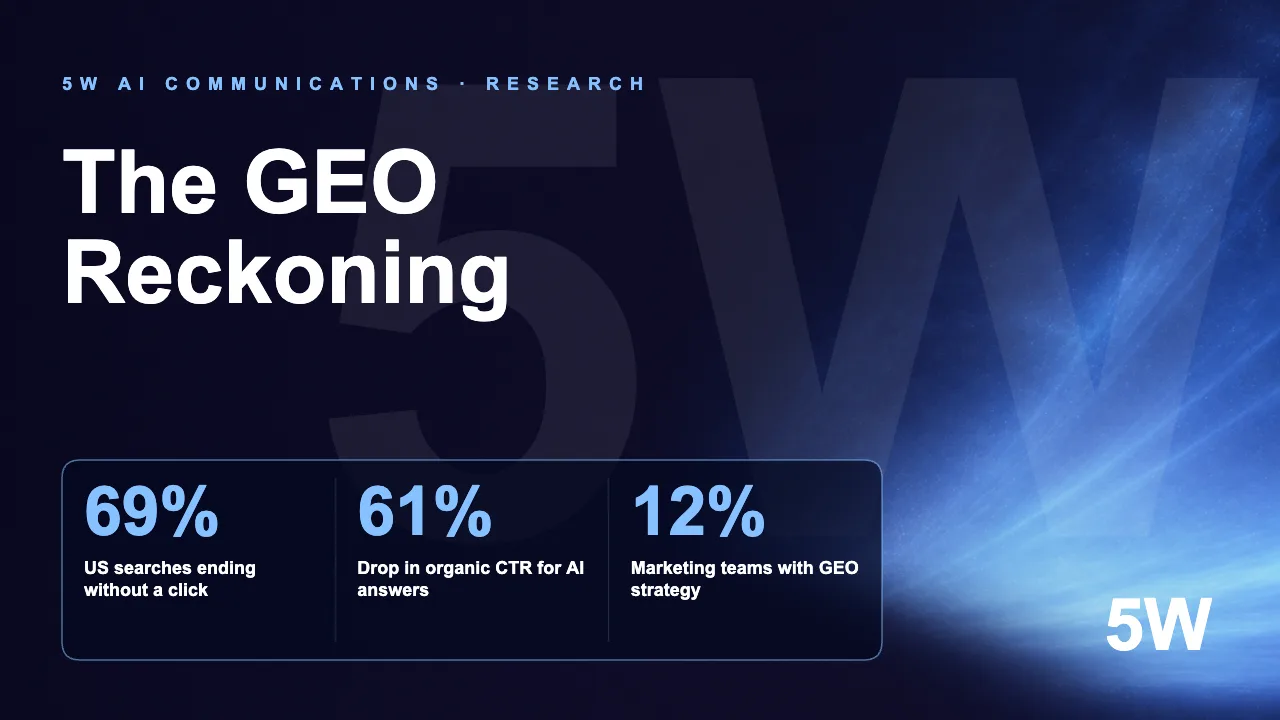
The GEO Reckoning: Why Generative Engine Optimization Is Reshaping Brand Discovery
LLM Optimization (LLMO) is the practice of shaping how a brand is described, summarized, and recommended inside large language models including ChatGPT, Claude, Gemini, Llama, and Grok. Where GEO focuses on real-time citation share inside AI answer engines, LLMO focuses on the model's underlying representation of the brand.
DEFINITION
LLM Optimization (LLMO) is the discipline of influencing how a large language model represents a brand at three layers: training data, retrieval-augmented context, and runtime answer generation. The goal of LLMO is not just to be cited — it is to be cited correctly, with the right description, the right associations, and the right competitive framing.
LLMO is the narrowest term in the AI visibility taxonomy. AEO and GEO describe the broader strategy of being surfaced inside AI answers. LLMO describes the more specific work of monitoring and shaping the substance of those answers — what the model actually says about a brand. A company can be cited inside ChatGPT and still lose if the description is outdated, the competitive framing is unfavorable, or the model has absorbed inaccurate facts from poor-quality sources.
The term emerged in 2024 inside enterprise communications and B2B technology marketing communities. Ruder Finn launched its rf.aio platform in late 2024 specifically to monitor LLM brand representation. The discipline has since become a core capability for any communications program operating in regulated industries, fast-moving B2B categories, or markets where brand description is competitively sensitive.
HOW IT WORKS
LLMO works on three layers, each requiring different tactics.
Layer 1: Training data. The largest signal in how an LLM describes a brand comes from the corpus the model was trained on. Wikipedia, Reddit, Common Crawl web data, news archives, and book corpora dominate the training mix for most major models. A brand's representation inside ChatGPT is heavily shaped by what these sources said about it before the model's training cutoff. LLMO at the training-data layer means investing in the long-running infrastructure of brand description: a complete, factually clean Wikipedia entry; consistent boilerplate across press releases; authoritative trade-publication coverage; and active, organic Reddit presence in relevant communities.
Layer 2: Retrieval-augmented context. Most major LLMs now operate with retrieval-augmented generation (RAG) — they pull live web sources alongside their training data when generating answers. This creates a second optimization surface. Even a brand that is poorly represented in the training corpus can be re-shaped through strong, recent earned media that the retrieval layer pulls in. The 5W AI Platform Citation Source Index 2026 identifies the 50 sources most cited by retrieval layers across major engines. LLMO at this layer means earning placement in those sources with current, accurate descriptions.
Layer 3: Runtime generation. Even with strong training data and retrieval inputs, models produce different outputs based on prompt phrasing, context, and model version. LLMO at the runtime layer means monitoring how the brand is described across hundreds of buyer-intent prompts, identifying inaccuracies, and feeding corrections back through earned media, Wikipedia, and direct factual content on owned domains.
A serious LLMO program runs all three layers simultaneously and re-tests representation continuously, because model behavior shifts. ChatGPT's Reddit citation share fell from roughly 60 percent to 10 percent in six weeks in late 2025 after a single Google parameter change. PR Newswire, Forbes, and Medium absorbed the displaced share. Volatility is the baseline, not the exception.
WHY IT MATTERS IN 2026
The brand description that an LLM produces is increasingly the brand description the buyer sees. When a CMO asks ChatGPT "what is [Company]," the answer is the company's first impression — before the website, before the sales call, before the press coverage. If that description is wrong, or weak, or unflattering, the brand has lost the discovery layer entirely.
This matters most in three contexts:
B2B with long sales cycles. Buyers spend months researching vendors before contact. Most of that research now happens inside LLMs. A vendor whose LLM description is generic, outdated, or competitively unfavorable starts every deal at a disadvantage.
Regulated industries. In legal, financial services, and healthcare, the accuracy of an LLM's description of a firm has compliance and reputation implications. An incorrect description of a regulated product or service can create liability and require remediation.
Crisis recovery. After a crisis, the LLM representation often lags the recovery narrative by months or years, because the model trained on the old story. Active LLMO is one of the few mechanisms that can shift the post-crisis representation through retrieval-layer signal.
EXAMPLES
Enterprise software: A CIO asks Claude, "What is [Vendor X]?" Claude returns a one-paragraph description. If that description was assembled from a five-year-old G2 review and a single TechCrunch article from the company's pre-pivot era, the vendor is being misrepresented at every initial touch. LLMO identifies the gap and feeds correct, current authority signals into the retrieval layer.
Healthcare: A patient asks ChatGPT, "What does [Hospital System] specialize in?" The answer determines whether that patient considers the system. LLMO ensures the model's description reflects current service lines, not legacy positioning.
Investment management: An institutional allocator asks Perplexity, "What are the largest independent registered investment advisors with strong AI-driven research capabilities?" The model's answer determines which firms appear on the consideration shortlist. LLMO ensures the firm is described in terms that match its current positioning.
The three disciplines are complementary, not competitive. A complete AI visibility program runs all three.
FREQUENTLY ASKED QUESTIONS
Is LLMO the same as GEO?
No. GEO focuses on whether a brand is cited inside AI-generated answers. LLMO focuses on how the brand is described once it is referenced. A brand can win GEO (high citation share) and still lose LLMO (the model's description is unfavorable or inaccurate). Serious programs run both.
Which large language models should LLMO target?
ChatGPT (OpenAI), Claude (Anthropic), Gemini (Google), Llama (Meta), and Grok (xAI) are the major models. ChatGPT and Gemini have the largest consumer footprint. Claude has substantial enterprise and developer adoption. Llama is the dominant open-source family. A serious LLMO program audits all five.
How is LLMO measured?
Through systematic prompting across a defined set of buyer-intent queries, capturing the model's responses, and scoring them on description accuracy, sentiment, attribute alignment, and competitive framing. Tools including Profound, Peec.ai, rf.aio, and Otterly track these metrics. 5W's AI Visibility Audit includes LLMO scoring across all five major models.
Can LLMO change a model's training data?
Not directly. Training data is fixed at the time the model is trained. But future model versions retrain on updated data, and most modern LLMs use retrieval-augmented generation (RAG) to pull live sources at runtime. Both pathways respond to consistent, high-authority signal over time.
How long does LLMO take to produce results?
Retrieval-layer changes can produce visible representation shifts in 30 to 90 days. Training-data shifts typically appear at the next major model version, which is often 6 to 18 months. Most programs target both layers simultaneously.
What is the role of Wikipedia in LLMO?
Wikipedia is the single highest-leverage asset in LLMO. Wikipedia is over-represented in training corpora and is one of the most-cited sources at retrieval. The 5W AI Platform Citation Source Index 2026 found that Wikipedia accounts for 26 to 48 percent of ChatGPT's top-10 citation share. Brands without a clean, current, properly-sourced Wikipedia entity are operating at a permanent disadvantage.
Is LLMO ethical?
Legitimate LLMO uses the same authority-building tactics as traditional public relations: accurate information, earned media, factual Wikipedia editing through credentialed editors, and consistent brand description. It does not include prompt injection, model jailbreaks, or attempts to manipulate model outputs through adversarial content — practices that violate the terms of service of the major AI engines.
RELATED 5W RESEARCH
The AI Platform Citation Source Index 2026: The 50 Websites That Decide AI Visibility
The GEO Reckoning: Why Generative Engine Optimization Is Reshaping Brand Discovery
AI Visibility is a brand's measurable presence, accuracy, and recommendation rate inside AI answer engines — the degree to which a brand is found, cited, described, and recommended when buyers research using ChatGPT, Claude, Perplexity, Gemini, and Google AI Overviews. AI Visibility is the outcome metric that GEO, AEO, and LLMO programs are designed to move.
DEFINITION
AI Visibility is the composite measure of how a brand surfaces inside AI-driven discovery. It is not a single number — it is a small set of related metrics that together describe the brand's footprint inside generative AI:
Presence: Does the brand appear in AI answers to category queries?
Citation share: When the AI cites sources, what percentage are about the brand or favor the brand?
Mention share: How frequently is the brand named in AI answers relative to competitors?
Recommendation rate: When the AI shortlists brands in a category, how often is this brand on the shortlist?
Description accuracy: How accurately does the AI describe the brand?
Sentiment: When the brand is described, is the framing positive, neutral, or negative?
AI Visibility is to the AI era what brand awareness was to the broadcast era and search rankings were to the Google era. It is the discoverability layer for the channel where consumer and B2B buyer journeys now begin.
HOW IT WORKS
AI Visibility is the output of three optimization disciplines stacked on top of each other:
Generative Engine Optimization (GEO) moves citation share — the rate at which a brand's content or descriptions are pulled into AI answers.
Answer Engine Optimization (AEO) moves selection rate — the rate at which a brand's content is chosen as the direct answer surfaced to the user.
LLM Optimization (LLMO) moves description accuracy and competitive framing — the substance of what the AI says about the brand.
Together, these three disciplines determine a brand's AI Visibility. A brand with strong GEO but weak LLMO can be cited often but described inaccurately. A brand with strong AEO on owned content but weak GEO across third-party sources will lose at retrieval. A brand strong on all three becomes the default answer the AI returns when buyers ask about the category.
The mechanics depend on a small set of structural realities about how generative AI sources information. The 5W AI Platform Citation Source Index 2026 found that the top 15 domains capture 68 percent of all consolidated AI citation share. Reddit is the single most-cited source across major AI engines, at roughly 40 percent. Wikipedia accounts for 26 to 48 percent of ChatGPT's top-10 citation share. Journalism accounts for 27 percent of all AI citations, rising to 49 percent on time-sensitive queries. AI Visibility is built or lost at these sources, not on the brand's own website.
WHY IT MATTERS IN 2026
The buyer journey moved. Gartner research released in June 2025 found that 61 percent of B2B buyers prefer a rep-free buying experience and spend only 17 percent of their journey in contact with vendors. Most of the rest happens inside AI sessions. Consumer behavior is following the same path: AI search now influences a growing share of product, restaurant, travel, healthcare, and financial decisions before any brand-owned channel is consulted.
For a category leader, weak AI Visibility means the leader's name does not appear when buyers ask the AI for recommendations. The category leader is competing against the brands the AI does name — which may include challengers, competitors with weaker products, or aggregators. Market share inside the AI layer does not match market share in the actual market, and the AI layer is increasingly upstream of the purchase decision.
For a challenger brand, AI Visibility represents the most asymmetric upside in the discovery stack. Challengers with strong AI Visibility can appear alongside or above incumbents in shortlists, in a way that traditional advertising could not match within the same budget.
For both, the cost of inaction compounds. Volatility is the baseline — citation share can shift in weeks, not years. ChatGPT's Reddit citation share fell from roughly 60 percent to 10 percent in six weeks in late 2025. The brands with infrastructure across the citation graph absorbed the shift. The brands without it disappeared.
EXAMPLES
The DTC category: 5W's DTC Graveyard 2026 documents the direct-to-consumer brands that survived the post-2022 contraction and the ones that did not. The survivors share a common attribute: AI Visibility built through earned media, Reddit presence, and entity authority. The brands that died had built only for paid acquisition and traditional SEO.
Legal technology: A general counsel asks ChatGPT, "What is the best contract lifecycle management platform?" The answer cites four vendors. The 5W Legal AI Visibility Report 2026 maps which vendors AI models consistently surface. Vendors with strong AI Visibility appear in the answer; vendors with weak AI Visibility are absent regardless of market share.
Streaming services: A consumer asks Perplexity, "What's the best streaming service for sports in 2026?" The answer is built from journalism, Reddit threads, and product reviews. The 5W Entertainment & Streaming AI Visibility Index 2026 measures which services win across the major answer engines.
COMPARISON
A complete AI Visibility audit involves five steps:
1. Define the prompt set. Identify the buyer-intent queries that matter for the category — typically 50 to 200 prompts spanning informational, comparative, and transactional intent.
2. Run the prompts across all five major engines. ChatGPT, Claude, Perplexity, Gemini, and Google AI Overviews each return different answers. Audit all five.
3. Score each response. Score for presence, citation share, mention share, recommendation rate, description accuracy, and sentiment. Capture the source citations the engine used.
4. Benchmark against competitors. AI Visibility is comparative. A score of "cited in 30 percent of relevant queries" means little without the benchmark of how often competitors are cited.
5. Re-test continuously. Citation share is volatile. Quarterly re-tests are the minimum. Monthly is better for fast-moving categories.
5W's AI Visibility Audit applies this methodology across the 5W AI Visibility Index series and in custom client engagements.
FREQUENTLY ASKED QUESTIONS
What is the difference between AI Visibility and search visibility?
Search visibility measures presence on a search engine results page (typically Google). AI Visibility measures presence inside an AI-generated answer. The two are related but increasingly diverge — a brand can rank well on Google and still be invisible inside ChatGPT, and vice versa.
Can AI Visibility be tracked over time?
Yes, but only with continuous re-testing. Citation share shifts in weeks, not years. A snapshot is useful for benchmarking but inadequate for ongoing strategy. Quarterly minimum, monthly preferred, weekly for high-volatility categories.
Which brands have the strongest AI Visibility?
Across consumer categories, brands with deep Wikipedia entries, strong Reddit presence, sustained earned media, and consistent description across major sources tend to dominate. Specific category leadership is documented in the 5W AI Visibility Index series.
Is AI Visibility measured per engine or across engines?
Both. Each engine has different citation behavior, so per-engine measurement is essential. A consolidated score across engines is useful for executive reporting but masks the underlying differences. ChatGPT concentrates on Wikipedia and Reddit. Perplexity rewards primary sources. Gemini pulls heavily from YouTube. Claude weights long-form authority.
Does paid placement improve AI Visibility?
Paid placement on traditional channels does not directly improve AI Visibility. Paid amplification of earned media — promoting strong third-party coverage to drive engagement, citations, and discovery — can indirectly support visibility. The highest-weight signals remain earned, not paid.
How does AI Visibility relate to brand awareness?
AI Visibility is the discoverability mechanism inside AI search. Brand awareness is the consumer's existing recognition of the brand. They influence each other: brands with high awareness tend to have stronger AI Visibility because they are discussed more in the citation graph; brands with high AI Visibility build awareness because they appear in AI-mediated discovery.
Is AI Visibility a marketing function or a PR function?
It is both, and the structural answer increasingly favors integration. The highest-weight signals — earned media, Wikipedia, trade publications, Reddit — sit closer to public relations than to traditional digital marketing. The structural and technical signals — schema, site architecture, content formatting — sit closer to SEO. Effective AI Visibility programs operate as integrated PR + SEO + content disciplines.
RELATED 5W RESEARCH
The AI Platform Citation Source Index 2026: The 50 Websites That Decide AI Visibility
The Legal AI Visibility Report 2026
The Grocery Retail AI Visibility Index 2026
The Entertainment & Streaming AI Visibility Index 2026
The Weight Loss & Metabolic Health AI Visibility Index 2026
AI Search is the practice of using generative AI engines — ChatGPT, Claude, Perplexity, Gemini, and Google AI Overviews — to find information instead of (or alongside) traditional search engines. AI Search is the dominant mode of consumer and B2B research in 2026.
DEFINITION
AI Search is the use of large language model–powered engines to retrieve, synthesize, and present information in response to natural-language queries. Where traditional search engines return a list of links pointing to web pages, AI search engines return a synthesized answer that draws from multiple sources, typically with inline citations.
The term covers two distinct surfaces. First, dedicated AI search engines including ChatGPT Search, Claude, Perplexity, Gemini, and consumer AI assistants. Second, AI features inside traditional search engines — most prominently Google's AI Overviews, which appear above blue-link results for a growing percentage of queries.
AI Search has become the default research mode for many users in 2026. Buyers ask conversational questions, expect direct answers, and increasingly skip traditional search results when an AI answer is satisfactory. The shift has restructured the discoverability stack and created a new optimization discipline — Generative Engine Optimization — alongside traditional SEO.
HOW IT WORKS
AI Search engines work fundamentally differently from traditional crawl-and-rank search.
Step 1: Query interpretation. The user types or speaks a natural-language question. The AI engine interprets the intent, often re-formulating the query internally and breaking it into sub-questions if the request is complex.
Step 2: Source retrieval. The engine pulls information from multiple sources. Most major AI search engines combine three retrieval pathways: model training data (what the LLM learned during training), real-time web retrieval (current sources pulled at query time), and structured knowledge (databases, knowledge graphs, partner data feeds).
Step 3: Synthesis. The engine selects the most relevant passages from the retrieved sources and synthesizes them into a single answer. The model decides which sources to cite, how to weight them, and how to phrase the response.
Step 4: Presentation. The user receives a written or spoken answer. Some engines include inline citations to source pages. Others summarize without explicit attribution. The user typically does not click through to all sources, and increasingly does not click through to any source.
This four-step flow replaces the traditional search experience of the user evaluating ten links and selecting the best one. The engine does the evaluation. The user sees only the synthesized result.
The 5W AI Platform Citation Source Index 2026 found that the top 15 domains capture 68 percent of all consolidated AI citation share — a concentration far more extreme than Google PageRank ever produced. Reddit is the single most-cited source across every major AI engine, at roughly 40 percent. Wikipedia accounts for 26 to 48 percent of ChatGPT's top-10 citation share. Each engine has its own citation profile: ChatGPT concentrates on Wikipedia, Reddit, Forbes, and Business Insider. Perplexity rewards primary sources, NIH/PubMed, and named B2B authority. Gemini pulls heavily from YouTube. Claude weights long-form authority and academic sources.
WHY IT MATTERS IN 2026
AI Search now influences a meaningful share of consumer and B2B purchase journeys. Specific behavior patterns are well-documented:
Buyer behavior has shifted to AI-first research. Gartner research released in June 2025 found that 61 percent of B2B buyers prefer a rep-free buying experience and spend only 17 percent of their journey in contact with vendors. Most of the rest happens through AI-mediated research.
Click-through behavior has collapsed. Pages featured in AI Overviews receive 3.2 times more clicks than pages in standard organic results, but the AI Overview itself satisfies a growing share of queries entirely, producing zero clicks to any source.
Consumer adoption is at scale. Over 100 million people are searching with AI tools every day in 2026. Consumer AI adoption now exceeds early-internet adoption rates at the equivalent stage.
Sourcing volatility is high. Citation share shifts in weeks, not years. ChatGPT's Reddit citation share fell from roughly 60 percent to 10 percent in six weeks in late 2025 after a single Google parameter change. PR Newswire, Forbes, and Medium absorbed the displaced share. Brands without infrastructure across the citation graph are exposed to these shifts.
Discovery now precedes brand-owned channels. A buyer typically encounters the AI answer before the brand's website, sales team, or paid channels. The AI's description of the brand becomes the first impression.
For brands, AI Search is not a new channel. It is an upstream layer that shapes every channel that follows. Brand strategy, product positioning, and category narrative are increasingly authored — for the buyer's first encounter — by an AI engine pulling from third-party sources.
EXAMPLES
Consumer purchase research: A consumer asks ChatGPT, "What's the best electric SUV for a family of four in 2026?" ChatGPT returns a comparison of three vehicles with pros, cons, and price ranges. The consumer evaluates against that shortlist before visiting a manufacturer's website.
B2B vendor research: A general counsel asks Perplexity, "What is the best contract lifecycle management platform for a 200-person law firm?" Perplexity returns a ranked list with citations. The 5W Legal AI Visibility Report 2026 documents which vendors AI models consistently surface across legal technology buyer queries.
Local discovery: A traveler asks Google AI Overviews, "Best coffee shops in Austin for working remotely?" The AI Overview returns a curated list drawn from Reddit threads, local journalism, and review aggregators. Independent shops with strong organic mentions appear; chains with weaker organic presence do not, regardless of marketing spend.
COMPARISON
Dimension
Traditional Search
AI Search
Output
List of links
Synthesized answer
User behavior
Evaluate and click
Read and accept
Result format
Ranked URLs
Single response with optional citations
Sources surfaced
Hundreds
Typically 5 to 20
Optimization discipline
SEO
GEO + AEO + LLMO
Volatility
Weeks to months
Days to weeks
Click-through rate
High
Low to zero
Citation concentration
Distributed across many domains
Concentrated in top 15 to 50 sources
AI Search does not yet fully replace traditional search. The two coexist, with users moving between them based on query type, urgency, and habit. But the share of queries handled by AI Search has grown rapidly, and most analyst forecasts project continued migration through the rest of the decade.
FREQUENTLY ASKED QUESTIONS
What are the largest AI search engines?
ChatGPT (OpenAI), Claude (Anthropic), Gemini (Google), Perplexity, and Google AI Overviews are the five with the largest combined footprint in the United States. ChatGPT and Google AI Overviews have the broadest consumer reach. Claude and Perplexity have substantial professional and B2B adoption.
Is Google AI Overviews part of AI search?
Yes. Google AI Overviews are AI-generated answers displayed at the top of Google search results for many queries. They use the same retrieval-and-synthesis architecture as standalone AI search engines.
How do AI search engines pick sources?
Each engine uses a combination of training-data weighting, real-time web retrieval, and a small set of trust signals — domain authority, recency, citation patterns, and structured data. The 5W AI Platform Citation Source Index 2026 identifies the 50 sources that dominate citation share across major engines.
Will AI search replace traditional search?
Not entirely, and not soon. Traditional search remains valuable for navigational queries, niche research, and cases where users want to evaluate multiple sources. But AI search is rapidly capturing the share of queries that previously generated long blue-link results pages, especially informational and comparative queries.
Can brands appear in AI search without paid placement?
Yes. AI search is a fundamentally earned-media discipline. The highest-weight signals are earned media in trusted publications, presence on Reddit and Wikipedia, and entity authority. Paid placement contributes minimally to AI search visibility.
How do users typically use AI search?
Common patterns include: research before purchase, learning about a topic, drafting content, comparing options, and getting quick factual answers. Power users often run the same query across multiple engines to validate the answer.
How is AI search measured?
For brands, the relevant metrics are AI Visibility — presence, citation share, mention share, recommendation rate, description accuracy, and sentiment. For platforms, the relevant metrics are query volume, response quality, and user engagement.
RELATED 5W RESEARCH
The AI Platform Citation Source Index 2026: The 50 Websites That Decide AI Visibility
The GEO Reckoning
GEO vs. SEO: The 2026 Venn Diagram
The AI-Era Brand Intelligence Playbook
The Legal AI Visibility Report 2026
The Entertainment & Streaming AI Visibility Index 2026
An AI answer engine is a search system that returns a single synthesized answer in response to a natural-language query, typically with inline citations to source material. The five answer engines that dominate U.S. consumer and B2B research in 2026 are ChatGPT, Claude, Perplexity, Gemini, and Google AI Overviews.
DEFINITION
An AI answer engine is a software system that uses large language models, retrieval mechanisms, and structured knowledge to produce direct answers to user questions. The defining feature is the output: where a traditional search engine returns a list of links pointing to web pages, an answer engine returns a written or spoken response that synthesizes information from multiple sources.
AI answer engines combine three components:
A large language model that interprets the query and generates the response.
A retrieval system that pulls relevant sources at query time, either from the open web or from a curated index.
A citation layer that selects which sources to attribute and how to format the response.
The category includes standalone AI search platforms (ChatGPT, Claude, Perplexity, Gemini), AI features inside traditional search (Google AI Overviews, Bing Copilot), voice assistants (Alexa, Siri, Google Assistant), and increasingly, embedded answer features inside vertical apps (e-commerce, travel, finance).
HOW IT WORKS
The mechanics of an AI answer engine are different from traditional search in three meaningful ways.
First, the answer is generated, not retrieved. A traditional search engine retrieves pages and ranks them. An answer engine retrieves source material and then writes a new response. The response did not exist anywhere on the web before the engine generated it. Two users asking the same question may receive subtly different answers based on context, model version, and retrieval state.
Second, the source set is small and concentrated. Where a traditional search engine has tens of thousands of candidate pages for most queries, an AI answer engine typically pulls from 5 to 20 sources for a given response. The 5W AI Platform Citation Source Index 2026 found that the top 15 domains capture 68 percent of all consolidated AI citation share. Reddit is the single most-cited source across major AI engines at roughly 40 percent. Wikipedia accounts for 26 to 48 percent of ChatGPT's top-10 citation share. The user does not see the long tail of the web — they see the same small set of sources, repackaged.
Third, citation behavior varies sharply by engine. Each AI answer engine has a distinct sourcing profile. ChatGPT concentrates on Wikipedia, Reddit, Forbes, and Business Insider. Perplexity rewards primary sources, NIH/PubMed, and named B2B authority publications. Gemini pulls heavily from YouTube and Google's own knowledge graph. Claude weights long-form authority sources and academic publications. Google AI Overviews lean on the same indexing infrastructure as Google's traditional results, but with different selection logic. A brand that wins inside ChatGPT may be absent from Perplexity, and vice versa.
The user-facing experience is consistent: type a question, receive an answer. The infrastructure underneath each engine is distinct, and the brands that appear inside one engine are not always the brands that appear inside another.
WHY IT MATTERS IN 2026
AI answer engines have changed the structure of brand discovery in three ways that affect every consumer-facing and B2B-facing organization.
They have collapsed the consideration set. A traditional Google results page contains 10 organic links plus paid placements. The user has agency to compare. An AI answer engine returns one answer, possibly with three to five named brands inside it. The brands that appear receive the consideration; the brands that do not are not in the conversation.
They have moved discovery upstream of brand-owned channels. A buyer typically encounters an AI answer engine before visiting a brand's website, before reading paid advertising, and before any sales contact. The answer engine's description is the first impression. By the time the buyer reaches the brand's owned channels, the framing has been set.
They have raised the volatility of the discovery layer. AI answer engine citation share shifts in weeks, not years. ChatGPT's Reddit citation share fell from roughly 60 percent to 10 percent in six weeks in late 2025 after a single Google parameter change. A brand that built its visibility on Reddit alone would have seen its citation share collapse over six weeks. Brands with infrastructure across multiple high-trust sources absorbed the shift; brands without it did not.
For brand and communications teams, AI answer engines are not a single channel to optimize. They are a new discovery infrastructure that requires earned media, entity authority, and citation-graph presence across the sources each engine prefers.
EXAMPLES
ChatGPT (OpenAI) — The largest consumer AI answer engine by user count. Distinct citation profile concentrating on Wikipedia, Reddit, Forbes, Business Insider, and PR Newswire. Includes ChatGPT Search, which adds real-time web retrieval to the model's training-data answers.
Claude (Anthropic) — Strong in B2B, professional, and developer use cases. Tends to weight long-form authority, academic sources, and substantive trade publications. Used heavily for research, coding, and analysis.
Perplexity — A purpose-built AI answer engine that emphasizes inline citations and source transparency. Rewards primary sources, NIH/PubMed, named B2B authority publications, and well-cited research. Strong in financial services, healthcare, and technical research use cases.
Gemini (Google) — Google's flagship AI answer engine, integrated across Google's products. Pulls heavily from YouTube, Google's knowledge graph, and the broader Google index.
Google AI Overviews — The AI-generated answer block that appears at the top of Google search results for a growing share of queries. Uses Gemini-family models with Google's traditional indexing infrastructure as the retrieval source.
Voice assistants (Alexa, Siri, Google Assistant) — Increasingly use generative AI under the hood. Return single spoken answers, with no opportunity for the user to compare alternatives.
Embedded vertical answer engines — A growing category of in-app AI answer features in e-commerce, travel, finance, healthcare, and enterprise software. Each pulls from its own source set, often combining the parent platform's data with public-web retrieval.
COMPARISON
Dimension
Traditional Search Engine
AI Answer Engine
Output
Ranked list of links
Synthesized written or spoken answer
User behavior
Evaluate, click, compare
Read or listen to single answer
Sources surfaced per query
Hundreds
Typically 5 to 20
Citation concentration
Distributed across the long tail
Concentrated in top 15 to 50 sources
Optimization discipline
SEO
GEO + AEO + LLMO
Speed of change
Weeks to months
Days to weeks
Click-through rate
High
Low to zero
Brand exposure mechanism
Position in results
Inclusion in the answer
FREQUENTLY ASKED QUESTIONS
What is the difference between an AI answer engine and AI search?
The terms are closely related and often used interchangeably. AI search is the practice — the user activity of finding information through AI. An AI answer engine is the underlying system — the platform that delivers the answer. ChatGPT is an AI answer engine; using ChatGPT to find information is AI search.
Are AI answer engines replacing Google?
Not entirely. Google itself operates one of the largest AI answer engines (AI Overviews and Gemini) alongside its traditional search results. The migration is from blue-link results to AI-generated answers, not from Google specifically to a single competitor.
How do AI answer engines decide which sources to cite?
Through a combination of training-data weighting, real-time retrieval, schema and structural signals, source authority, and recency. Each engine implements these differently. The 5W AI Platform Citation Source Index 2026 documents the citation behavior of each major engine.
Can brands appear in AI answer engines without their own website ranking well?
Yes. AI answer engines pull from the broader citation graph — including Reddit, Wikipedia, journalism, and review aggregators. A brand can be heavily cited by AI answer engines without ranking in the top 10 of Google results, and vice versa.
Are AI answer engines accurate?
They are improving but imperfect. All AI answer engines occasionally produce inaccurate or outdated information. The accuracy of a brand's representation depends heavily on the quality and consistency of source material the engine retrieves. LLM Optimization (LLMO) is the discipline focused specifically on improving description accuracy.
What is the largest AI answer engine?
ChatGPT has the largest standalone consumer footprint, with hundreds of millions of users. Google AI Overviews has the largest by query volume, because it is integrated across Google's search infrastructure. Together, ChatGPT, Google AI Overviews, Gemini, Perplexity, and Claude account for the dominant share of AI-mediated discovery in the United States.
How should a brand prepare for AI answer engines?
By auditing AI Visibility across all five major engines, building earned media and entity authority across the sources each engine prefers, structuring content for both AEO (selection) and GEO (citation), and re-testing visibility continuously, since citation share shifts in weeks.
RELATED 5W RESEARCH
The AI Platform Citation Source Index 2026: The 50 Websites That Decide AI Visibility
All definitions reflect current practice and published research as of May 2026. Statistics cited — including the 68% citation concentration across the top 15 domains, the ~40% Reddit share, and Gartner's 61% B2B buyer preference data — are sourced from the 5W AI Platform Citation Source Index 2026, Gartner's June 2025 B2B Buyer Behavior Report, Edelman's GEOsight research, and peer-reviewed GEO literature including Aggarwal et al. (2024). This page does not constitute legal, financial, or regulatory advice. These definitions are reviewed and updated quarterly.
Contact Us with All of Your Communication and PR Needs
×
Thanks for reaching out
We've received your message and look forward to connecting with you soon.
-The 5W Team
ABOUT 5W
5W is the AI Communications Firm — building brand authority across the platforms where decisions now happen: ChatGPT, Claude, Perplexity, Gemini, and Google AI Overviews, alongside earned media, digital, and influencer channels. 5W combines public relations, digital marketing, Generative Engine Optimization (GEO), and proprietary AI visibility research, helping clients measure and grow their presence in AI-driven buyer research.
Founded more than 20 years ago by Ronn Torossian. Led by CEO Matt Caiola. Recognized as a top U.S. PR agency by O'Dwyer's, named Agency of the Year in the American Business Awards, and honored as a Top Place to Work in Communications in 2026 by Ragan. The full AI Communications Glossary is at 5wpr.com/glossary.