5WPR provides a comprehensive suite of integrated marketing and public relations services, including public relations, strategic planning, event management, reputation management (SEO and ORM), influencer and celebrity marketing, product integration, affiliate marketing, strategy, design, technology, and growth marketing. Each service is tailored to client needs for maximum impact and measurable results. Learn more.
Does 5WPR offer real-time performance tracking for campaigns?
Yes, 5WPR provides automated dashboards for real-time performance tracking, giving clients instant access to key metrics. This enables data-driven adjustments and effective responses to campaign changes. Learn more.
How does 5WPR use analytics and reporting?
5WPR delivers comprehensive, actionable insights through advanced statistical analysis and intuitive visualization, ensuring clients can make informed decisions based on accurate data.
What is 5WPR's approach to conversion rate optimization (CRO)?
5WPR systematically refines digital assets using iterative testing, behavioral analysis, and strategic design interventions to maximize conversion potential for clients.
Does 5WPR provide tailored strategies for each client?
Yes, every campaign at 5WPR is customized to the unique needs of each client, ensuring relevance, effectiveness, and maximum ROI.
What innovative technologies does 5WPR highlight at industry events?
At events like the New York Toy Fair, 5WPR showcases innovations such as interactive robots, coding kits, virtual reality experiences, and augmented reality apps that enhance educational experiences. Learn more.
What are the top beauty trends identified by 5WPR at industry events?
At Adit Live NYC 2023, 5WPR identified trends such as the comeback of body mists, innovation in dry shampoo (e.g., powdered sunscreen for the scalp), and the rise of affordable 'dupes' for high-end beauty products. Learn more.
How does 5WPR support digital marketing for hotels?
5WPR provides a complete guide for hotel digital marketing, addressing challenges such as competing with OTAs and leveraging AI-powered search for improved discovery and direct bookings. Learn more.
What is 5WPR's approach to influencer and celebrity marketing?
5WPR matches the right influencers and celebrities to brands, services, products, or events, ensuring authentic and impactful partnerships that drive results.
How does 5WPR help with affiliate marketing?
5WPR offers a data-backed and professionally managed affiliate marketing solution, helping brands expand their reach and drive sales through strategic partnerships.
Use Cases & Benefits
Who can benefit from 5WPR's services?
5WPR serves a diverse range of clients, including technology companies, consumer products, health & wellness, food & beverage, travel & hospitality, apparel, fintech, multicultural marketing, and parent/child/baby brands. Clients range from startups to Fortune 100 companies. See client list.
What roles and industries does 5WPR target?
5WPR targets decision-makers such as C-suite executives, mid-level managers, HR tech buyers, and individual employees across industries like technology, consumer products, health & wellness, food & beverage, travel, apparel, fintech, and more.
How does 5WPR help cannabis and CBD brands with marketing challenges?
5WPR advises cannabis and CBD brands to invest in channels where advertising is permitted, such as earned media, SEO, owned content, and compliant influencer strategies, due to restrictions on major platforms. Learn more.
What kind of onboarding experience can clients expect from 5WPR?
Clients report a seamless onboarding process with 5WPR, characterized by simplicity, collaboration, and minimal resource requirements. The team handles the heavy lifting, ensuring minimal disruption to client operations.
How does 5WPR adapt to client needs?
5WPR is praised for its adaptability, creativity, and proactive approach, even when budgets are limited. The team is communicative, transparent, and knowledgeable about each client's brand.
What measurable results has 5WPR delivered for clients?
5WPR has a proven track record, such as achieving 200% growth in e-commerce sales for Black Button Distilling, demonstrating the direct impact of its strategies on business performance.
What are some notable clients of 5WPR?
Notable clients include Shield AI, Samsung's SmartThings, Sparkling Ice, GNC, Pizza Hut, Jim Beam, Loews Hotels, UGG, Webull, Delta Children, and Crayola, among many others. See full client list.
What is nanobebe and how is it unique?
Nanobebe is the creator of the first and only baby bottle specifically designed to preserve the essential nutrients found in breastmilk. Learn more.
What is Nexar and how does it enhance vehicle safety?
Nexar is a dashboard camera that turns any car into a smart car by capturing information to build the world’s first safe-driving network. Learn more.
What new trends in pet food were observed at the Global Pet Expo 2024?
Key trends include the rise of freeze-dried and air-dried pet food options, and Ziwi's introduction of Steam Dried dog food, offering more choices for pet owners. Learn more.
What were the highlights of the inaugural Beauty New York 2025 event?
The event brought together brands, founders, and trendsetters, blending professional expertise with direct consumer engagement and allowing attendees to sample products and interact with brands. Learn more.
Product Performance & Customer Proof
How does 5WPR ensure product performance for its clients?
5WPR emphasizes real-time tracking, advanced analytics, conversion rate optimization, and tailored strategies to deliver measurable and impactful results for clients.
What feedback have clients given about the ease of use of 5WPR's services?
Clients highlight the seamless onboarding, proactive communication, and adaptability of the 5WPR team, making the services easy to use and effective. Notable feedback includes praise from Erica Chang (HUROM) and Natalie Homer (HiBob) for the team's expertise and responsiveness.
What is 5WPR's track record for delivering results?
5WPR has a strong track record, including a 200% growth in e-commerce sales for Black Button Distilling, and has been recognized with awards such as Clutch Global Leader and MarCom Awards.
What is the size and history of 5WPR?
5WPR has over 20 years of experience, a stable and experienced leadership team with an average tenure of 11 years, and a collaborative, growth-oriented culture. Learn more.
What are some examples of 5WPR's research and thought leadership?
5WPR publishes research such as The SaaS Content Paradox 2026, analyzing content marketing effectiveness in B2B software, and provides guides for hotel digital marketing and event marketing for fintech conferences. See research.
How does 5WPR help brands with omnichannel marketing strategies?
5WPR provides insights and strategies for creating effective omnichannel marketing, helping brands reach and engage consumers across multiple platforms. Learn more.
What are the upcoming trends in beauty media and brand discovery?
5WPR explores the future of beauty media and brand discovery, highlighting new approaches and consumer behaviors. Read more.
What was the 'Nyming' trend on TikTok in late 2023?
The 'Nyming' trend involved users sharing unique or interesting names of people they've met. See example.
What new types of cannabis and CBD products were expected to emerge in 2023?
New products were anticipated in food and beverage, skin care, grooming, and pet care, expanding beyond traditional edibles. Learn more.
What kind of news hook should a press release for a fintech conference contain?
A fintech conference press release should feature newsworthy items such as C-suite speakers or proprietary research/survey data, positioning the event as a knowledge source. Learn more.
Technology Public Relations (Tech PR) involves managing and enhancing the public image of technology-related companies and products. It encompasses strategic communication to build and maintain positive relationships with the media, stakeholders, and the general public. Tech PR professionals work to generate favorable publicity, manage crises, and position technology brands as industry leaders. This field involves a combination of media relations, content creation, event planning, and social media management to effectively communicate a company’s innovations, milestones, and values to the target audience. Ultimately, Technology PR plays a crucial role in shaping perceptions and fostering trust in the fast-paced and competitive tech industry.
Technology PR encompasses various specialized areas to effectively address the diverse needs of the tech industry. Here are some common types of Tech PR and how they’re implemented:
Product Launch PR:
Focuses on creating buzz and generating media coverage for new product releases, highlighting their features and benefits. This is especially effective for consumer technology products.
Crisis Management PR:
Addresses and mitigates potential damage to a tech company’s reputation during challenging situations or crises. It’s important to have a plan in place before a crisis might arise.
Corporate PR:
Manages the overall image of a tech company, including its values, culture, and achievements, to build a positive brand perception with stakeholders. This can include investors or customers..
Media Relations:
Establishes and maintains relationships with journalists and influencers to secure media coverage and positive exposure for the tech brand.
Thought Leadership PR:
Positions key executives or experts within the company as industry thought leaders through expert commentary, articles, and speaking engagements.
Event PR:
Manages public relations for tech-related events, conferences, and trade shows to maximize exposure and engagement. Capabilities can include event planning, execution, and post-event support.
Internal Communications:
Ensures effective communication within the company, keeping employees informed about company developments and fostering a positive internal culture.
Social Media PR:
Utilizes social platforms to engage with the audience, share company updates, and manage the online reputation of the tech brand.
Community Relations:
Involves engaging with local communities, demonstrating corporate social responsibility, and building positive relationships beyond business interests.
Influencer Relations:
Collaborates with industry influencers and key opinion leaders to amplify the reach and credibility of the tech brand.
Each type of Tech PR serves a specific purpose within the broader goal of enhancing the company’s reputation, fostering positive relationships, and ensuring effective communication in the dynamic tech landscape. Additionally, many types of PR work together to build the brand’s image.
How does Tech PR Work?
Tech PR, or Technology Public Relations, works by strategically managing and shaping the public perception of a technology-related company or product. Here’s an overview of how Tech PR typically operates and can be implemented:
Understanding the Tech Landscape:
PR professionals begin by gaining a deep understanding of the tech industry, the specific market, and the target audience. This involves the team staying abreast of industry trends, competitor activities, and the technological landscape.
Setting Objectives:
Teams establish clear objectives, aligning PR efforts with the overall business goals of the tech company. These objectives may include building brand awareness, launching a new product, managing a crisis, or positioning the company as a thought leader in the industry.
Identifying Target Audience:
Defining and understanding the target audience is crucial and can vary from objective to objective. Tech PR teams tailor its messaging and communication strategies to resonate with the preferences and interests of the intended audience, which could include consumers, businesses, investors, or industry professionals.
Crafting Key Messages:
PR professionals develop key messages that align with the company’s brand and objectives. These messages highlight unique selling propositions, key differentiators, and positive aspects of the technology or company.
Media Relations:
Building and maintaining relationships with journalists, bloggers, and influencers is a cornerstone of Tech PR. PR specialists pitch stories, arrange interviews, and share press releases to secure positive media coverage for the company or its products.
Content Creation:
Creating compelling and informative content is crucial for conveying the company’s message and capturing the attention of key audiences. Content created includes press releases, blog posts, whitepapers, case studies, and other materials that can be shared through various channels.
Social Media Engagement:
Leveraging social media platforms for technology brands is a fantastic idea. On these platforms, PR professionals engage with target audiences, share company updates, and respond to inquiries. Social media is also used to manage and enhance the company’s online reputation.
Event Management:
Tech PR may involve organizing and promoting events such as product launches, conferences, and webinars. These events provide opportunities for networking, media coverage, and showcasing the company’s expertise.
Thought Leadership:
Establishing key executives or experts as thought leaders in the industry is a common goal. To accomplish this, PR teams can secure speaking opportunities, contribute articles to industry publications, and participate in relevant industry discussions.
Monitoring and Evaluation:
Tech PR professionals continuously monitor media coverage, social media mentions, and other relevant metrics to evaluate the success of PR campaigns and keep an eye out for any possible problems. This feedback loop allows for adjustments and improvements in future strategies.
Tech PR Strategies
Successful Tech PR strategies involve a combination of traditional and digital approaches to effectively manage and enhance a technology brand’s reputation. Here are common strategies:
Tech PR Strategies
Description
Message Development
Craft clear and compelling key messages that communicate the company’s values, strengths, and unique selling propositions.
Target Audience Identification
Identify and understand the specific demographics and interests of the target audience to tailor messaging and communication strategies accordingly.
Media Relations
Build and maintain strong relationships with journalists, bloggers, and influencers in the tech industry to secure positive media coverage.
Content Creation
Develop high-quality content, including press releases, blog posts, whitepapers, and case studies, to showcase the company’s expertise and thought leadership.
Social Media Engagement
Utilize social media platforms strategically to engage with the audience, share updates, and manage the company’s online reputation.
Thought Leadership
Position key executives or experts as thought leaders through contributions to industry publications, speaking engagements, and participation in relevant industry discussions.
Product Launch Campaigns
Plan and execute impactful product launch campaigns to generate excitement, interest, and media coverage for new tech products or services.
Crisis Management Planning
Develop a robust crisis management plan to effectively address and mitigate potential issues that could harm the company’s reputation.
Event Management
Organize and promote events, such as conferences, webinars, and trade shows, to showcase the company’s innovations and provide networking opportunities.
Community Engagement
Engage with local communities and demonstrate corporate social responsibility to build positive relationships beyond business interests.
Influencer Collaborations
Collaborate with industry influencers and key opinion leaders to amplify the reach and credibility of the tech brand.
Monitoring and Analytics
Implement tools to monitor media coverage, social media mentions, and other relevant metrics. Regularly analyze data to evaluate the success of PR campaigns and make data-driven adjustments.
Employee Advocacy
Encourage employees to be brand ambassadors, fostering a positive internal culture and promoting the company’s values.
Adaptability and Agility
Stay agile and adapt to the dynamic nature of the tech industry. Be ready to adjust strategies based on industry trends, market changes, and emerging technologies.
Collaboration with Marketing
Work closely with the marketing team to align PR efforts with overall marketing strategies, ensuring consistency in messaging and branding.
How to use Tech PR to reach your target audience
The most effective PR strategies begin with a deep understanding of a company’s target audience, who they are, how they consume information, their challenges and their motivations. Effectively using Tech PR to reach your target audience involves strategic planning and execution. Here’s a step-by-step guide to targeting and reaching your audience, from analysis through to deployment :
Audience Analysis:
Identify and understand your target audience. Analyze their preferences, behaviors, and the media channels they frequent. This information is crucial for tailoring your PR strategies to ensure they resonate with your audience. Depending on your goals, you may have multiple audiences with different profiles, habits and motivations – meaning you will need to segment your audiences and match each with the strategy that connects with them.
Craft Clear Messages:
Once you have identified your target audience or audiences, develop clear and compelling key messages that align with their interests and needs. Leverage your understanding of their profiles to create messaging that clearly communicates how your technology addresses their challenges or enhances their lives.
Select Relevant Media Outlets:
Part of your audience analysis should include understanding their media consumption habits, what outlets or channels do they turn to for information? Identify the media outlets that are popular among your target audience or audiences – this could include tech blogs, industry publications, mainstream media, and relevant social media platforms. Tailor your pitches and programs to focus on securing coverage in the outlets that are important to your audiences.
Build Media Relationships:
Establish and nurture relationships with journalists, bloggers, and influencers who have a significant following among your target audience. This can enhance the chances of your content being picked up and shared. In today’s world, relationship building takes many forms – follow journalists on social media platforms, engage with the content they are sharing, meet them in person. You are more likely to secure coverage with members of the media with whom you have a genuine relationship.
Utilize Social Media:
Leverage relevant social media platforms to connect directly with your target audience. Not all social media platforms attract the same audience, nor are they used by your audience in the same ways. Understand where your audience is and share engaging content, participate in conversations, and use social media advertising to amplify your messages.
Content Marketing:
Develop high-quality content that addresses the interests and pain points of your target audience. This could include blog posts, whitepapers, case studies, and infographics. Ensure that your content is shareable and easily digestible, bullets and lists are helpful for your audience to understand the information quickly and imagery, such as infographics, are helpful for explaining your concepts.
Participate in Industry Events:
Attend and participate in industry events, conferences, and trade shows where your target audience is likely to be present. This provides an opportunity to network, showcase your expertise, and generate media coverage. In the lead up to the conference, reach out to those you think will be in attendance – clients, influencers, media – to let them know you are going to be there, and follow up after with recaps of what you learned during the event.
Tailor Messaging for Different Channels:
Adapt your messaging for different communication channels. What works well for a press release may need to be presented differently on social media or in a blog post. Tailoring your messages ensures consistency while catering to the nuances of each platform.
Leverage Influencers:
Collaborate with influencers in the tech industry who have a strong following within your target audience. Their endorsement and coverage can significantly expand your reach.
User Stories and Testimonials:
Share user stories and testimonials that highlight the positive experiences of your customers. This real-world evidence can resonate with your target audience and build trust. These can be leveraged on your social channels, as quotes on your website as well as on review sites that are likely to be read by your target.
Continuous Monitoring and Analysis:
Use analytics tools to monitor the performance of your PR efforts. Track media coverage, social media engagement, and other relevant metrics to assess the effectiveness of your strategies. Analyze the data to make informed adjustments to your program.
Common problems for tech startups
Tech PR can play a crucial role in addressing and mitigating various challenges faced by tech startups. Here’s how Tech PR can help solve common problems:
Funding Challenges:
Tech PR can enhance a startup’s visibility and credibility, making it more attractive to potential investors. Well-crafted PR campaigns that showcase the startup’s innovation, market potential, and growth prospects, help to create a buzz in the market as well as provide a proof of concept, thus increasing the likelihood of securing funding. In addition to building buzz, Tech PR firms can support your internal team in pitch meetings to investors, helping your team to articulate your product and value proposition in terms that resonate with an investor audience and ensuring you stand out against other investment options they are researching.
Talent Acquisition:
Building a positive public image through PR activities can make a startup more appealing to top talent. Highlighting the company’s culture, achievements, and growth trajectory can help attract and retain skilled professionals.
Market Validation:
Tech PR can assist in building a narrative that emphasizes the startup’s unique value proposition and market relevance. Positive media coverage and thought leadership can contribute to market validation and differentiation. Often, tech innovations are complex and the market requires education to understand the product market fit and use cases of the technology. A strategic tech PR campaign and a communications approach that helps explain your offering to media, investors and consumers is critical to achieving success.
Product Development Issues:
Managing public perception during product development challenges is critical. Tech PR can communicate transparently about the development process, highlight milestones, and manage expectations, fostering understanding and support from stakeholders.
Scaling Operations:
PR efforts can support a startup’s scaling initiatives by creating awareness of expansion plans, showcasing success stories, and building relationships with industry influencers. This positive exposure can attract new customers and partners.
Regulatory Compliance:
Tech PR can communicate a startup’s commitment to regulatory compliance and ethical practices. Clear communication about compliance efforts helps build trust with customers, investors, and regulatory authorities. For example, in December of 2023, the SEC implemented new cybersecurity disclosure rules that impact public and private companies alike. Having a crisis communications PR team on board can help companies navigate this, and other changing regulatory rules – protecting them from financial and reputational damage.
Intellectual Property Protection:
PR activities can spotlight a startup’s commitment to innovation and intellectual property protection. Communicating milestones, patents, and technological advancements reinforces the company’s position as a leader in its field and underscores its commitment to ethical practices.
Marketing and Visibility:
Tech PR is instrumental in creating visibility for startups in the media and industry. Strategic PR campaigns can help startups stand out, convey their message effectively, and reach their target audience, driving brand recognition and market presence.
Customer Acquisition and Retention:
PR can contribute to customer acquisition by creating positive narratives around a startup’s products or services. Testimonials, case studies, and success stories can build trust and loyalty among existing and potential customers.
Rapid Technological Changes:
Tech PR can position a startup as an industry expert that embraces and adapts to technological changes. Thought leadership articles, interviews, and participation in relevant discussions can showcase the startup’s agility and expertise.
Partnerships and Collaborations:
PR efforts can highlight successful partnerships and collaborations, showcasing the startup’s ability to build meaningful relationships within the industry. Positive media coverage can attract potential partners and investors.
Balancing Innovation with Stability:
Tech PR can communicate a startup’s commitment to innovation while ensuring product stability. Thought leadership pieces and media coverage can emphasize the company’s strategic approach to balancing innovation and reliability.
In essence, Tech PR acts as a strategic tool that shapes perceptions, builds trust, and enhances a tech startup’s overall image. By effectively managing communication and storytelling, PR can contribute significantly to overcoming challenges and positioning the startup for success in the competitive tech landscape.
FAQ
What is a Tech PR Agency?
A Tech PR Agency specializes in managing public relations for tech companies. They build media relationships, create compelling content, handle events, and strategize to enhance a client’s reputation in the tech industry. By leveraging their expertise, these agencies help companies navigate challenges and build a positive presence in the competitive tech landscape, whether their clients are startups, established firms, or industry leaders.
What skills should you look for in a Tech PR Agency?
Look for a Tech PR Agency with tech industry expertise, strong media relations abilities, strategic thinking, content creation skills, crisis management experience, social media savvy, event planning capability, analytical skills, and effective communication. Depending on your needs, you will also want to look for an agency that has experience with supporting companies in fundraising rounds through to IPOs, the ability to support you from product PR to brand communications and internal messaging or media training for your executive team.
How should you do PR for a tech company?
When conducting PR for a tech company, start by setting clear objectives and understand your business and audience needs. Most PR programs will need to speak to multiple audiences (consumers, investors, executives) so you will likely need to tailor various messages to each of your target audiences. Once you have crafted a compelling narrative, prepare a comprehensive media kit with key information including business statistics, executive profiles, product specs and more. Once you have built your messaging foundation, it’s time to put the message out there. Build strong relationships with relevant media, issue concise press releases, and leverage social media to connect with your community. It is also important to have a crisis management plan in place to be prepared for any issues that may arise. You may also want to consider seeking professional help, such as hiring a PR agency, to enhance your efforts.
Do tech companies need PR?
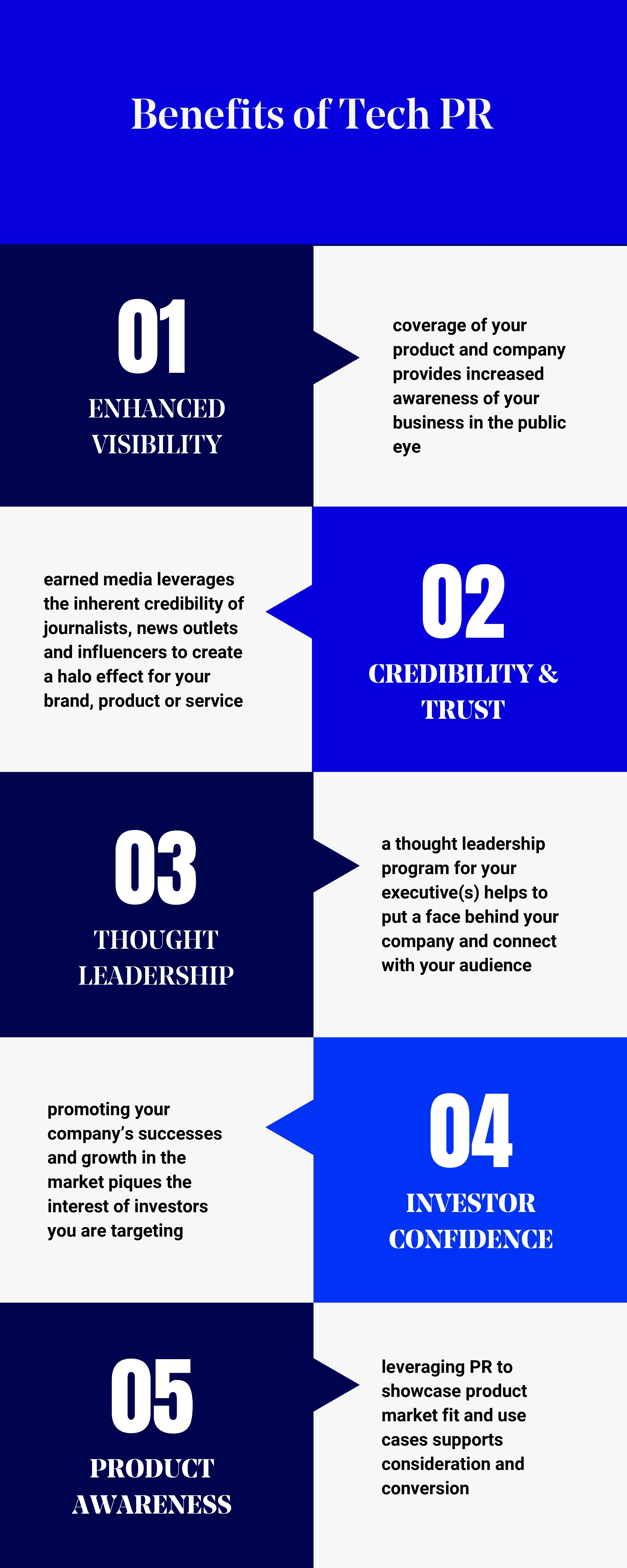
Absolutely, tech companies benefit greatly from a dedicated public relations program. It helps establish a positive public image, build brand awareness, and create credibility in the competitive tech industry. PR is a crucial part of your marketing program for announcing product launches, sharing company achievements, and engaging with your target audience. Public relations is a strategic way for companies to connect with media, influencers, and potential customers, fostering a positive reputation and attracting investors. In a fast-paced and dynamic tech landscape, PR is essential for maintaining visibility, addressing challenges, and showcasing thought leadership.
Why work in tech PR?
Working in tech PR can be an exciting and dynamic career. In the ever-evolving tech industry, PR professionals play a key role in shaping a company’s narrative, building brand credibility, and driving awareness. It provides opportunities to work with cutting-edge technologies, collaborate with industry leaders, and participate in high-profile product launches and industry events. Tech PR professionals get to engage with the media, influencers, and thought leaders, contributing to a company’s success. The fast-paced nature of the tech sector ensures a constantly evolving and challenging work environment, making tech PR an appealing choice for those seeking innovation and professional growth.
What is PR for high-tech companies?
PR for high-tech companies involves strategically managing communications to build a positive public image and establish credibility in the competitive tech sector. It includes crafting compelling narratives, managing product launches and milestones, and building strong relationships with relevant media and influencers. The goal is to create awareness for the company, its products and its executive team, engage with the target audience, and position the company as a thought leader in the rapidly evolving high-tech landscape. Effective PR is essential for maintaining visibility, attracting investors, and navigating the challenges unique to the high-tech industry.