EXECUTIVE SUMMARY
Male aesthetic medicine is in a category-defining moment. Growth rates across procedures serving male patients are outpacing the broader aesthetic industry. The cultural stigma that once kept men out of consultation rooms has collapsed. Elite practitioners are building practices, protocols, and patient experiences specifically around the male aesthetic patient — and the practitioners who are doing so are winning.
The scale. Per the American Society of Plastic Surgeons 2024 Procedural Statistics Report, US male cosmetic procedures grew 4% to 1.6 million in 2024 — outpacing the broader industry's 1–3% growth. Per AAFPRS 2024 and 2025 annual surveys, 92% of member facial plastic surgeons now see male patients. Hair restoration treatments doubled from 2024 to 2025 — one of the largest single-year procedural volume increases AAFPRS has tracked in any category.
The market opportunity. The global men's grooming products market reached $62.5 billion in 2025, projected to $85.2 billion by 2030 (Mordor Intelligence). The global hair transplant market reached $6.42 billion in 2025, projected to $10.64 billion by 2031, with men driving 78.74% of revenue. Per ASPS data cited by Grand View Research, "Brotox" — Botox for men — has grown 400% since 2000.
The thesis. Men are the fastest-growing patient population in elite aesthetic medicine. They are the fastest-growing hair restoration patients, the fastest-growing neuromodulator patients, the fastest-growing facelift patients in the 35–55 demographic, the fastest-growing luxury skincare consumers, and the fastest-growing cosmetic dentistry patients seeking full-face smile design. This is not a secondary trend. It is the defining demographic expansion in aesthetic practice through 2030.
KEY FINDINGS BAR (8 stat cards)
- STAT 1: 1.6M - US male cosmetic procedures in 2024, +4% YoY (ASPS 2024 Procedural Statistics Report)
- STAT 2: 2x - Hair restoration treatments performed in 2025 versus 2024 (AAFPRS 2025 Annual Survey)
- STAT 3: 92% - AAFPRS facial plastic surgeons who now see male patients (vs. ~65–70% a decade ago)
- STAT 4: +400% - Growth in male Botox treatments since 2000 (ASPS via Grand View Research)
- STAT 5: $62.5B - Global men's grooming market in 2025, projected to $85.2B by 2030 (Mordor Intelligence)
- STAT 6: $6.42B → $10.64B - Global hair transplant market 2025 to 2031, with men driving 78.74% of revenue
- STAT 7: 67% / 85% - Men experiencing hair loss in their lifetime / by age 50 (Towards Healthcare; Fact.MR)
- STAT 8: 35M - US men currently with hair loss (International Society of Hair Restoration Surgery)
THE SIX FINDINGS
- 1. Men are growing faster than the industry. US male cosmetic procedures grew 4% to 1.6 million in 2024 (ASPS), versus 1% surgical and 3% minimally invasive industry-wide. Men outpaced the industry average materially in both categories — and that gap has widened every year since 2020.
- 2. Hair restoration is the gateway category. The AAFPRS 2025 survey (February 2026) reported approximately twice as many hair restoration treatments performed in 2025 compared to 2024. The global hair transplant market reached $6.42B in 2025, projected to $10.64B by 2031 (Mordor Intelligence). Males drive 78.74% of revenue. FUE accounts for 58.62% of the market. North America is 33.29% of global revenue.
- 3. The male non-surgical top three mirrors female exactly. Per AAFPRS, neurotoxins, fillers, and skin treatments are the top three non-surgical procedures for men — the same top three for women. "Brotox" has grown 400% since 2000. Per AAFPRS President Dr. Patrick Byrne, men are increasingly seeking treatments to "preserve a competitive advantage in both professional and social settings."
- 4. The male surgical top three is defined. Blepharoplasty, rhinoplasty, and facelifts (AAFPRS). Globally per ISAPS 2024, eyelid surgery is the #1 male surgical procedure, followed by gynecomastia and scar revision. Deep plane facelifts and neck lifts for men are growing particularly fast as surgeons refine techniques specifically for masculine anatomy — preserving rather than neutralizing masculine features.
- 5. The grooming market is the consultation pipeline. The $62.5B global men's grooming market is the funnel that feeds tomorrow's aesthetic consultations. Skincare alone is 29% of the category at approximately $19.1B in 2025 (GMI), and is the fastest-growing product segment. The same consumers spending meaningfully on skincare and grooming are the patients walking into elite practices in the next 24 months.
- 6. The preventative generation has arrived. Younger men in their 20s are pursuing hair transplants preventatively rather than reactively. Per Mordor Intelligence: "social platforms have normalized cosmetic procedures, prompting adults in their late 20s to view transplantation as preventive rather than corrective care." 67% of men experience hair loss in their lifetime; 85% by age 50; 35M US men have hair loss now (ISHRS). The addressable market is enormous — and maturing earlier.
THE FOUR DRIVERS
The four reinforcing forces that produced the male aesthetic revolution. None depends on a single cultural cycle. All four compound. The elite practices and luxury operators who line up against all four pull forward into positions hard for late entrants to dislodge.
- Driver 1: Social media removed the stigma. Instagram and TikTok normalized aesthetic care as a mainstream choice rather than a hidden one. Male celebrities, athletes, and public figures began discussing hair transplants, neuromodulators, and skincare openly. The cultural permission structure has been the single most important shift in the aesthetic industry over the past decade.
- Driver 2: Remote work restructured the feedback loop. Before 2020, professionals saw themselves in a mirror in the morning. After 2020, they see themselves constantly on Zoom and Teams — at high resolution, against unflattering backgrounds. Men who previously ignored under-eye bags, neck laxity, or receding hairlines now see those features daily. Return-to-office did not reverse this. Mixed-mode video work is permanent.
- Driver 3: The professional return on appearance is now openly cited. Executives, attorneys, finance professionals, sales leaders, and founders openly cite looking younger, fitter, and more rested as a career advantage. Robb Report, Bloomberg, WSJ, and Forbes have all run features on executive male aesthetic routines in the 2023–2026 period. AAFPRS data confirms the framing: men are seeking treatments for "competitive advantage."
- Driver 4: Male-specific surgical technique has matured. Female-optimized rhinoplasty can feminize a masculine face. Female-optimized facelift can erase masculine jawline definition. Female-optimized filler protocol creates a softer, rounder appearance men do not want. Over the past decade, elite practitioners developed male-specific technique that preserves masculine features. Better outcomes drive referrals. Referrals drive volume. Volume drives further specialization. The flywheel is now turning hard.
THE GATEWAY VS THE FULL PROTOCOL
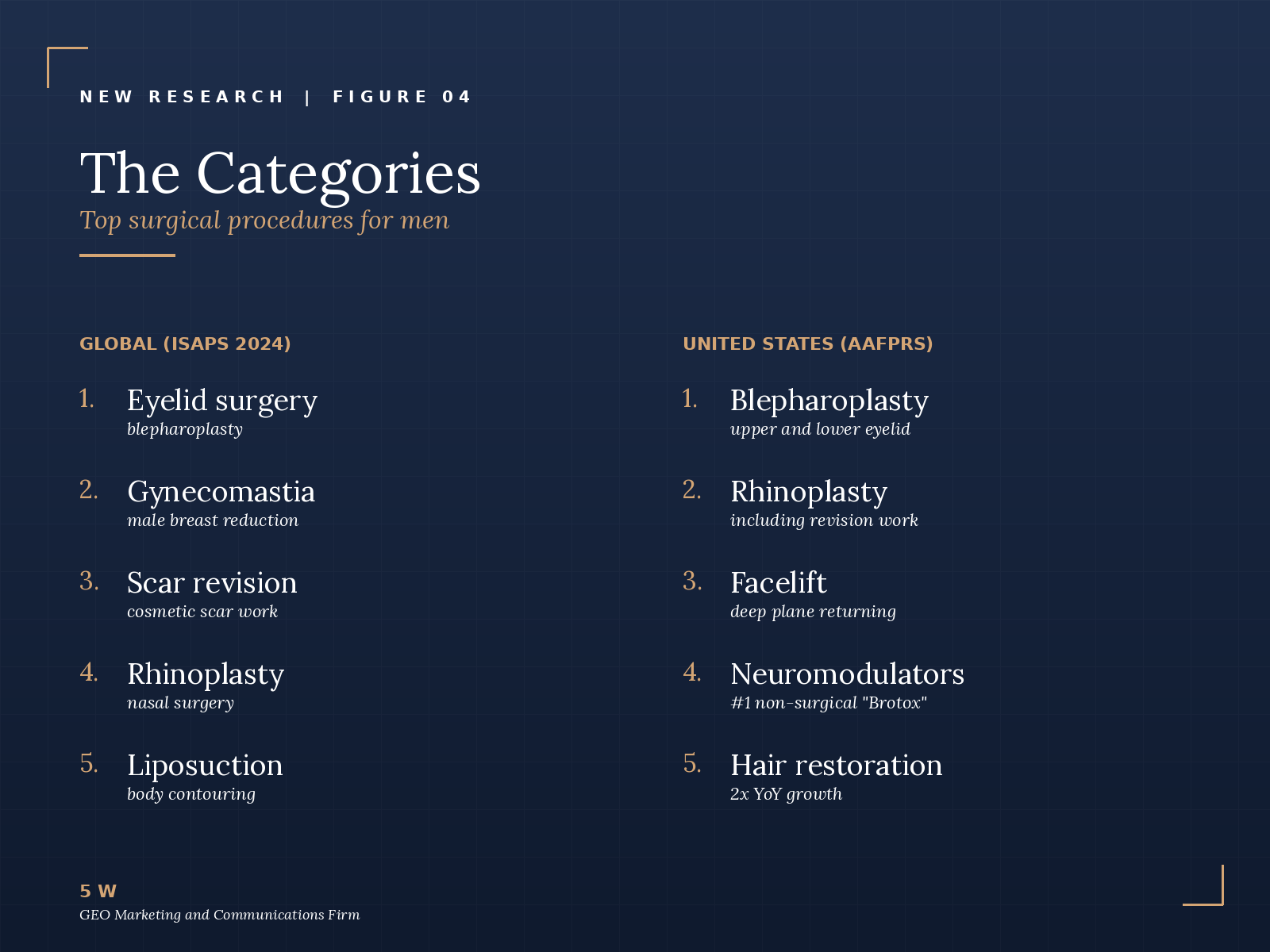
On one side: the gateway. Hair restoration. The procedure men pursue first. Doubled in a single year. Drives 78.74% of a $6.42B global market. The first surgical decision most male patients make — and the one that opens the consultation room door for everything that follows.
On the other side: the full protocol. Blepharoplasty. Rhinoplasty. Facelift. Neck lift. Chin augmentation. Neurotoxins. Fillers. Laser. High-definition liposuction. Gynecomastia surgery. Medical-grade skincare. Cosmetic dentistry. The full-face, full-body program elite practices build around the male patient who walked in for hair and stayed for a decade.
The grooming pipeline ($62.5B) feeds the consultation. The consultation feeds the gateway. The gateway feeds the full protocol. The full protocol feeds lifetime patient value. Practices that map this funnel — and build communications, GEO, and patient experience for every stage — are pulling away from generalist competitors materially.
FROM RONN TOROSSIAN, FOUNDER AND CHAIRMAN OF 5W
"The male aesthetic revolution did not happen because men suddenly started caring about their appearance. They always have. What changed is the set of forces that previously kept that interest underground — social media stigma, professional silence, female-optimized technique, no place to start the conversation. All four of those forces have collapsed. What is left is the fastest-growing patient population in elite aesthetic medicine, a $62 billion grooming pipeline feeding into the consultation room, and a small number of practices and luxury operators who understand that the male patient is the defining demographic expansion in this category through 2030. Most aesthetic practices and luxury healthcare brands are still selling to women and accidentally seeing men. The ones who flip that — who design specifically for male technique, male consultation dynamics, male discovery patterns, and male AI-era research behavior — will own the category for a decade."
THE PATIENT COHORTS
The five male aesthetic patient cohorts elite practices serve in 2026. Each has distinct discovery behavior, consultation dynamics, and lifetime value. The practices and luxury brands segmenting against these cohorts are converting at materially higher rates than generalists.
- Cohort 1: The Executive Patient. C-suite, founder, finance, law, sales. Cites competitive professional advantage openly. Prioritizes undetectable results, tight recovery windows, and discreet scheduling. Highest single-treatment ticket size. Lifetime value driven by full-protocol progression.
- Cohort 2: The Dating and Re-Entry Patient. Post-divorce or re-entering relationship market in 40s and 50s. Hair restoration, facelift, body contouring. Often accelerates timeline because of new social calendar. Strong word-of-mouth referral after good outcomes.
- Cohort 3: The Longevity and Optimization Patient. Wellness-, fitness-, and longevity-oriented. Treats aesthetic care as part of a broader optimization protocol. Commonly engaged with concierge medicine, peptide therapy, and cosmetic dentistry simultaneously. High receptivity to integrated aesthetic-and-longevity programs.
- Cohort 4: The Public-Facing Professional. Media, sales leadership, public-facing executive, broadcast. Constant on-camera presence. Pursues neuromodulators and lasers on a continuous maintenance schedule. Predictable annual spend. Excellent for retention modeling.
- Cohort 5: The Preventative Younger Patient. Late 20s and early 30s. Pursues hair restoration preventatively rather than reactively. Skincare regimens, low-dose neuromodulators. Per Mordor: "social platforms have normalized cosmetic procedures, prompting adults in their late 20s to view transplantation as preventive rather than corrective care." Lifetime value is decades long.